
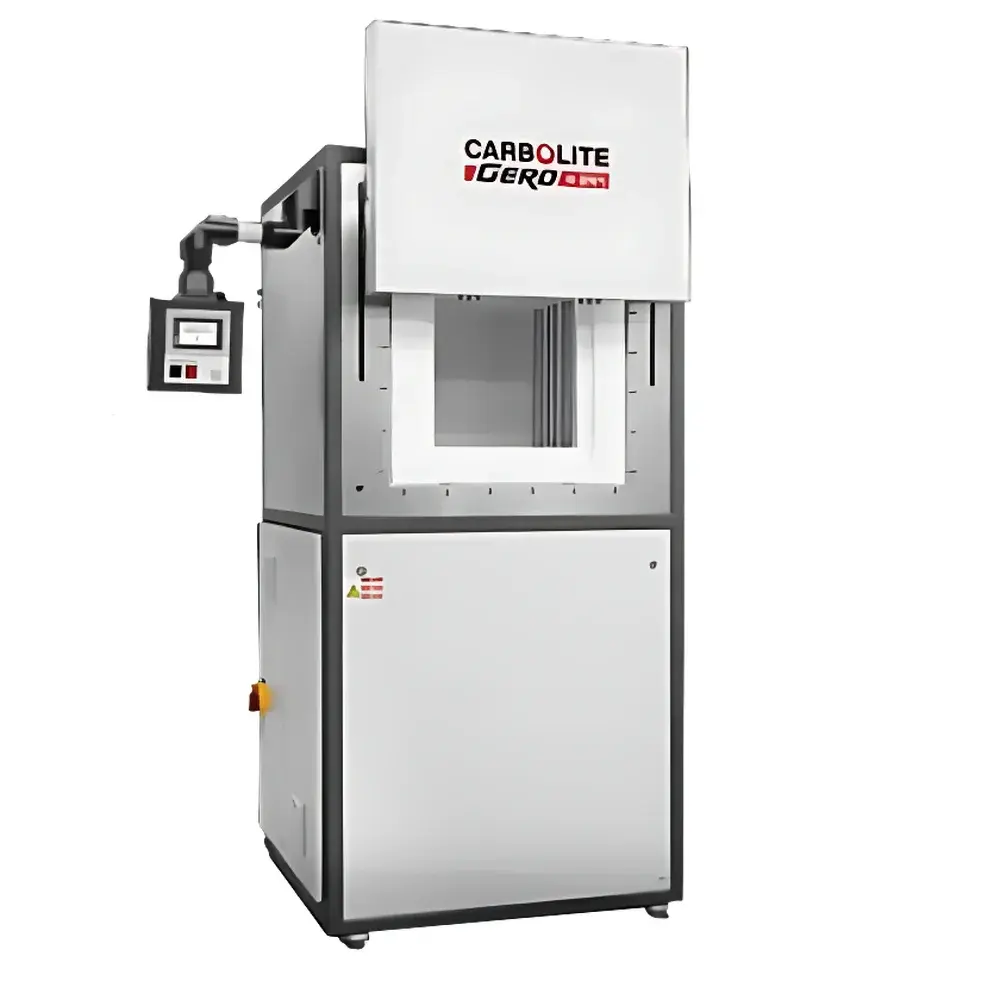
Carbolite Gero HTF High-Temperature Box Furnace (1800 °C)
| Brand | Carbolite Gero |
|---|---|
| Origin | Germany |
| Model | HTF |
| Type | Box-type Muffle Furnace |
| Max Operating Temperature | 1800 °C |
| Chamber Volume Range | 27–560 L |
| Controller | EPC3016P1 Programmable |
| Heating Element | Vertical U-shaped MoSi₂ Rods |
| Insulation | Multilayer Ceramic Fiber Boards with Low Thermal Conductivity |
| Door Operation | Motorized Lift Mechanism |
| Interface | Ethernet (TCP/IP) |
| Safety | Dual Independent Overtemperature Protection |
| Compliance | Designed for GLP/GMP environments, compatible with ASTM E220, ISO/IEC 17025 temperature validation protocols |
Overview
The Carbolite Gero HTF is a high-precision, vertically oriented box-type muffle furnace engineered for sustained operation at extreme temperatures up to 1800 °C. It employs the fundamental principle of resistive heating via silicon molybdenum (MoSi₂) elements operating in oxidizing atmospheres—wherein a self-healing SiO₂ passivation layer forms dynamically during use, ensuring long-term stability and reproducible thermal profiles. Unlike conventional resistance-heated furnaces relying on metallic alloys or graphite, the HTF leverages MoSi₂’s intrinsic oxidation resistance and minimal creep deformation above 1500 °C, making it uniquely suited for applications demanding both thermal integrity and dimensional stability over extended dwell cycles. Its rigid steel frame, low-conductivity multilayer ceramic fiber insulation, and air-cooled outer casing eliminate the need for water cooling while maintaining surface temperatures below 60 °C under full-load conditions—critical for laboratory safety and energy efficiency.
Key Features
- Vertical U-shaped MoSi₂ heating elements mounted on robust ceramic supports, enabling uniform radiant heat distribution and minimizing thermal gradients across the chamber.
- Modular insulation architecture comprising graded-density ceramic fiber boards—optimized thickness and layering reduce radial and axial thermal losses, achieving ±3 °C temperature uniformity (measured per ASTM E220 at 1700 °C, 3-point mapping).
- Motor-driven lift door mechanism with position feedback and mechanical end-stop protection, integrated into the furnace’s structural frame to preserve alignment and sealing integrity over thousands of cycles.
- EPC3016P1 programmable controller featuring 16-segment ramp-soak profiles, real-time data logging, and dual independent overtemperature cut-off circuits (one hardware-based, one software-configurable).
- Industrial-grade Ethernet interface supporting Modbus TCP and OPC UA protocols for integration into centralized lab automation systems, LIMS, and MES platforms compliant with FDA 21 CFR Part 11 requirements for audit trails and user access control.
- Front-accessible thermocouple ports (Type S or B configurable), calibrated reference inputs, and optional traceable NIST-certified calibration reports for IQ/OQ/PQ documentation.
Sample Compatibility & Compliance
The HTF accommodates diverse sample geometries—including crucibles (Al₂O₃, ZrO₂, Pt, graphite), ceramic setters, sintering boats, and CIM green parts—within its fully accessible chamber. Its muffle design isolates samples from direct contact with heating elements and ensures atmosphere purity, supporting inert, oxidizing, and limited reducing environments (e.g., diluted H₂/N₂ mixtures up to 5% H₂). The furnace meets mechanical and electrical safety standards per EN 61000-6-2 (EMC immunity) and EN 61000-6-4 (EMC emission), and its construction aligns with ISO 15190:2019 for laboratory safety. When operated with validated procedures, it satisfies temperature uniformity and stability criteria outlined in ISO/IEC 17025:2017 Annex A.3 for accredited thermal testing laboratories.
Software & Data Management
The EPC3016P1 controller provides native web server functionality accessible via standard browsers, allowing remote monitoring of setpoints, actual temperatures, power consumption, and alarm status. Logged data (sampled at 1 Hz) is stored internally (up to 1 million points) and exportable as CSV or Excel-compatible files. Optional Carbolite Gero FurnaceLink™ software enables multi-furnace fleet management, automated report generation (including deviation tracking against SOP-defined tolerances), and electronic signature support for GLP-compliant workflows. All data modifications are time-stamped and attributed to user accounts, fulfilling ALCOA+ principles (Attributable, Legible, Contemporaneous, Original, Accurate, Complete, Consistent, Enduring, Available).
Applications
The HTF serves critical roles in advanced materials R&D and production QA/QC: ceramic sintering (e.g., SiC, AlN, YSZ); powder metallurgy densification; thermal debinding of metal and ceramic injection molded components; high-temperature annealing of optical fibers and semiconductor substrates; ashing of high-ash-content biological or polymer samples; and controlled oxidation studies for catalyst development. Its stable 1800 °C capability enables phase transformation analysis in refractory oxides and verification of thermal stability limits in next-generation battery cathode materials (e.g., layered nickel-rich oxides).
FAQ
What atmosphere options are supported inside the HTF chamber?
The HTF is designed for ambient air operation but can accommodate inert gas purging (N₂, Ar) or low-concentration reducing atmospheres (≤5% H₂ in N₂) using optional gas inlet/outlet fittings and flow controllers.
Is the furnace suitable for continuous 24/7 operation at 1750 °C?
Yes—when operated within specified duty cycles and with proper maintenance intervals (e.g., quarterly element resistance checks and annual insulation integrity assessment), the HTF maintains rated performance at 1750 °C for extended periods per manufacturer specifications.
Can the EPC3016P1 controller be reprogrammed to meet custom PID tuning requirements?
Yes—the controller allows full user access to PID parameters, derivative filtering, and anti-windup settings via password-protected engineering mode, supporting application-specific thermal response optimization.
Does Carbolite Gero provide installation qualification (IQ) documentation?
Yes—standard delivery includes a Factory Acceptance Test (FAT) report; site-specific IQ/OQ protocols and executed documentation packages are available as optional services.
What is the typical lead time for HTF models with 300 L chamber volume and Ethernet + RS485 dual interface?
Standard lead time is 12–14 weeks from order confirmation, subject to configuration review and final chamber lining material selection (e.g., high-purity alumina vs. zirconia-reinforced fiber).
Related Products



