
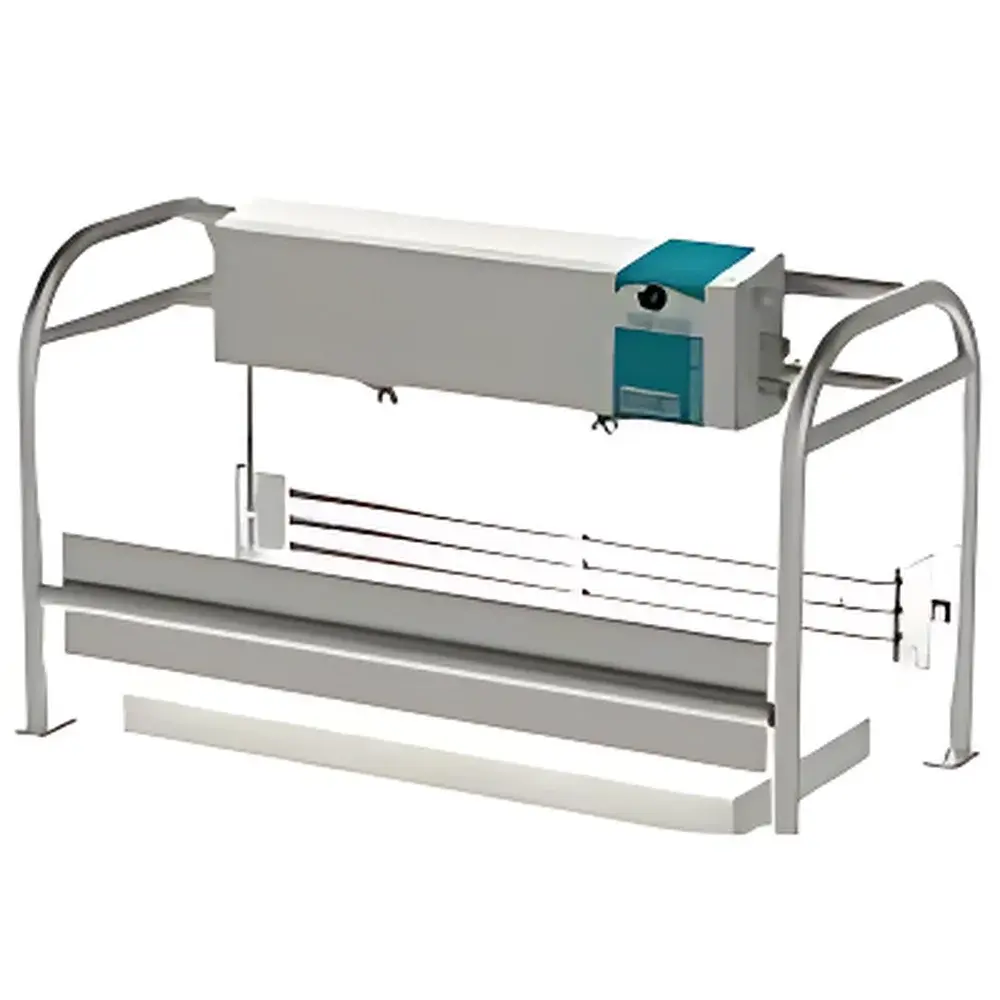
EV Candy Starch Mold Inspection System
| Origin | Guangdong, China |
|---|---|
| Manufacturer Type | Distributor |
| Origin Category | Domestic |
| Model | SMI-1 |
| Pricing | Upon Request |
Overview
The EV Candy Starch Mold Inspection (SMI) System is an industrial machine vision solution engineered for real-time, non-contact quality assurance in starch-based confectionery molding lines. It operates on high-resolution monochrome and color imaging coupled with adaptive pattern recognition algorithms to verify tray fill integrity, mold cavity occupancy, stencil orientation, and surface contamination prior to downstream processing. Unlike manual inspection or generic optical sensors, the SMI system is purpose-built for the unique challenges of starch-molded candy production—including low-contrast cavity boundaries, variable lighting from humid environments, and rapid conveyor speeds typical of NID, W&D, Makat, and Fast Track production lines. Its core function is to prevent defective trays from entering storage or packaging by triggering immediate line stoppage upon detection of critical deviations—thereby enforcing zero-defect throughput without compromising line velocity.
Key Features
- Multi-criteria cavity validation: Simultaneously verifies presence/absence of starch fill per cavity, detects partial fills, overfills, and foreign particulates using pixel-level grayscale thresholding and morphological analysis.
- Stencil registration & orientation check: Validates rotational alignment and positional accuracy of reusable starch molds against CAD-derived reference templates, tolerating ±0.5° angular deviation and ≤0.3 mm lateral offset.
- Surface anomaly detection: Identifies starch residue, oil film, dust accumulation, or moisture streaks on tray surfaces using dynamic background subtraction and texture variance mapping.
- Automated reference acquisition: Captures and stores golden-standard images of fully compliant trays under production conditions—enabling adaptive baseline updates without operator calibration.
- Integrated PLC interface: Communicates via EtherNet/IP or Modbus TCP to halt conveyors, reject trays via pneumatic diverters, and log event timestamps synchronized to line encoder pulses.
- Real-time performance analytics: Generates OEE subcomponents (availability, performance, quality rate) and tracks defect root causes (e.g., mold wear, dosing pump drift, humidity-induced starch adhesion).
Sample Compatibility & Compliance
The SMI-1 supports standard starch-molded candy trays ranging from 200 × 300 mm to 600 × 800 mm, accommodating both aluminum and food-grade polymer trays with matte or semi-gloss finishes. It complies with IEC 62443-3-3 for industrial cybersecurity fundamentals and meets IP65 enclosure rating for operation in high-humidity, washdown-prone environments. All image data handling adheres to ISO/IEC 27001-aligned internal protocols; audit logs record user actions, parameter changes, and system alerts with immutable timestamps. While not certified to FDA 21 CFR Part 11 out-of-the-box, the system supports optional configuration for electronic signature capture and audit trail export—enabling alignment with GMP documentation requirements during customer validation.
Software & Data Management
The embedded VisionOS software provides a browser-accessible interface (HTTPS, TLS 1.2+) for setup, diagnostics, and reporting. Defect classifications are stored in SQLite databases with daily automated backups to network shares. Raw image archives (lossless TIFF) and metadata (XML) are retained for 90 days unless configured otherwise. Reporting modules generate PDF summaries compliant with ISO 9001 clause 8.5.2 (Control of nonconforming output), including defect type frequency, shift-wise yield trends, and correlation with upstream process variables (e.g., starch moisture content, mold temperature). API endpoints support integration into MES platforms such as Siemens Opcenter or Rockwell FactoryTalk.
Applications
- Verification of cavity fill status in gumdrop, jelly bean, and marshmallow starch molding lines
- Detection of misaligned or warped reusable molds before tray loading
- Early identification of starch degradation effects (e.g., clumping, inconsistent flow) reflected in fill uniformity
- Monitoring of tray cleaning efficacy between cycles to prevent cross-contamination
- Supporting continuous improvement initiatives through quantitative defect taxonomy (e.g., “cavity void”, “edge smearing”, “color misregistration”)
FAQ
What lighting configuration is required for reliable detection under varying ambient conditions?
The system includes integrated LED strobes with adjustable intensity and pulse width, calibrated to suppress glare from wet starch surfaces while maintaining >75 dB SNR across all cavity depths.
Can the SMI-1 integrate with legacy PLCs on older production lines?
Yes—it supports discrete I/O hardwiring and serial Modbus RTU in addition to Ethernet protocols, enabling retrofitting onto lines commissioned as early as 2008.
How frequently must the reference model be updated?
Reference models auto-refresh when statistical process control (SPC) metrics indicate ≥3σ deviation in cavity fill homogeneity over 24 hours; manual override remains available.
Is training provided for operators and maintenance personnel?
A 2-day onsite commissioning workshop covers system operation, basic troubleshooting, and report interpretation; remote support and annual refresher modules are included in the service agreement.



