
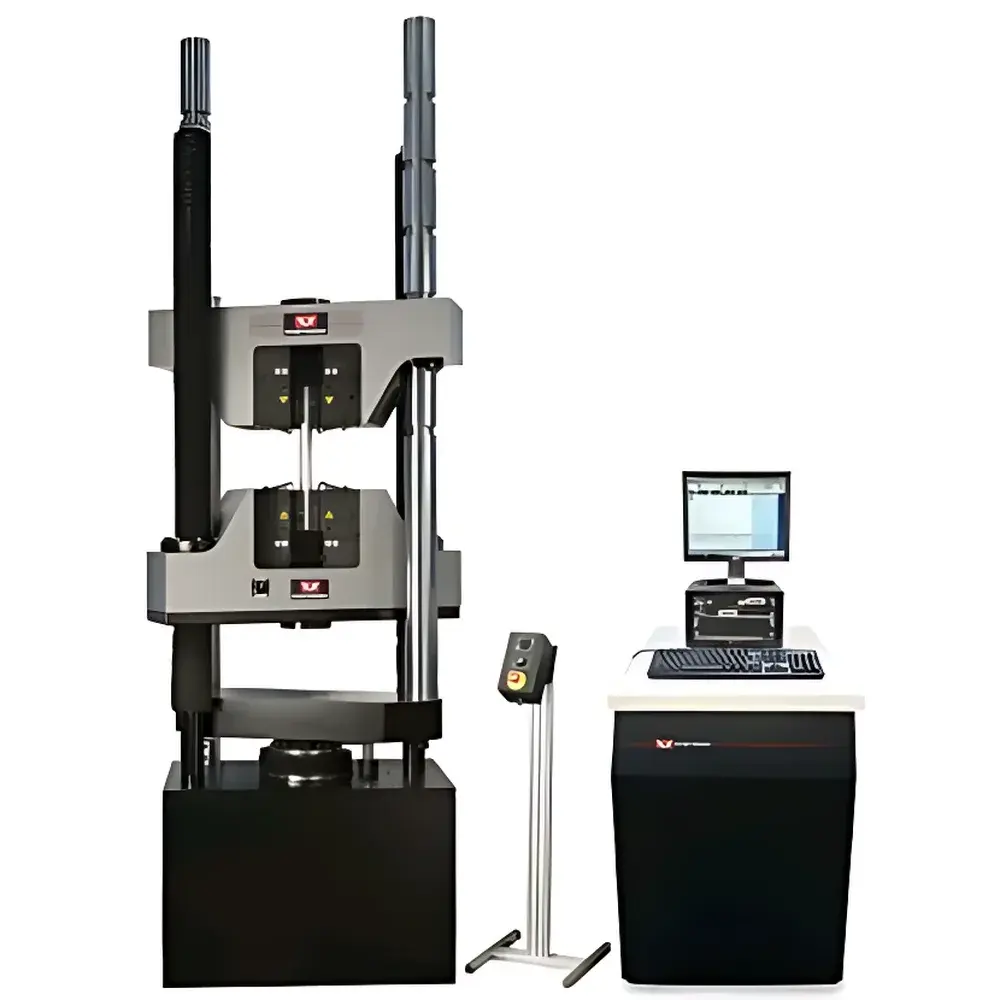
Instron Legend MDX Series Universal Testing Machine
| Brand | Instron |
|---|---|
| Origin | USA |
| Model | Legend MDX |
| Type | Hydraulic Universal Testing Machine |
| Control System | Instron V11b Variable-Pressure Hydraulic Power Unit |
| Actuation | High-Bandwidth Servo-Valve (200 Hz Frequency Response) |
| Fixture Integration | Integrated Hydraulic Wedge Grips in Crosshead |
| Load Frame Design | Dual-Test-Space, Open-Frame Crosshead |
| Load Cell | Instron Precision Load Cell with Zero-Drift Compensation |
| Software Platform | Bluehill Universal |
| Compliance | ASTM E4, E8, E9, E21, ISO 6892-1, ISO 7500-1, USP <1043>, FDA 21 CFR Part 11 Ready |
Overview
The Instron Legend MDX Series Universal Testing Machine is a high-performance, dual-test-space hydraulic testing system engineered for precision mechanical characterization of advanced materials—including high-strength composites, aerospace alloys, structural polymers, and reinforced concrete. Operating on the principle of closed-loop electrohydraulic force and displacement control, the Legend MDX leverages a high-fidelity servo-valve architecture with a 200 Hz bandwidth to maintain dynamic fidelity during transient loading events—critical when evaluating materials exhibiting internal vibrational modes up to 30 Hz (e.g., carbon-fiber laminates under cyclic tensile loading). Its open-frame crosshead design integrates hydraulic wedge grips directly into the moving beam, eliminating external actuation levers and enabling consistent initial clamping force retention throughout test duration. The system’s foundation rests on Instron’s proprietary V11b variable-pressure hydraulic power unit, which dynamically modulates output pressure in real time according to load demand—reducing energy consumption, thermal drift, noise emission, and hydraulic oil degradation while eliminating the need for external cooling circuits.
Key Features
- Integrated hydraulic wedge grip system housed within the crosshead—no manual handles or mechanical arms required; maintains constant clamping force pre- and post-yield.
- V11b variable-displacement hydraulic pump: automatically adjusts pressure output based on instantaneous load requirements, minimizing heat generation and extending fluid service life.
- Dual-test-space configuration: accommodates both high-force tension/compression testing in the upper zone and low-force flexure/shear testing in the lower zone without reconfiguration.
- Instron precision load cell with active zero-drift compensation and NIST-traceable calibration—ensuring long-term measurement stability per ISO 7500-1 Class 0.5.
- High-bandwidth digital control electronics with 10 kHz sampling rate and sub-millisecond response latency—optimized for ASTM E21 and ISO 14577 indentation-based creep protocols.
- Modular accessory interface compliant with Instron’s standardized mounting geometry—supports rapid interchange of fixtures, extensometers, environmental chambers, and transducers.
Sample Compatibility & Compliance
The Legend MDX supports specimen geometries ranging from 0.5 mm diameter wire to 100 mm × 100 mm compression cubes, enabled by interchangeable grip faces covering broad dimensional ranges without tooling changeover. Its hydraulic wedge action delivers uniform stress distribution across heterogeneous surfaces—essential for testing fiber-reinforced polymer (FRP) coupons, metal matrix composites (MMCs), and additively manufactured lattice structures. The system meets full regulatory alignment with ASTM E4 (load verification), ASTM E8/E21 (tensile/creep testing), ISO 6892-1 (metallic materials), ISO 7500-1 (static calibration), and USP (mechanical testing of pharmaceutical packaging). When configured with audit-trail-enabled Bluehill Universal software and hardware-enforced user access controls, it satisfies FDA 21 CFR Part 11 requirements for electronic records and signatures in GxP environments.
Software & Data Management
Controlled exclusively via Bluehill Universal software, the Legend MDX provides a validated, scriptable platform supporting method-driven test sequencing, real-time pass/fail logic, multi-channel synchronized data acquisition (force, displacement, strain, temperature, video), and automated report generation in PDF, Excel, and XML formats. All test parameters—including grip separation, preload ramp rate, and hold durations—are stored with cryptographic hash integrity. Audit trails record operator identity, timestamp, parameter modifications, and raw data export events—fully traceable for GLP/GMP audits. Data export conforms to ASTM E1434 and ISO/IEC 17025 metadata standards, including instrument ID, calibration certificate expiry, environmental conditions, and uncertainty budgets.
Applications
- Tensile and compressive testing of high-modulus composites per ASTM D3039 and D6641.
- Quasi-static and low-cycle fatigue evaluation of turbine blade root attachments.
- Bending and shear characterization of sandwich core materials (ASTM C393, C273).
- Fastener pull-out and torque-tension analysis using dedicated bolt-testing fixtures.
- Creep and stress-relaxation studies on thermoplastic matrix composites at elevated temperatures (with optional environmental chamber).
- Fracture toughness determination (KIc) via single-edge notched bend (SENB) configurations.
FAQ
What hydraulic fluid is specified for the V11b power unit?
Instron recommends Instron Hydraulic Oil ISO VG 46 (P/N 20-3000-100), certified for oxidative stability and anti-wear performance under continuous duty cycles.
Is the Legend MDX compatible with non-Instron extensometers?
Yes—via analog voltage output (±10 V) and digital TTL synchronization ports; third-party devices must comply with ASTM E83 Class B accuracy requirements.
Can the dual-test-space configuration be reconfigured for single-zone high-force testing?
No—the upper and lower zones are mechanically fixed; however, the lower zone may be deactivated via software lockout for dedicated high-load applications.
Does the system support automated specimen alignment prior to testing?
Yes—Bluehill Universal includes motorized crosshead positioning with programmable approach velocity and contact-force detection (≤1 N threshold) for precise zero-point establishment.
What is the maximum recommended maintenance interval for the V11b pump under continuous lab operation?
Oil analysis every 2,000 operating hours; full fluid replacement and filter change every 4,000 hours or 12 months—whichever occurs first—per Instron Service Bulletin SB-LEGEND-MDX-02.



