
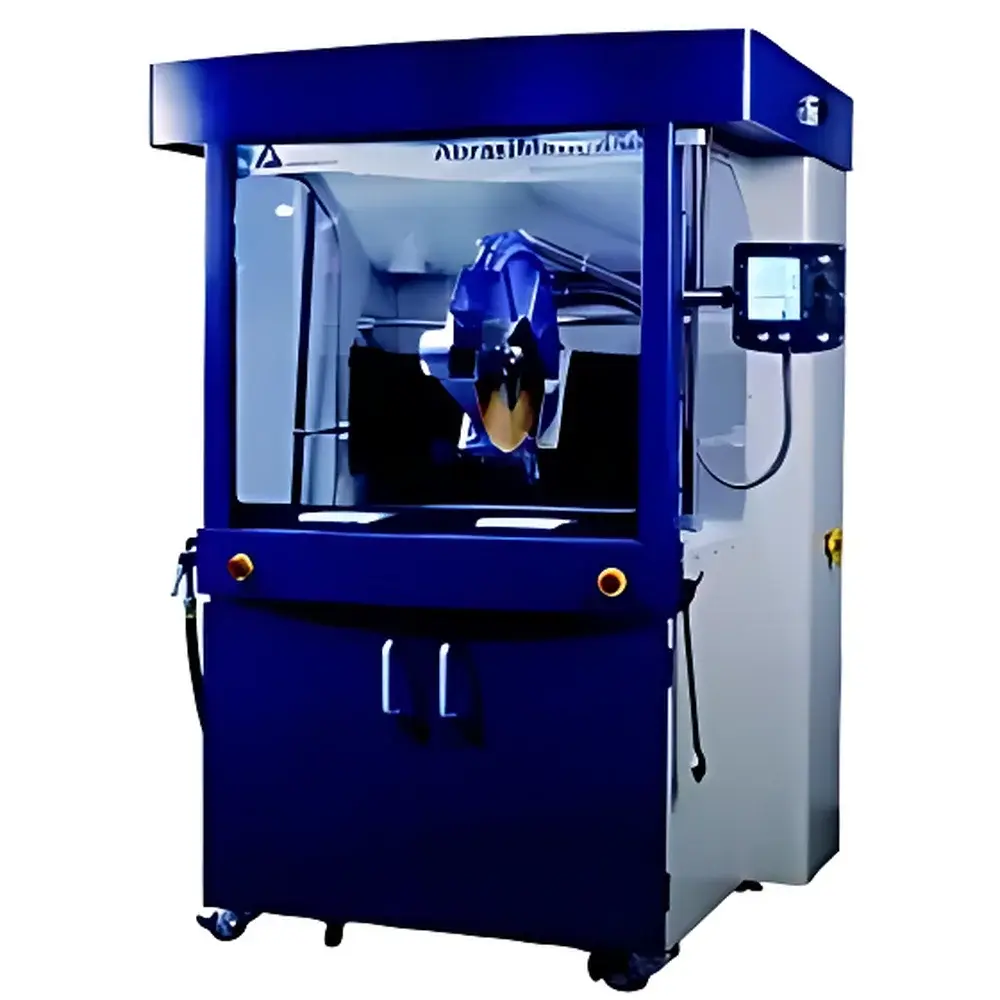
Buehler AbrasiMatic 450 Fully Automated Abrasive Cut-Off Machine
| Brand | Buehler |
|---|---|
| Origin | USA |
| Model | AbrasiMatic 450 |
| Cutting Types | Planer, Saw, Y-Feed, Chop |
| Dimensions (Overall) | 914 × 558 × 203 mm (W × D × H) |
| Cutting Chamber | 914 × 254 × 171 mm (W × D × H) |
| Viewing Windows | Triple-sided transparent polycarbonate |
| Illumination | Four integrated LED lights |
| Structural Frame | Heavy-duty cast iron chassis |
| Detection Systems | Touch-sensing sample detection, wheel diameter auto-detection |
| Cooling System | Removable coolant reservoir with level and concentration visibility |
Overview
The Buehler AbrasiMatic 450 is a floor-standing, fully automated abrasive cut-off machine engineered for precision sample sectioning in metallurgical, materials science, and failure analysis laboratories. It operates on the principle of controlled abrasive cutting—using rotating silicon carbide or diamond-impregnated wheels under regulated coolant flow and programmable feed motion—to achieve reproducible, low-distortion cross-sections of hard and brittle materials. Designed for high-duty-cycle environments, the system integrates mechanical robustness with intuitive automation to minimize operator intervention while maximizing consistency across serial sample preparation. Though discontinued, the AbrasiMatic 450 remains widely referenced in ISO 148-1, ASTM E3, and EN ISO 643 compliant workflows for metallographic specimen preparation, particularly where dimensional accuracy, edge integrity, and thermal damage minimization are critical.
Key Features
- Four programmable cutting modes—Planer (linear horizontal feed), Saw (reciprocating vertical cut), Y-Feed (lateral sample advancement), and Chop (single-axis downward plunge)—enabling optimized material removal strategies per specimen geometry and hardness.
- Integrated touch-sensing technology detects physical contact between the abrasive wheel and sample surface, initiating precise feed control and eliminating manual zero-point calibration.
- Automatic wheel diameter detection compensates for wear in real time, maintaining consistent linear cutting speed and feed rate throughout the wheel’s service life.
- Triple-sided polycarbonate viewing windows provide unobstructed, distortion-free observation from front and both sides—critical for monitoring cut progression, coolant distribution, and wheel condition during operation.
- Four high-lumen LED lamps illuminate the entire cutting chamber uniformly, supporting visual verification of alignment, fixturing, and kerf formation without shadow interference.
- Heavy-duty cast iron frame and reinforced base deliver exceptional vibration damping and long-term dimensional stability, essential for repeatable cuts on large or irregularly shaped specimens up to 254 mm in depth.
- Front-accessible, slide-out coolant reservoir allows rapid inspection of fluid level and refractometric concentration checks; full removal enables thorough cleaning and contamination control per GLP laboratory maintenance protocols.
Sample Compatibility & Compliance
The AbrasiMatic 450 accommodates a broad spectrum of conductive and non-conductive materials—including ferrous and non-ferrous alloys, ceramics, composites, geological cores, and electronic packages—within its 254 mm maximum depth capacity. Fixturing options support flat, cylindrical, and irregular geometries via adjustable vise systems and custom jaw inserts. The machine conforms to electrical safety standards IEC 61000-6-2/6-4 and carries CE marking for use in EU-based accredited labs. Its cutting methodology aligns with ASTM E3-22 (Standard Guide for Preparation of Metallographic Specimens), ISO 148-1:2016 (Metallic materials — Charpy pendulum impact test), and ISO 643:2021 (Steels — Microstructure standards), ensuring traceability in QA/QC and failure investigation reporting.
Software & Data Management
While the AbrasiMatic 450 utilizes an embedded microprocessor-based controller (not PC-dependent), it supports full parameter logging—including cycle start/stop timestamps, feed rate profiles, total cut time, and wheel usage metrics—stored internally for retrieval via USB export. All operational parameters are password-protected and audit-trail enabled, meeting basic requirements for 21 CFR Part 11–aligned documentation in regulated environments. Method templates can be saved, recalled, and version-controlled to enforce standardized cutting protocols across multiple operators and shifts.
Applications
- Metallographic sectioning of weld joints, heat-affected zones (HAZ), and coating interfaces for subsequent grinding, polishing, and microscopic analysis.
- Preparation of tensile, fatigue, and Charpy test specimens per ASTM E8/E23 specifications.
- Cutting of additively manufactured (AM) metal parts to isolate build layers or defect clusters for SEM-EDS evaluation.
- Sectioning of geological drill cores and ceramic matrix composites for petrographic or fractographic assessment.
- Routine QC cutting in foundry and aerospace component manufacturing, where dimensional repeatability directly impacts downstream metrology validity.
FAQ
Is the AbrasiMatic 450 still supported with spare parts and service?
Yes—Buehler maintains an extended lifecycle support program for legacy platforms, including documented schematics, certified replacement wheels, coolant pumps, and control board assemblies.
Can it be integrated into a fully automated lab workflow?
While not natively robotic-arm compatible, its digital I/O interface supports external PLC triggering and status signaling, enabling synchronization with conveyor-based sample handling systems.
What coolant types are recommended?
Water-soluble synthetic coolants meeting ASTM D4627 specifications are advised; glycol-free formulations prevent residue buildup on optical windows and sensors.
Does it meet noise emission limits for open-lab environments?
At 72 dBA (measured at 1 m), it complies with OSHA 29 CFR 1910.95 and EU Directive 2003/10/EC for daily 8-hour exposure in shared laboratory spaces.
How is calibration verified post-maintenance?
A traceable mechanical verification kit—including gauge blocks, dial indicators, and wheel runout testers—is available through Buehler Field Service to validate feed axis linearity and Z-axis positioning accuracy.



