
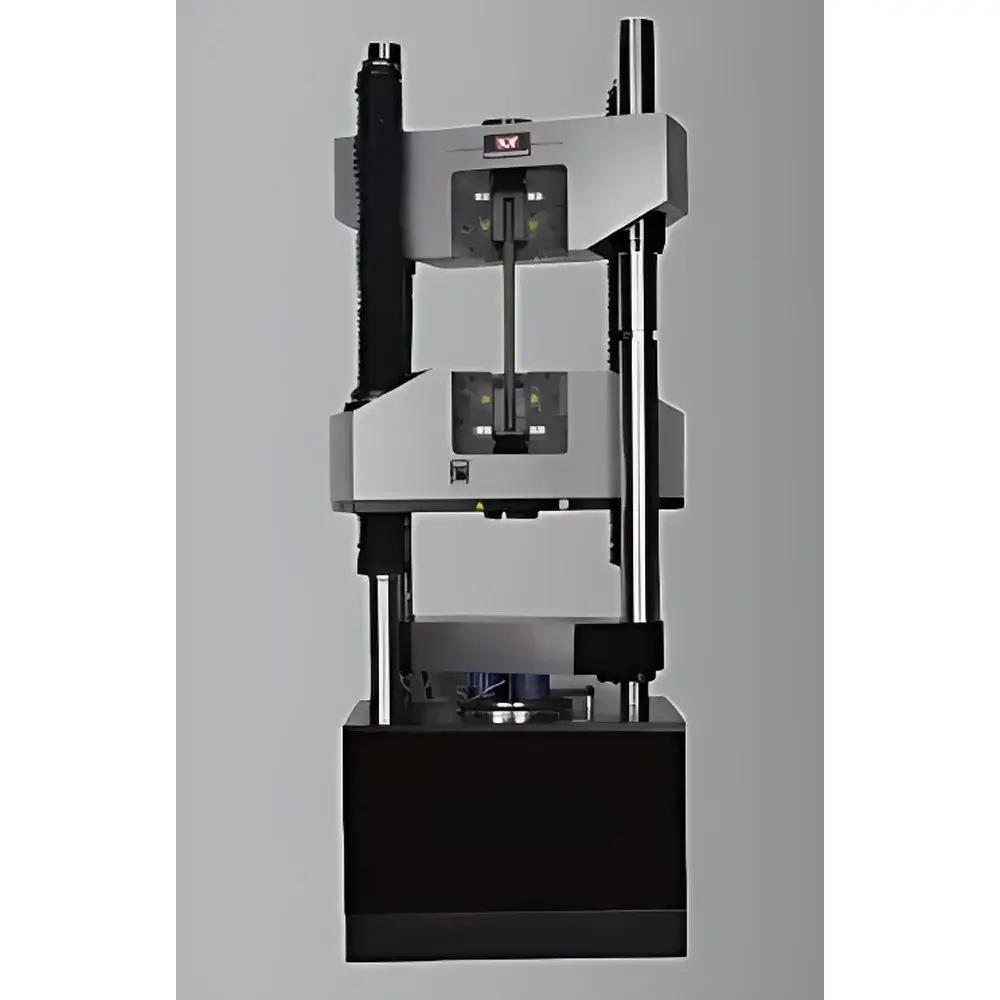
INSTRON HDX Series Hydraulic Universal Testing Machine
| Brand | INSTRON |
|---|---|
| Origin | USA |
| Type | Hydraulic Universal Testing Machine |
| Model | HDX Series (600HDX / 1000HDX / 1500HDX) |
| Force Capacity | 600 kN / 1000 kN / 1500 kN (135,000 lbf / 220,000 lbf / 300,000 lbf) |
| Load Measurement | Strain-Gauge-Based Load Cell |
| Control System | Integrated Advanced Digital Electronics with Auto-Sensor Recognition & Calibration |
| Software Platform | Windows®-Based TestSuite™ |
| Hydraulic Power Supply | Variable-Pressure Pump System |
| Frame Design | Dual-Column, Front-Access Open Crosshead with Adjustable Upper Crosshead via Vertical Column Slots |
| Compliance | ASTM E4, ASTM E8/E8M, ASTM E9, ISO 7500-1, ISO 6892-1, ISO 15630-1, EN 10002-1, USP <1041>, FDA 21 CFR Part 11 (Audit Trail Enabled) |
Overview
The INSTRON HDX Series Hydraulic Universal Testing Machine is a high-capacity, electro-hydraulic servo-controlled system engineered for precision mechanical testing of structural and high-strength materials under tension, compression, flexure, bend, and shear loading conditions. Built upon a robust dual-column frame architecture with front-access open crosshead design, the HDX platform delivers exceptional rigidity, thermal stability, and long-term force calibration integrity. Its core measurement principle relies on closed-loop hydraulic actuation coupled with strain-gauge-based load transducers—ensuring traceable, high-reproducibility force data per ISO 7500-1 Class 1 or better. The system’s variable-pressure hydraulic pump minimizes energy consumption and heat generation during low-force or dwell-phase testing, while maintaining full responsiveness across the entire force range—from initial preload to maximum rated capacity.
Key Features
- Dual-column rigid frame with vertically slotted uprights enabling precise, tool-free adjustment of the upper crosshead height to accommodate specimens of varying lengths and test configurations.
- Front-access open crosshead design eliminates rear obstruction, allowing unimpeded specimen loading/unloading from the operator side—reducing setup time and mitigating ergonomic risk during high-volume or large-part testing.
- Strain-gauge-type load cell directly integrated into the actuator train, providing direct force measurement without lever-arm amplification errors or mechanical hysteresis.
- Advanced digital control electronics with automatic sensor recognition and one-touch calibration verification—ensuring correct transducer identification, scaling, and metrological traceability prior to each test sequence.
- Variable-displacement hydraulic power unit delivering pressure-on-demand operation; dynamically adjusts system pressure to match instantaneous load requirements, improving energy efficiency and reducing oil temperature drift over extended test durations.
- Windows®-based TestSuite™ software with intuitive workflow-driven interface, preconfigured test methods (ASTM/ISO-compliant), real-time data visualization, and automated report generation with embedded metadata and digital signatures.
Sample Compatibility & Compliance
The HDX series accommodates a broad spectrum of specimen geometries—from standard metallic tensile bars (per ASTM E8/E8M) and concrete cylinders (ASTM C39) to reinforced composites, welded joints, and civil engineering components. Its modular grip and fixture ecosystem supports wedge-action, hydraulic, pneumatic, and custom-engineered solutions for brittle, ductile, or anisotropic materials. All HDX systems are factory-verified to meet ISO 7500-1 (static force calibration), ISO 6892-1 (tensile testing of metals), ASTM E4 (verification of force-measuring instruments), and EN 10002-1 (metallic materials tensile testing). Optional validation packages support GLP/GMP environments, including 21 CFR Part 11-compliant audit trails, electronic signatures, and instrument qualification documentation (IQ/OQ/PQ).
Software & Data Management
TestSuite™ serves as the central data acquisition and analysis environment, supporting synchronized multi-channel recording (load, displacement, strain, extensometer, environmental inputs) at up to 10 kHz sampling rate. Raw data is stored in vendor-neutral .tdms format with embedded metadata—including operator ID, calibration history, environmental logs, and test parameters. The software enforces role-based access control, versioned method templates, and configurable pass/fail criteria aligned with internal SOPs or regulatory standards. Export options include PDF reports with certified signature blocks, CSV/Excel datasets for statistical process control (SPC), and direct integration with LIMS platforms via OPC UA or RESTful API interfaces.
Applications
- Mechanical characterization of high-strength alloys (e.g., titanium Grade 5, Inconel 718) used in aerospace landing gear and turbine components.
- Compression testing of ultra-high-performance concrete (UHPC) and fiber-reinforced cementitious composites per ASTM C39 and EN 12390-3.
- Shear and bearing strength evaluation of structural bolted connections in civil infrastructure projects.
- Quasi-static fatigue pre-cracking and R-curve determination in fracture mechanics laboratories (ASTM E561, E1820).
- Qualification testing of additively manufactured (AM) metal parts, including build-orientation-dependent tensile and compressive property mapping.
- Validation of material behavior under simulated service loads for nuclear containment vessels and offshore drilling equipment.
FAQ
What standards does the HDX series comply with for force calibration and testing methodology?
The system conforms to ISO 7500-1 (Class 1 accuracy), ASTM E4, ASTM E8/E8M, ASTM E9, ISO 6892-1, ISO 15630-1, and EN 10002-1. Optional qualification packages support FDA 21 CFR Part 11 and EU Annex 11 requirements.
Can the HDX be integrated into an existing laboratory information management system (LIMS)?
Yes—TestSuite™ supports secure data export via CSV, XML, and .tdms formats, and offers native OPC UA connectivity and RESTful API endpoints for bidirectional LIMS integration.
Is extensometer compatibility supported across all HDX models?
All HDX systems feature standardized analog and digital (LVDT, strain gauge, video) extensometer inputs with automatic detection and configuration within TestSuite™.
What maintenance intervals are recommended for the hydraulic power unit?
INSTRON recommends quarterly oil analysis, annual filter replacement, and biennial full hydraulic system inspection—including pump wear assessment and accumulator precharge verification—per Maintenance Manual P/N 23-125000-001.
Does the HDX support closed-loop strain control during high-force creep or relaxation tests?
Yes—the advanced control electronics enable true closed-loop strain control using axial or lateral extensometers, with programmable ramp rates, dwell periods, and load/strain hold modes compliant with ASTM E139 and ISO 204.



