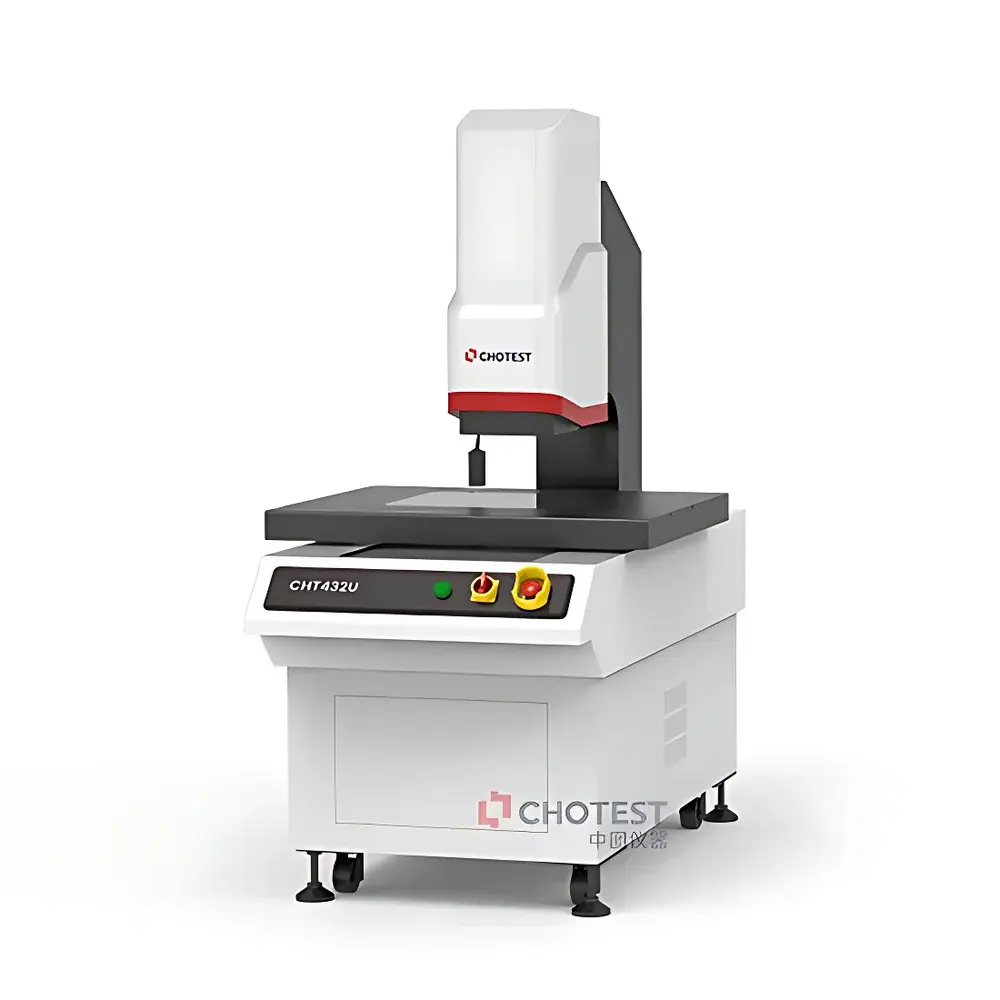
CHOTEST CHT Series Fully Automatic Vision Measuring Machine
| Brand | CHOTEST |
|---|---|
| Origin | Guangdong, China |
| Model | CHT Series |
| Construction | Granite Base Frame |
| Motion System | Precision Servo-Controlled Linear Guides (X/Y/Z) |
| Optical System | Motorized Zoom Lens with Programmable Illumination (Surface/Transmitted/Coaxial) |
| Measurement Principle | High-Resolution Digital Image Metrology Based on Sub-Pixel Edge Detection and Geometric Feature Fitting |
| Software Certification | PTB-Validated Algorithm Engine |
| Compliance Framework | Supports ISO 10360-7, ISO 1101, ASME Y14.5, GD&T Standards, and FDA 21 CFR Part 11 Audit Trail Requirements for Measurement Data Integrity |
Overview
The CHOTEST CHT Series Fully Automatic Vision Measuring Machine is an industrial-grade coordinate metrology system engineered for non-contact, high-reproducibility geometric measurement of 2D and 3D features on manufactured parts. It operates on the principle of digital image metrology—capturing high-magnification monochrome images via a motorized telecentric optical path, detecting edge contours at sub-pixel resolution using adaptive thresholding and gradient-based algorithms, and fitting ideal geometric primitives (lines, circles, arcs, conics, polygons) to extracted features. The system integrates a rigid granite base frame, preloaded linear motion stages with servo-driven closed-loop positioning, and programmable multi-spectral illumination (surface LED ring, transmitted backlight, coaxial telecentric) to ensure consistent contrast across diverse surface finishes—from matte rubber gaskets to polished stainless steel molds. Designed for integration into production-line quality control environments, the CHT Series supports full automation of measurement sequences, including auto-focus, auto-lighting adjustment, feature recognition, and GD&T evaluation—all traceable under ISO/IEC 17025-aligned calibration protocols.
Key Features
- Granite structural base with vibration-damping design ensures long-term thermal and mechanical stability over extended operational cycles.
- Servo-controlled XYZ axes with repeatability ≤ ±0.5 µm and positional accuracy certified per ISO 10360-2; Z-axis equipped with precision encoder feedback for height mapping.
- Motorized zoom lens (e.g., 0.7x–4.5x continuous magnification) with calibrated pixel-to-unit scaling, enabling seamless switching between wide-field overview and high-magnification detail inspection.
- Programmable multi-mode illumination: independently controllable surface light (ring/dome), transmitted backlight, and coaxial telecentric illumination—each adjustable in intensity and angle per measurement step.
- PTB-validated image analysis engine compliant with DIN EN ISO/IEC 17025 requirements for algorithmic uncertainty quantification; includes edge detection robustness testing against noise, glare, and partial occlusion.
- Integrated hybrid probing capability: optional tactile trigger probe or optical line scanner for Z-height, flatness, and 3D profile acquisition—enabling combined 2.5D metrology workflows.
Sample Compatibility & Compliance
The CHT Series accommodates parts ranging from <1 mm micro-electromechanical components (e.g., connector pins, SMT solder paste deposits) to 600 mm × 600 mm large-format PCBs or injection-molded housings. Surface compatibility includes metallic, ceramic, polymer, elastomeric, and composite materials—regardless of reflectivity, texture, or transparency—due to adaptive lighting and multi-threshold segmentation logic. The system conforms to international metrological standards including ISO 10360-7 (verification of vision measuring systems), ISO 1101 (geometrical tolerancing), and ASME Y14.5-2018 (dimensioning and tolerancing). Measurement data records include full audit trails (operator ID, timestamp, software version, calibration status), satisfying FDA 21 CFR Part 11 electronic record/electronic signature requirements when deployed in regulated medical device or pharmaceutical manufacturing environments.
Software & Data Management
CHOTEST’s proprietary MeasurLink™ software provides an intuitive graphical interface with drag-and-drop routine programming, CAD/Gerber file import (DXF, STEP, Gerber RS-274X), and automatic coordinate system alignment via 3-2-1 or best-fit registration. Over 80 built-in geometric evaluation tools support point, line, circle, slot, ellipse, polyline, and custom contour analysis; GD&T modules cover position, concentricity, symmetry, profile of a surface, circular runout, and total runout per ISO 1101. Statistical Process Control (SPC) reports are auto-generated with X̄-R, Cp/Cpk, Pp/Ppk indices and exported in CSV, PDF, or XML formats. Native Q-DAS QDB protocol support enables direct transmission to enterprise SPC servers. All measurement programs and results are stored in a relational database with role-based access control, version history, and encrypted backup—fully compatible with GLP/GMP documentation workflows.
Applications
The CHT Series serves as a primary metrology platform across industries requiring dimensional verification of complex geometries without physical contact. In electronics manufacturing, it validates solder mask alignment, pad coplanarity, and flex circuit trace width on FPCs and rigid-flex PCBs. For precision machining, it measures gear tooth profiles, thread pitch diameters, and turbine blade airfoil sections. In medical device production, it verifies critical dimensions of catheter hubs, stent crimping fixtures, and orthopedic implant mating surfaces. Automotive suppliers use it for gasket thickness uniformity, brake caliper bore roundness, and EV battery module tab geometry. Additional applications include watch component gear train clearance, injection mold cavity wear tracking, silicone sealant bead consistency, and solar cell busbar width/height profiling.
FAQ
What calibration standards does the CHT Series support?
The system supports traceable calibration using NIST-traceable glass scale artifacts, ball bars, and step gauges; annual verification follows ISO 10360-2 and ISO 10360-7 procedures.
Can the CHT Series integrate with factory MES or ERP systems?
Yes—via OPC UA, RESTful API, or direct SQL database access; MeasurLink™ supports configurable data mapping to SAP QM, Siemens Opcenter, or custom MES schemas.
Is operator training required to deploy new measurement programs?
No formal certification is required; typical users achieve proficiency within one working day using guided workflow templates and context-sensitive help.
Does the software support multi-language UI and reporting?
Yes—interface and report generation are available in English, German, Japanese, Korean, and Simplified Chinese with locale-specific number/date formatting.
How is measurement uncertainty estimated for each reported dimension?
Uncertainty budgets are automatically calculated per GUM (JCGM 100:2008) principles, incorporating contributions from lens distortion, pixel interpolation error, illumination variability, and environmental temperature drift—displayed alongside nominal values in reports.