
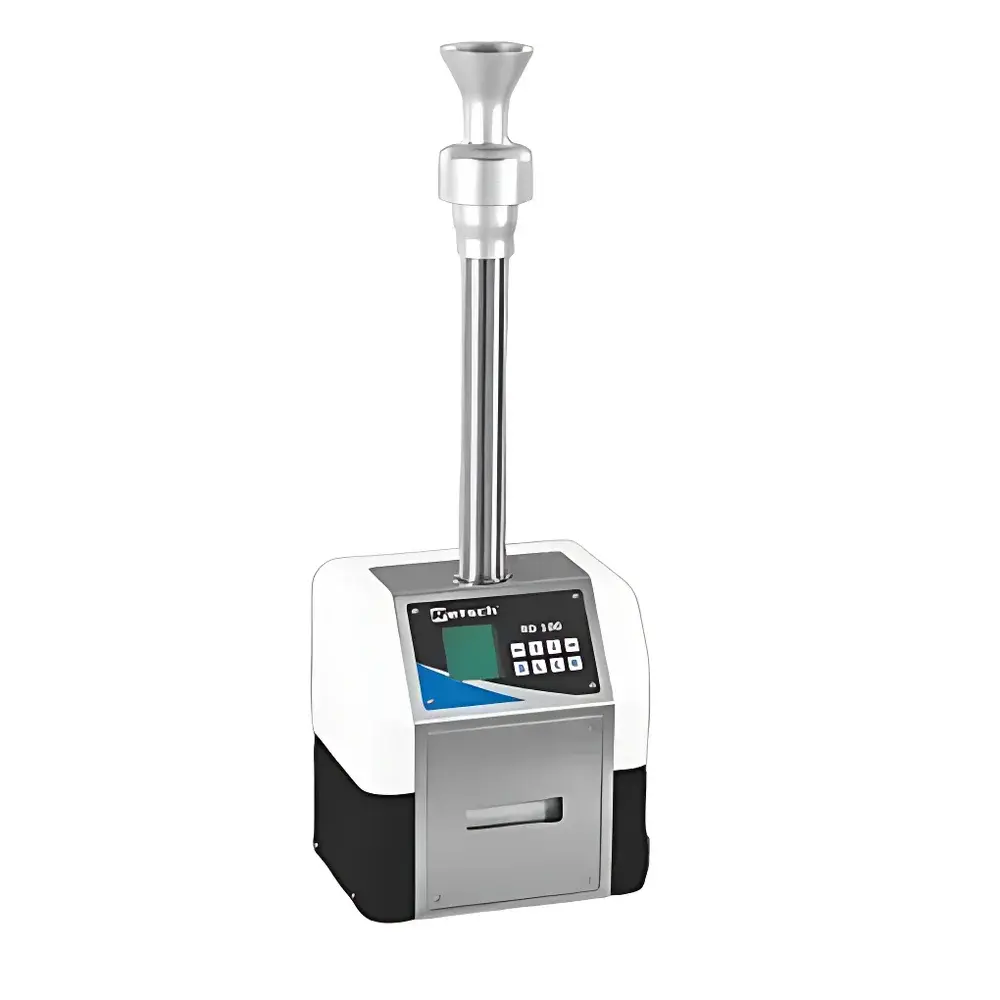
RETSCH DustMon RD 100 Dust Analyzer
| Brand | RETSCH |
|---|---|
| Origin | Germany |
| Model | RD 100 |
| Measurement Principle | Real-time optical dust concentration monitoring via laser scattering |
| Sampling Rate | Up to 1000 measurements per second |
| Compliance | CIPAC MT 171 |
| Dust Index & Dust Area Calculation | Yes |
| Dust Curve Storage | Up to 10 comparative dust release profiles |
| Sample Containment | Sealed sample chamber |
| Interface | Integrated touchscreen display |
| Data Export | CSV/Excel-compatible output |
| User Interface | Standalone operation without external PC required |
Overview
The RETSCH DustMon RD 100 is a precision-engineered dust analyzer designed for the quantitative assessment of dust generation from granular and powdered materials under standardized mechanical agitation. Operating on the principle of real-time laser light scattering, the instrument detects airborne particulate matter released during controlled sample handling—such as pouring, vibration, or tumbling—enabling objective, repeatable quantification of dustiness. Unlike gravimetric or filter-based methods, the DustMon RD 100 delivers high-temporal-resolution data (up to 1000 readings per second), capturing transient dust release dynamics essential for regulatory compliance, occupational exposure assessment, and formulation optimization. Its application scope spans agrochemicals, pharmaceuticals, food ingredients, catalysts, and industrial powders where dust control directly impacts safety, process efficiency, and product stability.
Key Features
- Optical dust detection system with calibrated laser diode and photodetector array, ensuring high sensitivity across typical respirable particle size ranges (sub-10 µm)
- Sealed, reusable sample chamber with integrated agitation mechanism compliant with CIPAC MT 171 test protocol
- Onboard touchscreen interface enabling fully standalone operation—no external computer or software installation required
- Simultaneous calculation of three standardized dust metrics: Dust Index (DI), Dust Area (DA), and maximum dust concentration (mg/m³ equivalent)
- Storage capability for up to 10 full dust release curves per session, facilitating direct comparative analysis between formulations or processing conditions
- Automated timestamping and metadata tagging (operator ID, sample ID, date/time, test duration) supporting GLP-aligned documentation practices
- Export functionality via USB port to standard CSV format, compatible with Excel, LIMS, and statistical analysis platforms
Sample Compatibility & Compliance
The DustMon RD 100 accommodates dry, free-flowing powders and granules with nominal particle sizes ranging from 50 µm to 4 mm. It supports sample masses from 10 g to 500 g, adjustable via programmable fill height settings. All testing procedures align strictly with CIPAC MT 171 (“Determination of Dustiness of Solid Pesticide Formulations”), making it suitable for regulatory submission in EU, UK, and other jurisdictions requiring harmonized dustiness evaluation. While not certified for explosion-proof environments, its sealed chamber design minimizes operator exposure and meets OSHA and EU Directive 2004/37/EC (Carcinogens and Mutagens) preliminary screening requirements. The instrument’s measurement repeatability (RSD < 5% for replicate runs under identical conditions) has been verified per ISO 5725-2 guidelines.
Software & Data Management
The DustMon RD 100 operates via embedded firmware with no dependency on third-party software. All data—including raw scattering intensity time-series, derived dust curves, and calculated indices—are stored internally and accessible through the device’s file browser. Each measurement session generates a timestamped report containing test parameters, environmental conditions (ambient temperature/humidity logged externally), and summary statistics. Data export preserves full traceability: filenames include batch identifiers, and CSV headers conform to ASTM E1488-22 recommended metadata fields for particulate emission reporting. Audit trail functionality records user login events and parameter modifications, satisfying FDA 21 CFR Part 11 requirements when paired with institutional electronic signature protocols.
Applications
- Pre-formulation screening of active pharmaceutical ingredients (APIs) and excipients to assess inhalation risk during manufacturing
- Quality control of pesticide granules and water-dispersible granules (WDGs) prior to registration dossier submission
- Development of low-dust fertilizer blends meeting EU Fertilising Products Regulation (EU) 2019/1009 Annex I criteria
- Comparative evaluation of anti-caking agents, surface coatings, or moisture content adjustments on dust suppression efficacy
- Supporting hazard communication under CLP Regulation (EC) No 1272/2008 by generating objective dustiness classification inputs
- In-process monitoring during scale-up of dry powder blending or pneumatic conveying system validation
FAQ
What standards does the DustMon RD 100 comply with?
It is validated for CIPAC MT 171 and supports alignment with ISO/IEC 17025-accredited testing workflows.
Can the instrument measure respirable versus total dust fractions?
No—it reports total airborne dust concentration optically; size-fractionated analysis requires coupling with a cascade impactor or aerosol spectrometer.
Is calibration traceable to national standards?
Yes—optical path calibration is performed using NIST-traceable polystyrene latex (PSL) microsphere suspensions at 1 µm and 5 µm diameters.
How is sample loading and containment managed?
Samples are placed into a disposable or autoclavable stainless-steel sample cup, then secured within a pneumatically sealed chamber before automated agitation begins.
Does the system support multi-language UI?
The interface is available in English and German; firmware updates may extend language options via RETSCH’s authorized service portal.



