TQC AB6000/AB6010 Dry/Wet Crockmeter for Colorfastness Testing
| Brand | TQC |
|---|---|
| Origin | Netherlands |
| Model | AB6000 / AB6010 |
| Speed Range | 1–60 cycles/min (±1% accuracy) |
| Stroke Length | 20–300 mm (±0.01 mm precision) |
| Pump Flow Rate (AB6000 only) | 0.0–3.0 mL/min |
| Max Sample Dimensions | 350 × 70 × 35 mm |
| Power Supply | 100–240 VAC, 50–60 Hz |
| Display | 480 × 272 px TFT color touchscreen |
| Supported Languages | English, Spanish, German, French, Italian, Polish, Russian, Japanese, Chinese |
| Weight | 30–35 kg |
| Compliance | ASTM D2486, D4213, D4828, D3450, F1319 |
Overview
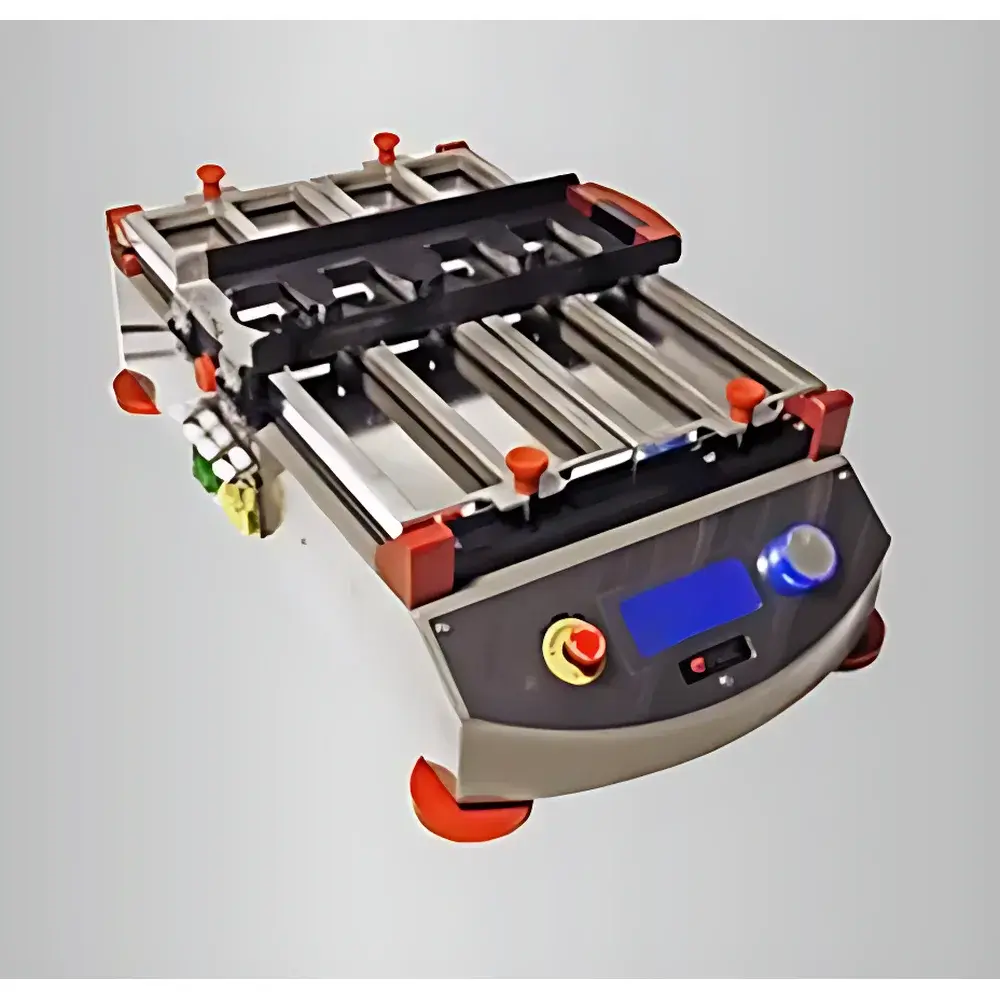
The TQC AB6000 and AB6010 Dry/Wet Crockmeters are precision-engineered instruments designed to evaluate colorfastness to rubbing — a critical performance parameter for coated surfaces, inks, textiles, automotive finishes, and decorative laminates. Based on standardized reciprocating linear motion, these crockmeters simulate mechanical abrasion under controlled dry or wet conditions to quantify dye or pigment transfer onto standardized white test cloth (e.g., cotton or multifiber fabric). The AB6010 variant operates exclusively in dry mode, while the AB6000 integrates a programmable peristaltic pump enabling precise, reproducible wet-crocking tests per ISO 105-X12 and ASTM D2486. Both models comply with internationally recognized test protocols governing surface durability in industrial R&D, quality control, and regulatory validation workflows.
Key Features
- Modular architecture allowing rapid reconfiguration between dry and wet test modes via interchangeable fixtures and pump integration — minimizing instrument footprint and capital investment per testing requirement.
- Micro-stepper motor drive system delivering stable, low-vibration motion across the full speed range (1–60 cycles/min) with ±1% speed accuracy and stroke repeatability of ±0.01 mm over 20–300 mm travel distance.
- Intuitive 480 × 272 px full-color TFT touchscreen interface supporting nine languages (including English, German, French, Japanese, and Chinese), with pre-loaded test methods aligned to ASTM, ISO, EN, DIN, and OEM-specific standards.
- Triple-i Interface (integrated, intelligent, interactive) providing real-time status feedback, step-by-step procedural guidance, and visual progress tracking during test execution — reducing operator dependency and training overhead.
- Firmware-upgradable operating system ensuring long-term compatibility with evolving standard revisions and laboratory informatics requirements without hardware replacement.
- Robust mechanical design certified for continuous operation in regulated environments; CE-marked and compliant with EN 60730-1 (automatic electrical controls) and EN 13300 (decorative coatings safety).
Sample Compatibility & Compliance
The AB6000/AB6010 accommodates flat, rigid, or semi-flexible substrates up to 350 mm in length, 70 mm in width, and 35 mm in thickness — suitable for panels, printed films, coated metal sheets, painted wood samples, and plastic components. Its open-frame geometry supports custom fixturing for non-standard geometries when validated per method-specific annexes. The instrument meets the mechanical and metrological requirements of key international standards including ASTM D2486 (wet crocking), ASTM D4213 (dry crocking), ISO 11998 (paints and varnishes), ISO 105-X12 (textiles), EN 13523-11 (coil-coated metals), DIN 53778 (German paint standard), and OEM specifications such as Renault D431010 and GME 60269. All firmware and calibration routines are traceable to NIST-traceable reference artifacts where applicable.
Software & Data Management
No external PC is required: all test configuration, execution, and result logging occur onboard. Each test record stores timestamp, cycle count, speed, stroke length, pump flow rate (AB6000), operator ID, and pass/fail status against user-defined acceptance thresholds. Export options include CSV files via USB port for LIMS integration or audit-ready reporting. While the device does not natively support FDA 21 CFR Part 11 electronic signatures, its audit trail functionality — including immutable event logs, firmware version stamping, and user-access-controlled settings — aligns with GLP and GMP documentation expectations when deployed within validated laboratory procedures.
Applications
These crockmeters serve cross-industry QC laboratories evaluating surface integrity across multiple sectors: coating manufacturers assessing binder resistance in architectural paints; automotive suppliers validating scratch-and-rub performance of interior trim finishes; packaging converters verifying ink adhesion on flexible laminates; textile labs certifying dye migration in apparel prints; and R&D teams developing functional coatings with enhanced wear resistance. Their dual-mode capability ensures consistent evaluation whether simulating dry handling abrasion (e.g., finger rub on touchscreens) or moisture-assisted pigment transfer (e.g., damp cloth contact on signage).
FAQ
What is the difference between the AB6000 and AB6010 models?
The AB6000 includes an integrated peristaltic pump for automated wet crocking tests; the AB6010 is dry-only and lacks the pump assembly.
Can the instrument be used for non-standard test methods?
Yes — users may define custom speed, stroke, and cycle parameters outside preloaded standards, though method validation remains the responsibility of the end user.
Is calibration traceable to national standards?
TQC provides factory calibration certificates; optional annual recalibration services are available through authorized service centers using traceable reference masses and displacement gauges.
Does the device support network connectivity or remote monitoring?
No — it operates as a standalone unit with local USB data export only; no Ethernet, Wi-Fi, or cloud interfaces are implemented.
What maintenance is required for long-term reliability?
Routine cleaning of the test head, carriage rails, and pump tubing (AB6000) is recommended after each use; biannual inspection of motor coupling and belt tension is advised per the maintenance schedule in the operator manual.