
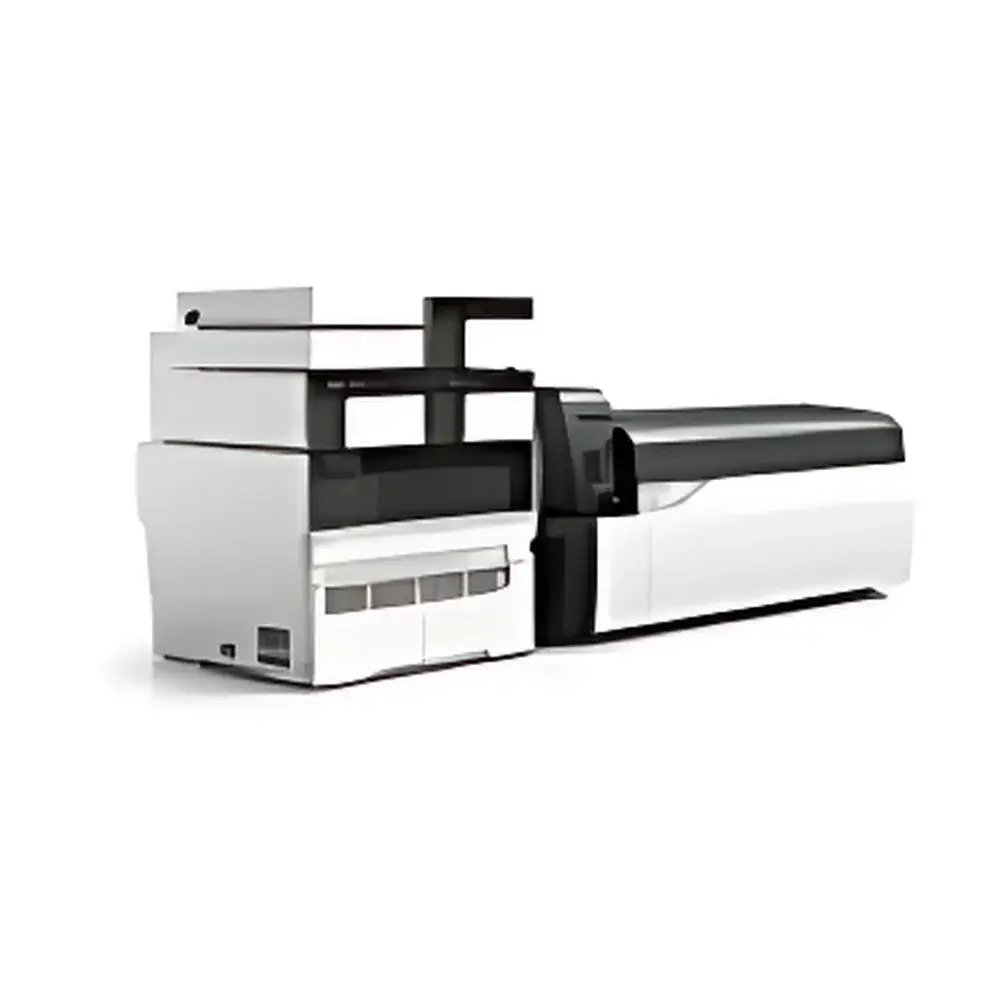
Shimadzu LCMS-8045 Triple Quadrupole Liquid Chromatography-Mass Spectrometer
| Origin | Guangdong, China |
|---|---|
| Manufacturer Type | Authorized Distributor |
| Origin Category | Domestic (PRC) |
| Model | LCMS-8045 |
| Pricing | Available Upon Request |
Overview
The Shimadzu LCMS-8045 is a high-performance triple quadrupole liquid chromatography–mass spectrometry (LC-MS/MS) system engineered for ultra-fast, high-sensitivity quantitative analysis in regulated and research-intensive laboratories. Leveraging Shimadzu’s decades-long heritage in mass spectrometry development—including foundational contributions by Nobel Laureate Dr. Koichi Tanaka—the LCMS-8045 integrates advanced ion optics, rapid polarity-switching electrospray ionization (ESI), and optimized collision cell dynamics to deliver sub-second dwell times and cycle times under 100 ms per MRM transition. Its core architecture adheres to the principles of tandem mass spectrometry using three quadrupole mass filters: Q1 for precursor ion selection, Q2 as a collision-induced dissociation (CID) cell, and Q3 for product ion detection. This configuration enables highly selective, low-noise multiple reaction monitoring (MRM), essential for trace-level quantification in complex biological, environmental, pharmaceutical, and food matrices.
Key Features
- Ultra-fast acquisition: Achieves up to 500 MRM transitions per second with <100 ms total cycle time, enabling comprehensive multi-analyte profiling without sacrificing sensitivity.
- High-sensitivity triple quadrupole design: Optimized ion transmission efficiency and low-noise detector electronics support sub-pg on-column detection limits for small molecules in ESI-positive and ESI-negative modes.
- Robust source architecture: Features a heated electrospray ionization (HESI) probe with active desolvation gas control and ceramic-coated ion transfer capillary—engineered to minimize matrix-induced signal suppression and enhance long-term stability during unattended operation.
- Enhanced duty cycle management: Intelligent scheduling algorithms prioritize high-priority transitions and dynamically allocate dwell time based on peak width and retention time, maximizing data point density across narrow UHPLC peaks.
- Modular vacuum system: Dual-stage differential pumping with turbomolecular and backing pumps ensures stable high-vacuum conditions (<1×10⁻⁶ Pa in Q2/Q3 regions) even during rapid gradient elution or high-flow mobile phase conditions.
Sample Compatibility & Compliance
The LCMS-8045 accommodates a broad range of sample types—from plasma, urine, and tissue homogenates to soil extracts, wastewater filtrates, pesticide residues in produce, and residual solvents in pharmaceutical intermediates. It supports standard LC flow rates (0.2–2.0 mL/min), column diameters from 2.1 mm to 4.6 mm ID, and compatible with reversed-phase, HILIC, and mixed-mode stationary phases. The system complies with key regulatory requirements for analytical instrumentation: it operates within ISO/IEC 17025-accredited laboratory workflows and supports audit-trail-enabled operation when paired with validated software configurations. Data integrity features—including electronic signatures, user access controls, and full audit trail logging—align with FDA 21 CFR Part 11 and EU Annex 11 expectations for GxP environments.
Software & Data Management
Labsolutions LCMS is the integrated acquisition and processing platform for the LCMS-8045. Built on a modular, Windows-based architecture, it provides method development tools for automated MRM parameter optimization, retention time alignment, and peak integration refinement. The software includes pre-configured, application-specific method packages—validated for pesticide screening (EPA Method 1694), veterinary drug residue analysis (EU Commission Decision 2002/657/EC), clinical toxicology (SAMHSA guidelines), and impurity profiling per ICH Q2(R2). All methods are exportable in standardized formats (e.g., .xml, .csv) and support LIMS integration via ASTM E1482-compliant interfaces. Raw data files adhere to mzML 1.1.0 specifications, ensuring interoperability with third-party processing tools such as Skyline, OpenMS, and Compound Discoverer.
Applications
The LCMS-8045 serves as a primary quantitative workhorse in quality control laboratories performing batch release testing of APIs and finished pharmaceuticals; in food safety labs conducting multi-residue screening for mycotoxins, antibiotics, and illegal dyes; in environmental agencies monitoring PFAS, endocrine disruptors, and pharmaceutical metabolites in surface water; and in clinical research cores quantifying biomarkers (e.g., steroids, acylcarnitines, vitamin D metabolites) in high-throughput cohort studies. Its speed and robustness make it particularly suited for applications requiring >1,000 samples per day with <5% RSD precision over 48-hour continuous runs.
FAQ
What regulatory standards does the LCMS-8045 support for GMP/GLP compliance?
The system supports 21 CFR Part 11 compliance through Labsolutions LCMS when deployed with appropriate IT infrastructure, including role-based user authentication, electronic signatures, and immutable audit trails.
Can the LCMS-8045 be coupled with UHPLC systems from other vendors?
Yes—it accepts standard LC analog/digital I/O signals and is compatible with third-party UHPLC modules via TTL-triggered start/stop synchronization and pressure interlock protocols.
Is method transfer from older Shimadzu LC-MS/MS platforms straightforward?
MRM transition lists, dwell times, and collision energies are fully importable from LCMS-8030 and LCMS-8050 methods; minor optimization of source parameters may be required due to improved ion transmission efficiency.
Does the system support scheduled MRM for variable retention time windows?
Yes—scheduled MRM mode automatically activates transitions only during predefined ±30 sec windows around expected elution times, improving dwell time allocation and sensitivity for co-eluting analytes.
What maintenance intervals are recommended for routine operation?
Ion source cleaning is recommended every 2–4 weeks depending on sample cleanliness; turbomolecular pump oil replacement every 12 months; and annual performance verification per Shimadzu PQS-01 protocol.
Related Products





