
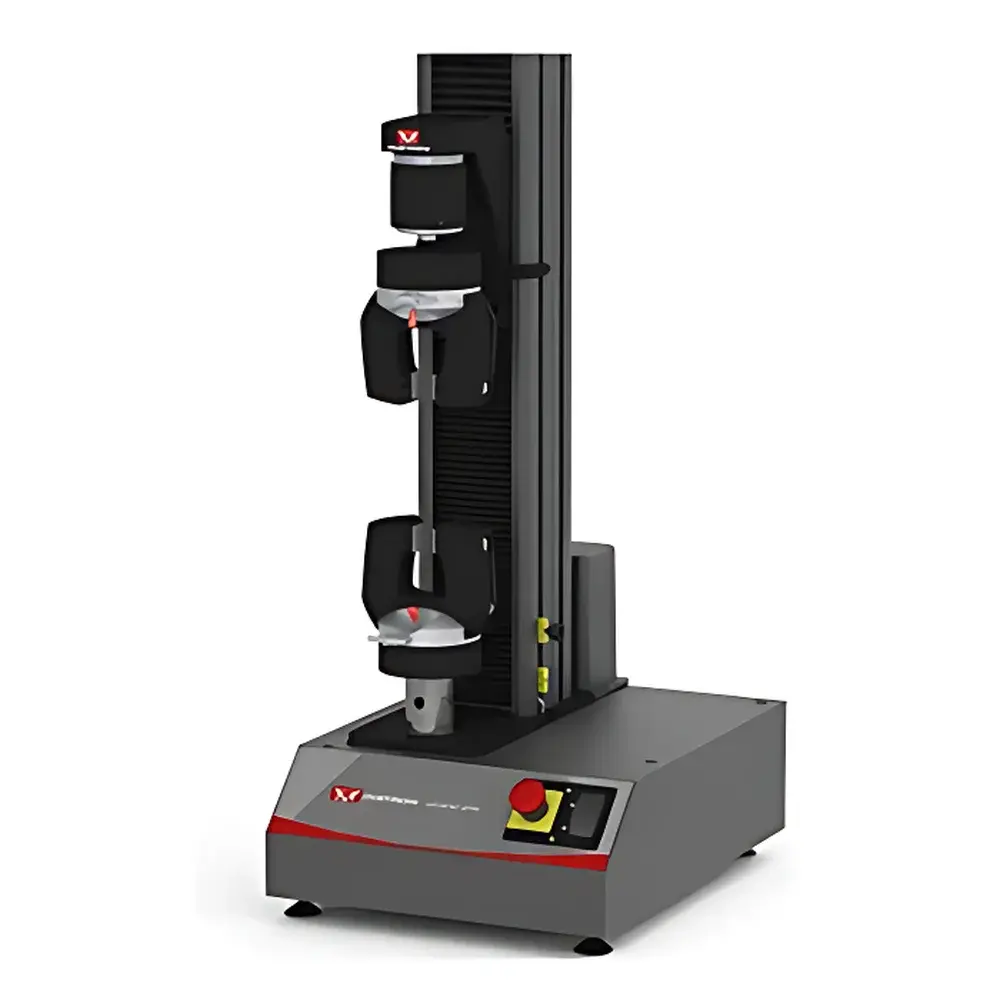
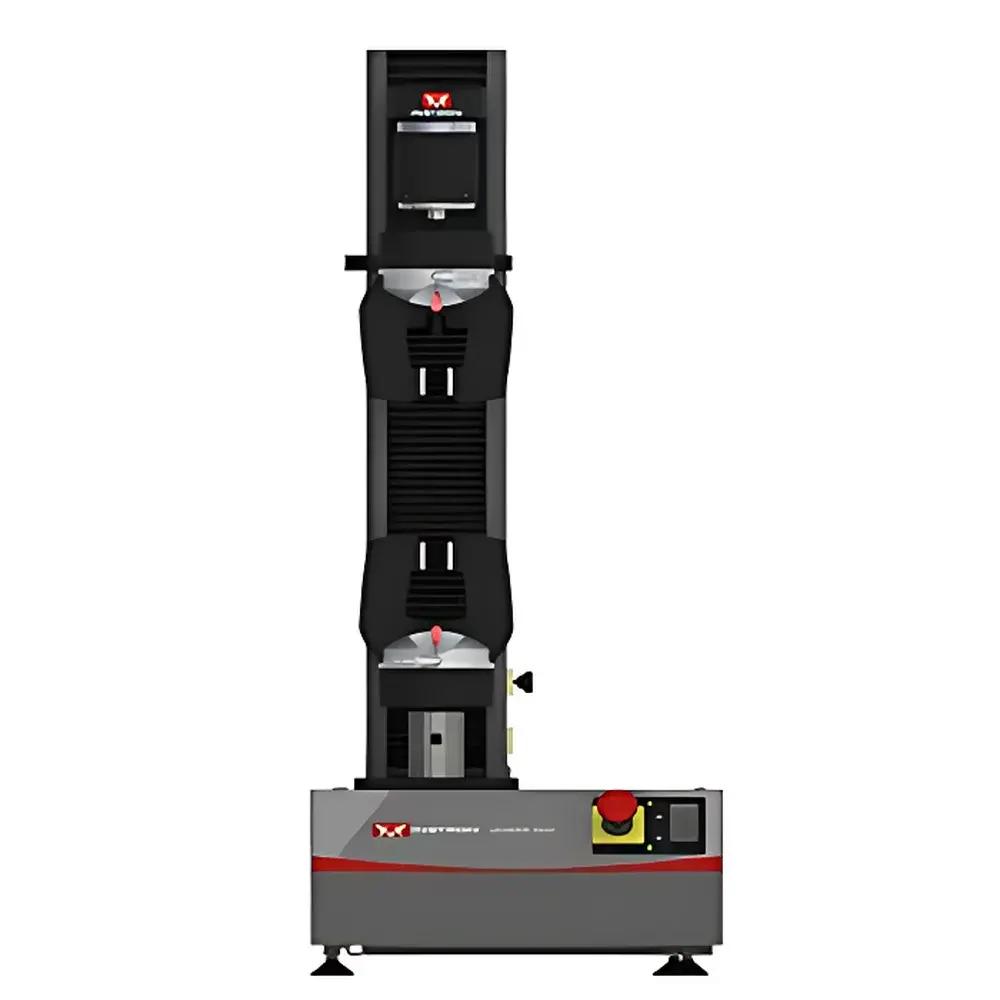
Instron 2340 Series Single-Column Universal Testing Machine
| Brand | Instron |
|---|---|
| Origin | USA |
| Model | 2340 |
| Load Capacity Options | 0.5 kN, 1 kN, 2 kN, 5 kN |
| Vertical Test Space | 651 mm (2342) to 1383 mm (high-clearance variant) |
| Load Accuracy | ±0.5% of indicated load |
| Load Resolution | 1/200 of full scale |
| Data Acquisition Rate | 500 Hz |
| Compliance | CE-marked |
| Sensor Recognition | Automatic |
| Software Control | Fully integrated via Bluehill Universal |
| Fixture Compatibility | Extensive catalog of standardized and custom grips & tooling |
Overview
The Instron 2340 Series is a precision-engineered single-column universal testing machine designed for static tensile, compression, flexure, and peel testing of materials and components in quality control, R&D, and academic laboratories. Operating on the principle of servo-controlled electromechanical actuation, the system delivers high-fidelity force-displacement data through closed-loop feedback regulation of a brushless DC motor and precision ball-screw drive assembly. Its compact footprint—optimized for laboratories with constrained floor space—maintains full accessibility to the test zone without compromising mechanical rigidity or thermal stability. The 2340 platform supports load capacities from 0.5 kN to 5 kN (112–1,125 lbf), with vertical test spaces ranging from 651 mm (2342 model) up to 1383 mm (high-clearance configuration), enabling evaluation of both small specimens and elongated samples such as medical tubing, polymer films, or composite laminates.
Key Features
- High-resolution load measurement across the entire capacity range: accurate to ±0.5% of indicated load, with resolution maintained down to 1/200 of full-scale capacity—eliminating the need for sensor swapping during multi-range testing.
- Real-time data acquisition at 500 Hz, supporting dynamic event capture including yield onset, fracture propagation, and viscoelastic relaxation behavior.
- Automatic load cell recognition via digital interface—ensuring correct calibration coefficient application and eliminating manual entry errors during instrument setup or sensor changeover.
- Modular mechanical architecture with rigid aluminum extrusion frame and precision-ground linear guidance system, delivering consistent alignment and minimal deflection under load.
- CE-compliant design meeting EN ISO 12100:2019 (safety of machinery) and EN 61000-6-3:2019 (EMC emission standards), suitable for installation in regulated laboratory environments.
- Integrated crosshead positioning with jog-and-go controls and programmable travel limits, reducing operator intervention and improving repeatability across routine QC protocols.
Sample Compatibility & Compliance
The 2340 Series accommodates a broad spectrum of specimen geometries and material classes—including metals, plastics, elastomers, textiles, adhesives, biomedical devices, and thin-film substrates—through Instron’s comprehensive portfolio of standardized and application-specific fixtures. All grip systems are engineered to minimize stress concentrations and ensure axial alignment per ASTM E8/E8M (tensile testing of metallic materials) and ISO 527-1 (plastics tensile properties). The system supports compliance with Good Laboratory Practice (GLP) and Good Manufacturing Practice (GMP) requirements when configured with BlueHill Universal software featuring 21 CFR Part 11–compliant audit trails, electronic signatures, and user-access controls. Routine verification follows ISO 7500-1 (static calibration of force-proving instruments) and ASTM E4 (verification of force-measuring systems).
Software & Data Management
Controlled exclusively via BlueHill Universal software, the 2340 platform provides intuitive test method development, real-time graphical monitoring, and automated result calculation per international standards. The software includes preconfigured test methods for ASTM D638, ISO 527, ISO 178, and EN 1303:2013, with customizable pass/fail criteria, statistical reporting (mean, SD, CV%), and export to CSV, PDF, or XML formats. Data integrity is preserved through timestamped audit logs, version-controlled method files, and secure database storage options. Optional network integration enables centralized instrument management across multi-system labs and traceability linkage to LIMS platforms.
Applications
- Quality assurance of incoming raw materials and finished goods in automotive, aerospace, and medical device manufacturing.
- Mechanical characterization of thermoplastics, thermosets, and biodegradable polymers for formulation development.
- Peel strength evaluation of pressure-sensitive adhesives and laminated packaging structures per ASTM D903 and FINAT FTM 1.
- Tensile testing of suture materials, catheter shafts, and hydrogel-based wound dressings under ISO 10993-12 physiological conditions.
- Compression testing of foams, gaskets, and soft tissue simulants per ASTM D3574 and ISO 1856.
- Educational use in undergraduate and graduate materials science laboratories for hands-on instruction in mechanical property fundamentals.
FAQ
What load cell accuracy specifications apply across the full range of 2340 models?
Load accuracy is consistently ±0.5% of indicated load from 1/200 to full scale for all 2340 configurations, verified per ISO 7500-1 Class 1 requirements.
Is BlueHill Universal software included with the base system?
Yes—full-featured BlueHill Universal software is supplied standard with every 2340 system, including method templates, reporting tools, and firmware update capability.
Can the 2340 be integrated into an existing laboratory network for remote monitoring?
Absolutely—the system supports Ethernet connectivity and OPC UA-compatible data streaming, enabling integration with SCADA, MES, or enterprise LIMS infrastructure.
Does Instron provide validation documentation for GxP-regulated environments?
Yes—IQ/OQ documentation packages, along with 21 CFR Part 11 readiness assessments and calibration certificates traceable to NIST standards, are available upon request.
Are high-temperature or environmental chamber options available for the 2340 platform?
While the base 2340 is optimized for ambient-condition testing, it is mechanically compatible with select third-party environmental chambers; full thermal compatibility requires engineering review prior to integration.
Related Products



