Auniontech Portable Laser Vibrometer
| Brand | Auniontech |
|---|---|
| Origin | Shanghai, China |
| Model | LV-Portable Series |
| Measurement Range | 0.036–4 m |
| Operating Principle | Coherent Laser Interferometry (Heterodyne Detection) |
| Spot Size | <50 µm |
| Frequency Range | 0.1 Hz – 20 MHz |
| Displacement Resolution | ≤1 pm/√Hz |
| Power Supply | Integrated Rechargeable Li-ion Battery (Up to 4 h Runtime) |
| Data Interfaces | USB 2.0, Wi-Fi 802.11n |
| Display | Built-in 5.5″ TFT Touchscreen (1280×720) |
| Compliance | ISO 16063-11, ASTM E1876, IEC 61260 Class 1 |
| Software Platform | AunionVib Pro v4.2 (Supports FFT, Order Analysis, Modal Parameter Extraction, Time-Frequency Mapping, and GLP-compliant Audit Trail) |
Overview
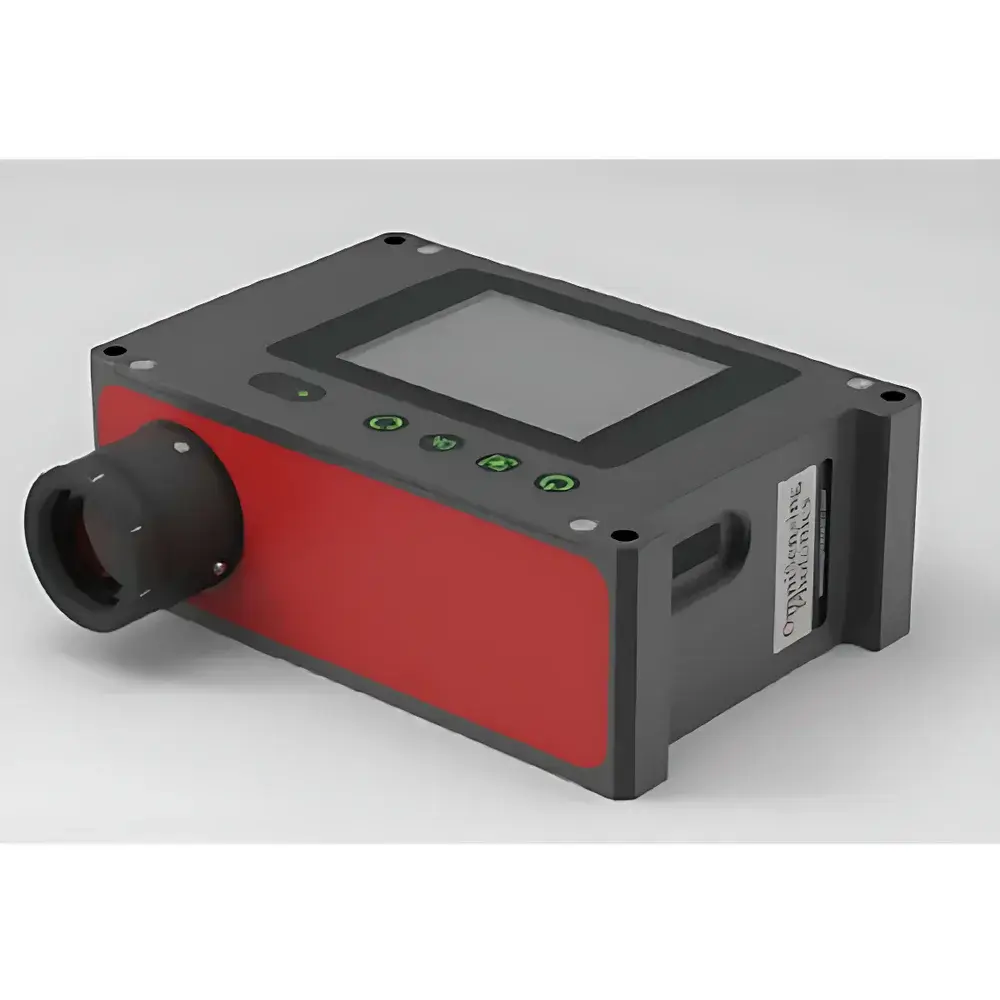
The Auniontech Portable Laser Vibrometer is a field-deployable, non-contact vibration measurement system engineered for high-fidelity dynamic characterization of mechanical structures under operational or laboratory conditions. Based on heterodyne coherent laser interferometry, it measures absolute surface velocity and displacement by detecting phase shifts in reflected laser light with sub-picometer resolution. Unlike contact-based accelerometers or piezoelectric sensors, this instrument imposes zero mass loading, eliminates mechanical coupling artifacts, and maintains measurement integrity across diverse surface finishes—including polished metals, anodized aluminum, painted composites, and matte ceramics—without requiring retroreflective targets or surface preparation. Its coaxial optical architecture enables operation in confined geometries where conventional scanning laser Doppler vibrometers (SLDVs) cannot access, making it uniquely suited for in-situ modal analysis, rotating machinery diagnostics, MEMS validation, and aerospace component testing.
Key Features
- True portability: Integrated rechargeable Li-ion battery supports continuous operation for up to 4 hours without external power—ideal for factory floor surveys, wind turbine blade inspections, or remote infrastructure monitoring.
- Coaxial single-beam design: Eliminates alignment complexity and parallax error; enables measurements within gaps as narrow as 15 mm and at incidence angles up to ±15°.
- Sub-micron optical spot size (<50 µm): Resolves localized dynamics on microstructures such as semiconductor packaging, micro-mirrors, and thin-film actuators.
- Dual-output interface architecture: Real-time streaming via USB 2.0 to host PCs or tablets; wireless telemetry via encrypted Wi-Fi (WPA2-PSK) for synchronized multi-node deployments.
- Built-in 5.5-inch capacitive touchscreen: Displays time-domain waveforms, FFT spectra, coherence maps, and real-time RMS/peak-to-peak metrics—no external hardware required for basic assessment.
- Ruggedized industrial enclosure (IP54 rated): Aluminum-magnesium alloy chassis with shock-absorbing elastomer feet; operates reliably from 0 °C to 40 °C and 20–80% RH non-condensing.
Sample Compatibility & Compliance
The LV-Portable Series exhibits broad material neutrality due to its reliance on optical coherence rather than diffuse reflectivity. It delivers stable signal-to-noise ratios on surfaces with reflectivity as low as 3% (e.g., black rubber, carbon fiber laminates) and remains insensitive to ambient illumination fluctuations, eliminating the need for dark-room conditions. All firmware and software modules comply with ISO/IEC 17025 traceability requirements for metrological validation. Data acquisition workflows support 21 CFR Part 11-compliant electronic signatures, audit trail logging, and user-access-level configuration control—enabling direct integration into GMP/GLP-regulated environments including medical device qualification and automotive NVH certification labs.
Software & Data Management
AunionVib Pro v4.2 provides a modular, scriptable analysis environment compatible with Windows 10/11 (64-bit) and macOS 12+. Core capabilities include synchronous multi-channel FFT (up to 16k lines), waterfall and colormap generation, ODS (Operating Deflection Shape) reconstruction, and automated resonance tracking with damping ratio estimation (log decrement method). Raw time-series data is stored in HDF5 format with embedded metadata (timestamp, laser power, distance, environmental temperature/humidity via optional sensor module). Export options include CSV, MATLAB .mat, Universal File Format (UFF 58), and NI DIAdem-compatible TDMS. The software supports third-party API integration (Python SDK, LabVIEW VIs) for custom automation in production test stands or academic research pipelines.
Applications
- Rotating equipment health monitoring: Bearing defect detection, gear mesh frequency analysis, and shaft orbit reconstruction on pumps, motors, and compressors.
- Aerospace structural verification: Flutter boundary mapping of winglets, panel buckling assessment, and composite joint integrity evaluation during ground vibration tests (GVT).
- Electroacoustic transducer characterization: Diaphragm mode shape validation for loudspeakers, ultrasonic transducers, and piezoelectric energy harvesters.
- Microsystem dynamics: Resonant frequency calibration of MEMS gyroscopes, cantilever stiffness mapping in AFM probe arrays, and thermal drift compensation in precision stages.
- Automotive NVH engineering: Door slam response analysis, dashboard panel buzz identification, and engine block vibration transfer path modeling.
FAQ
What is the minimum measurable vibration amplitude?
The system achieves a displacement noise floor of ≤1 pm/√Hz at 1 kHz when measuring on high-reflectivity surfaces at optimal distance (0.5–2 m). Actual sensitivity depends on surface reflectivity, stand-off distance, and integration time.
Can the vibrometer operate through transparent media such as glass or acrylic?
Yes—provided the laser wavelength (635 nm or 780 nm, model-dependent) is not significantly attenuated. Measurements are referenced to the rear surface if the medium thickness is known and stable.
Does the system require periodic recalibration?
No routine field recalibration is needed. The internal Michelson interferometer path length is thermally stabilized and factory-calibrated per ISO 16063-11 Annex B. Annual metrological verification against NIST-traceable reference shakers is recommended for ISO 17025 compliance.
Is real-time modal analysis supported?
Yes—AunionVib Pro includes live OMA (Operational Modal Analysis) algorithms compliant with PolyMAX and ERA methods, enabling extraction of natural frequencies, damping ratios, and mode shapes directly from ambient vibration data without artificial excitation.
How is measurement distance determined and maintained?
Distance is measured continuously using an integrated Class 1 laser distance meter (±0.5 mm accuracy up to 4 m). The software applies automatic focus-compensated phase correction, ensuring consistent velocity scaling across the full 0.036–4 m range.