
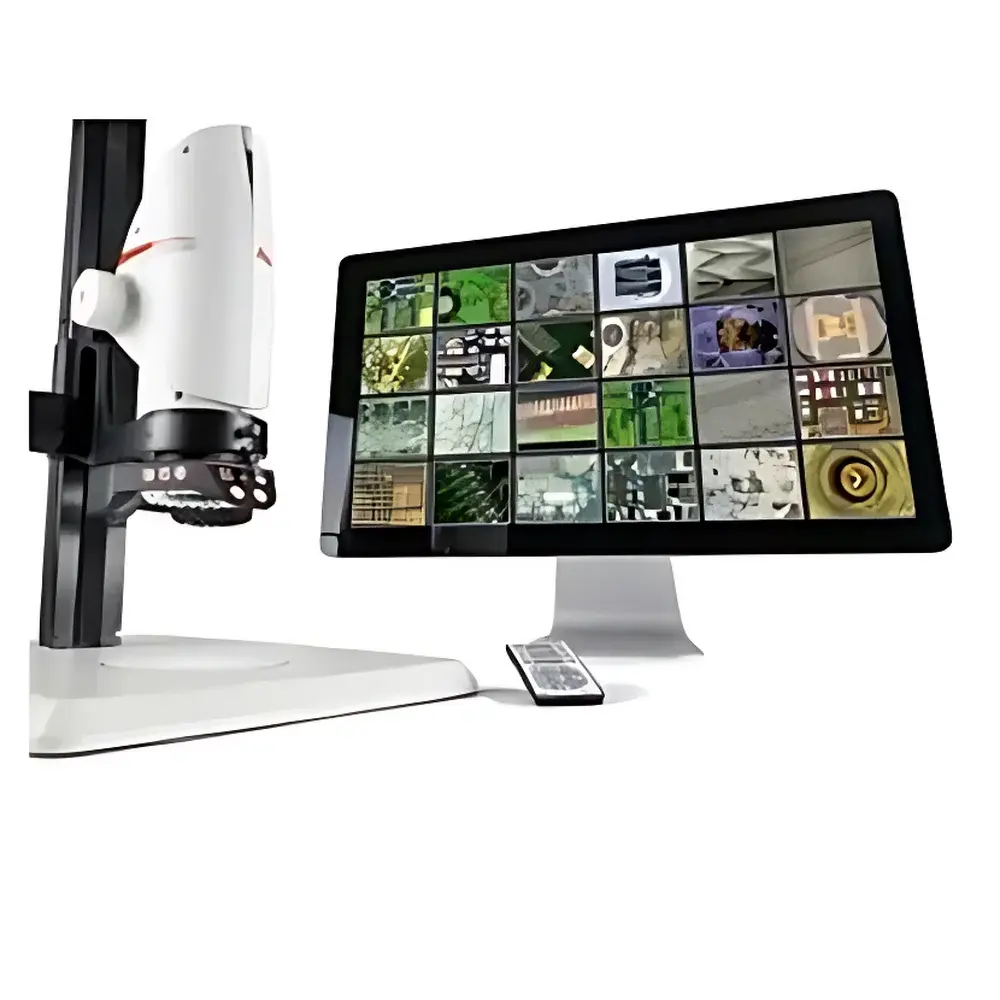
Leica DMS1000 Digital Microscope System
| Brand | Leica |
|---|---|
| Country of Origin | Germany |
| Model | DMS1000 |
| Camera Resolution | 5 MP |
| Frame Rate | up to 30 fps |
| Max Optical Magnification | 300× |
| Output Interface | HDMI |
| Measurement Capability | Encoded Zoom with Auto-Calibrating Scale |
| Standalone Operation | Yes (SD card storage, IR remote control) |
| Optical Design | Telecentric Pathway |
| Software Compatibility | Leica LAS (2D measurement, annotation, reporting) |
| Ergonomic Design | Eyepiece-Free, Display-Centric Workflow |
Overview
The Leica DMS1000 Digital Microscope System is a discontinued but historically significant entry-level industrial digital microscope engineered for precision visual inspection, rapid documentation, and non-contact 2D metrology in quality control, failure analysis, and materials science laboratories. Unlike conventional compound microscopes, the DMS1000 eliminates eyepieces entirely—relying instead on a dedicated telecentric optical pathway coupled with an integrated high-sensitivity CMOS image sensor. This architecture ensures minimal parallax error and consistent magnification scaling across the field of view, a prerequisite for reliable dimensional assessment. The system delivers real-time full-HD (1920 × 1080) video at up to 30 frames per second, enabling dynamic observation of sample manipulation, solder joint formation, or biological specimen behavior without perceptible latency. Its modular design supports both standalone operation via HDMI-connected display and PC-integrated workflows using Leica Application Suite (LAS) software—making it adaptable to environments where IT infrastructure constraints or GLP-compliant audit trails are operational priorities.
Key Features
- Telecentric optical path: Provides constant magnification across depth of field, critical for accurate length, area, and distance measurements without Z-axis correction.
- Encoded zoom lens: Automatically updates scale calibration with each zoom step—enabling traceable, repeatable 2D measurements directly on screen without external calibration routines.
- Integrated 5-megapixel CMOS sensor: Captures high-fidelity static images and full-HD video clips (up to several seconds) stored natively on removable SD cards—no host PC required.
- HDMI-native output: Delivers uncompressed real-time imaging to standard monitors or production line displays, supporting ergonomic viewing positions for extended operator use.
- Infrared remote control interface: Allows intuitive adjustment of capture mode (still/video), exposure, white balance, and freeze-frame functions—minimizing physical interaction with hardware during inspection tasks.
- Ergonomically optimized workflow: Eliminates ocular alignment, interpupillary distance adjustment, and neck strain associated with traditional microscopy—supporting multi-user environments with rapid reconfiguration.
Sample Compatibility & Compliance
The DMS1000 accommodates a broad range of solid, opaque, and semi-reflective specimens—including printed circuit boards, metallographic sections, polymer components, solder joints, and coated substrates—without requiring immersion media or vacuum chambers. Its coaxial LED illumination supports adjustable brightness and contrast optimization for low-reflectivity surfaces. While not certified to ISO/IEC 17025 as a standalone metrology instrument, its encoded zoom system adheres to fundamental principles outlined in ISO 9276-2 (representation of particle size distribution) and ASTM E1558 (standard guide for digital imaging in microscopy). When used with Leica LAS software under controlled validation protocols, the system supports documentation requirements aligned with FDA 21 CFR Part 11 for electronic records and signatures in regulated manufacturing settings.
Software & Data Management
Leica LAS (Leica Application Suite) provides calibrated image acquisition, annotation, report generation, and export functionality compatible with Windows-based workstations. The software enables pixel-to-unit conversion based on encoded zoom position, supports ROI-based measurement (line, angle, circle, polygon), and maintains audit-ready metadata including timestamp, magnification, exposure settings, and operator ID. All captured images and videos retain embedded EXIF-style metadata, facilitating traceability in failure analysis reports. For environments requiring strict data governance, LAS supports folder-based archiving with user-access controls and optional integration into LIMS or ELN platforms via standardized file formats (TIFF, JPEG, AVI, CSV).
Applications
- Electronics manufacturing: Solder paste inspection, component placement verification, and post-reflow defect identification (bridging, tombstoning, voiding).
- Materials failure analysis: Fractography assessment, inclusion mapping, coating thickness estimation, and corrosion morphology documentation.
- Quality assurance labs: First-article inspection, incoming goods verification, and process capability studies requiring quantitative image-based metrics.
- Academic teaching labs: Visual demonstration of microstructural features (e.g., grain boundaries, phase distributions) without shared eyepiece hygiene concerns.
- Maintenance and repair operations: In-field diagnostics of wear patterns, surface damage, or mechanical deformation on large-scale industrial parts.
FAQ
Is the Leica DMS1000 still supported by Leica Microsystems?
No—Leica discontinued the DMS1000 in 2014 and replaced it with the DMS1000 B and later the DMS300 series. Official firmware updates, hardware repairs, and technical support are no longer available from Leica.
Can measurements made with the DMS1000 meet ISO/ASTM traceability requirements?
Measurements are operator-dependent and rely on proper initial calibration using certified reference standards. While the encoded zoom provides repeatability, formal metrological traceability requires documented calibration against NIST-traceable artifacts and periodic verification per ISO/IEC 17025 procedures.
Does the system support third-party software integration?
Yes—the HDMI output allows compatibility with generic video capture tools; however, only Leica LAS fully accesses encoded zoom metadata and auto-scaling functionality.
What is the maximum usable working distance at highest magnification?
At 300× total magnification, the working distance is approximately 42 mm—sufficient for manipulating tools or probes beneath the objective while maintaining focus.
Is the SD card storage encrypted or password-protected?
No—the internal SD card slot uses standard FAT32 formatting with no built-in encryption or access control; data security must be enforced externally via network policies or physical handling protocols.




