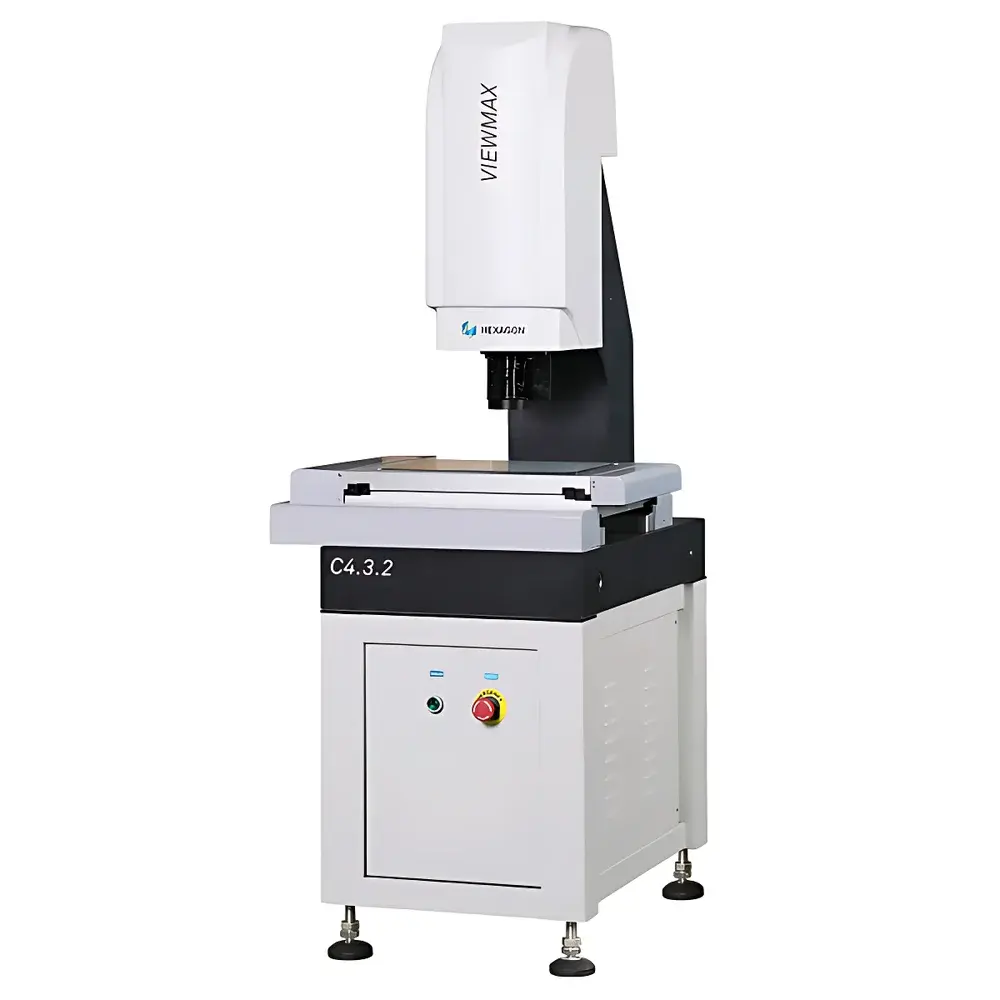
Hexagon Metrology VIEWMAX C Image Measuring Instrument
| Brand | Hexagon |
|---|---|
| Origin | Sweden |
| Model | VIEWMAX C |
| Base Material | Granite |
| Moving Stage | Dual-layer aerospace-grade aluminum |
| Drive System | Precision friction drive (backlash-free) |
| Control System | 3-axis CNC |
| Camera | High-resolution industrial camera |
| Lens | Manual zoom lens (0.7X–4.5X) |
| Illumination | Green LED transmitted light + quad-zone, four-ring adjustable ring light |
| Software | METUS metrology software |
| Optional Probes | MCP tactile probe |
| Optional Sensor | CWS confocal white-light sensor |
| Operating Temperature | 18–22°C |
| Temp. Stability | ≤1°C/h, ≤2°C/24h, ≤1°C/m |
| Humidity | 40–70% RH |
| Power Supply | 220 V ±10%, 50/60 Hz, 1000 VA |
| Grounding Requirement | <4 Ω |
Overview
The Hexagon Metrology VIEWMAX C Image Measuring Instrument is a high-precision, manually operated optical coordinate measuring system engineered for dimensional verification of small- to medium-sized mechanical components in quality control laboratories and production environments. It operates on the principle of non-contact 2D and 3D surface feature measurement using digital image acquisition, edge detection algorithms, and calibrated geometric metrology. The system captures magnified real-time video of parts under controlled illumination, then applies sub-pixel interpolation and spatial calibration models to compute linear dimensions, angles, radii, positions, and form tolerances—including flatness, circularity, and concentricity—per ISO 1101 and ASME Y14.5 standards. Its rigid granite base and thermally stable dual-layer aluminum stage minimize thermal drift and mechanical deformation, ensuring long-term repeatability within micrometer-level uncertainty budgets typical of Class 1 metrology workspaces.
Key Features
- Monolithic granite base and column providing exceptional vibration damping and long-term geometric stability
- Dual-layer aerospace-grade aluminum moving stage with optimized mass distribution and low thermal expansion coefficient
- Backlash-free precision friction drive system delivering smooth, repeatable motion with micron-level positioning accuracy
- Integrated 3-axis CNC controller enabling programmable axis sequencing, edge-triggered measurement routines, and multi-point alignment workflows
- High-resolution industrial CMOS camera with progressive scan capability and low-noise analog-to-digital conversion
- Manually adjustable telecentric zoom lens (0.7X–4.5X) supporting consistent magnification across field-of-view without parallax error
- Dual-mode illumination: green LED transmitted backlight for silhouette edge detection and quad-zone, four-ring surface ring light for directional contrast enhancement on complex geometries
- Real-time on-screen measurement navigation interface overlaying dynamic crosshairs, tolerance bands, and GD&T symbols directly onto live video feed
Sample Compatibility & Compliance
The VIEWMAX C accommodates parts up to 670 mm × 800 mm × 1630 mm (L×W×H) with maximum stage load capacity of 30 kg. It supports metallic, plastic, ceramic, and composite components with reflective, matte, or translucent surfaces—provided adequate contrast is achievable under configured lighting. All hardware and software modules comply with CE marking requirements under the EU Machinery Directive 2006/42/EC and Electromagnetic Compatibility Directive 2014/30/EU. METUS software adheres to audit trail and electronic signature provisions aligned with FDA 21 CFR Part 11 for regulated industries, and supports GLP/GMP-compliant reporting templates traceable to ISO/IEC 17025 calibration records.
Software & Data Management
METUS metrology software serves as the central platform for measurement programming, execution, and reporting. It provides a parametric feature-based programming environment where users define datums, tolerances, and inspection sequences via intuitive graphical workflow editors—not scripting. Measurement data is stored in structured XML-based project files with embedded calibration certificates, environmental logs (temperature/humidity timestamps), and full revision history. Export options include PDF reports with annotated images, CSV/Excel datasets for SPC analysis, STEP AP242 geometry exchange, and direct integration with Hexagon’s PC-DMIS ecosystem for enterprise-wide metrology data consolidation. Audit trails record all user actions—including measurement edits, report generation, and software configuration changes—with time-stamped, immutable entries.
Applications
The VIEWMAX C is routinely deployed for first-article inspection of machined housings, stampings, and injection-molded parts in automotive Tier-1 suppliers; GD&T validation of medical device components such as surgical instrument jaws and implant housings; dimensional release testing of PCB stencils and semiconductor packaging substrates; and incoming inspection of precision gears, bearings, and optical mounts. Its flexibility supports both routine pass/fail checks and detailed process capability studies (Cp/Cpk), especially when combined with optional MCP tactile probes for hybrid contact/non-contact inspection of deep bores or recessed features, or CWS confocal white-light sensors for surface roughness and step-height measurements at nanometer vertical resolution.
FAQ
What is the recommended environmental class for stable operation of the VIEWMAX C?
The instrument requires a temperature-controlled metrology room maintained between 18–22°C, with temporal gradients no greater than 1°C per hour and spatial gradients limited to 1°C per meter. Relative humidity must remain between 40–70% RH.
Is METUS software validated for regulated industries?
Yes—METUS includes configurable 21 CFR Part 11 compliance modules, including electronic signatures, role-based access control, and tamper-evident audit trails required for pharmaceutical, biotech, and medical device manufacturing.
Can the VIEWMAX C perform true 3D surface topography measurements?
With the optional CWS confocal white-light sensor, it achieves sub-micron vertical resolution and supports areal surface texture analysis per ISO 25178; the base optical system is optimized for 2.5D profile and planar geometry measurement.
What maintenance intervals are recommended for long-term accuracy?
Annual recalibration by an accredited metrology service provider is advised; quarterly verification using certified gauge blocks and step gauges is recommended for in-house performance monitoring.
Does the system support automated batch inspection?
Yes—METUS enables batch programming with part recognition via fiducial markers or pattern matching, auto-alignment, and pass/fail decision logic with configurable alarm outputs to PLCs or MES systems.