
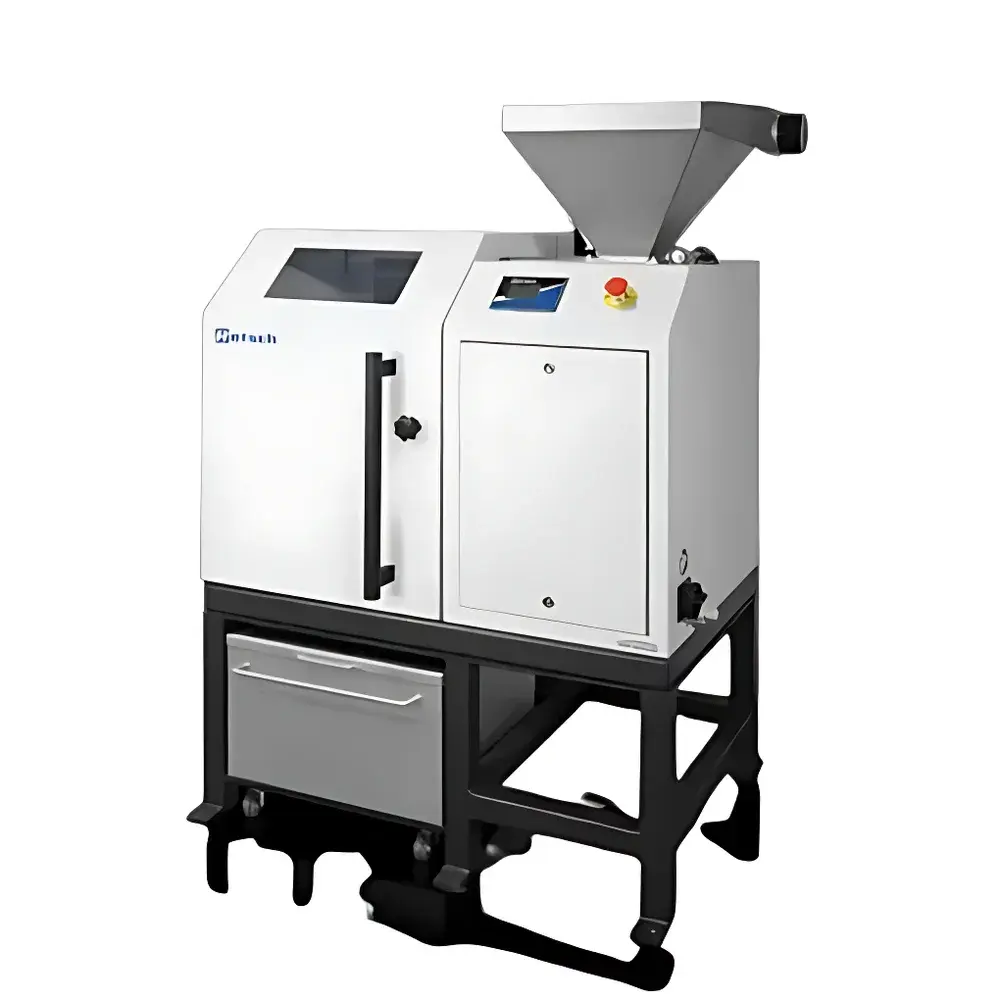
Retsch PT 300 Rotary Sample Divider
| Brand | Retsch |
|---|---|
| Origin | Germany |
| Model | PT 300 |
| Rotational Speed Range | 18–53 rpm |
| Number of Sample Outlets | 4–10 |
| Feed Mechanism | Vibratory Hopper with Push-in Loading Tray |
| Viewing Window | Integrated Illuminated Observation Port |
| Construction | Modular Stainless Steel Architecture |
| Compliance | Designed in Accordance with ISO 14887 and ASTM D6938 for Representative Sampling of Bulk Granular and Powdered Materials |
Overview
The Retsch PT 300 Rotary Sample Divider is an industrial-grade, gravity-fed sample division system engineered for high-reproducibility splitting of bulk granular, powdered, and particulate materials. Based on the principle of rotary sector division—where a rotating drum with equally spaced radial outlets distributes material via gravitational flow—the PT 300 ensures statistically representative sub-sampling without bias from particle segregation or flow channeling. Its design adheres to fundamental sampling theory as defined in ISO 14887 (Soil quality — Guidance on sampling) and ASTM D6938 (Standard Practice for Sampling and Processing In-Place Soils for Geotechnical Testing), making it suitable for laboratories requiring traceable, auditable sample preparation workflows under GLP or ISO/IEC 17025 frameworks.
Key Features
- Modular stainless steel construction with corrosion-resistant surfaces and tool-free access panels for rapid maintenance and validation.
- Adjustable rotational speed (18–53 rpm) enables optimization across diverse material densities, flow characteristics, and particle size distributions—from fine metal powders to coarse aggregates and whole grains.
- Configurable outlet configuration supporting 4 to 10 discrete collection positions, allowing parallel processing of replicate subsamples or sequential fractionation for multi-stage analysis.
- Integrated vibratory feed unit with push-in loading tray ensures consistent mass flow into the rotating divider head, minimizing bridging and funneling effects common in cohesive or heterogeneous feeds.
- Illuminated observation window provides real-time visual verification of material flow dynamics, outlet filling uniformity, and potential blockage events—critical for method qualification and operator training.
- Ergonomic height-adjustable support frame accommodates varying bench configurations and operator requirements, enhancing workflow integration in QC labs, geotechnical facilities, and R&D environments.
Sample Compatibility & Compliance
The PT 300 handles dry, free-flowing to moderately cohesive materials with particle sizes ranging from <100 µm (e.g., flour, catalysts) up to 25 mm (e.g., gravel, roasted coffee beans, mineral slag). It is routinely deployed for sample preparation prior to XRF, ICP-OES, sieve analysis, moisture content determination, and physical property testing. The instrument’s mechanical design and operational parameters comply with internationally recognized sampling standards including ISO 14887, ASTM D6938, and EN 15051 (Characterization of waste — Sampling of solid and liquid waste). Its repeatability performance supports data integrity requirements for regulatory submissions governed by FDA 21 CFR Part 11 when paired with compliant LIMS or ELN systems.
Software & Data Management
The PT 300 operates as a standalone electromechanical device with no embedded software or digital interface. All operational parameters—including speed setting, run duration, and outlet selection—are manually configured via front-panel controls. This architecture eliminates firmware dependencies, reduces cybersecurity exposure, and simplifies IQ/OQ/PQ validation in regulated environments. For traceability, users are advised to document settings and batch identifiers using laboratory notebooks or validated electronic systems. Optional accessories include calibrated sample containers and certified reference material kits for routine performance verification per ISO/IEC 17025 Clause 6.4.3.
Applications
- Preparation of representative subsamples for cement, fly ash, and slag analysis in construction materials QA/QC.
- Homogenization and division of agricultural commodities (grains, seeds, fertilizers) prior to nutritional or contaminant screening.
- Sample conditioning for mining and metallurgical labs handling ore concentrates, sinter fines, and alloy powders.
- Environmental testing laboratories performing soil and sediment characterization in accordance with EPA Method 8081B or ISO 11464.
- R&D facilities developing novel food powders, pharmaceutical excipients, or battery electrode materials requiring strict batch-to-batch consistency.
FAQ
Does the PT 300 require calibration certificates or annual recalibration?
No—calibration is not applicable to the PT 300 as it performs mechanical division without measurement transducers. However, periodic performance verification using certified reference samples is recommended per ISO/IEC 17025 Section 6.4.3.
Can the PT 300 handle moist or slightly agglomerated materials?
It is designed for dry, free-flowing materials. Slight cohesion may be managed via optimized vibration amplitude and reduced rotational speed; however, sticky or damp samples require pre-drying or alternative division methods such as riffle splitters.
Is the PT 300 compatible with automated lab systems or robotic arms?
While the PT 300 lacks native automation interfaces, its modular footprint and standardized outlet geometry allow integration with third-party sample handling robots using custom mounting fixtures and programmable logic controllers.
What cleaning protocols are recommended between sample types?
All wetted surfaces are accessible without tools. Cleaning is performed using lint-free wipes, compressed air, and, where necessary, ethanol or isopropanol rinses—validated per laboratory SOPs to prevent cross-contamination.
Does Retsch provide installation qualification (IQ) documentation?
Yes—Retsch supplies a comprehensive User Manual containing mechanical specifications, dimensional drawings, electrical safety certifications (CE, UL), and a template for IQ/OQ execution aligned with GAMP 5 guidelines.



