
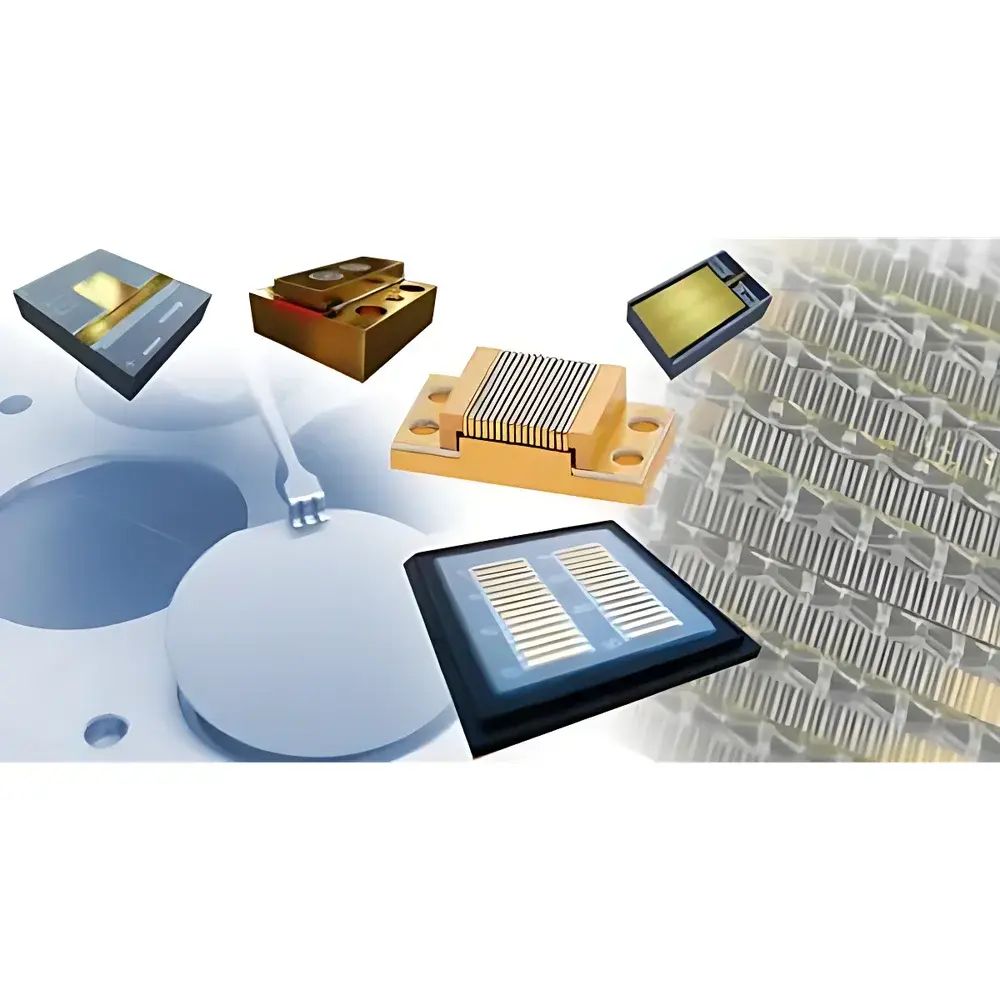
Modulight Free-Space Laser Diodes – Chip, Bar, and TO-Can Mounted Laser Sources
| Brand | Modulight |
|---|---|
| Origin | Finland |
| Laser Type | Solid-State / Semiconductor |
| Wavelength Range | 400–2000 nm |
| Output Power Range | 0.1 mW – 300 W |
| Packaging Options | TO-Can, C-Mount, CS-Mount |
| Laser Structures | FP, DFB, BA (Broad-Area), IAB (Individually Addressable Bar) |
| Operation Modes | CW and Pulsed |
| Compliance | RoHS, REACH, ISO 9001-certified manufacturing |
Overview
Modulight free-space laser diodes are high-reliability, in-house designed and manufactured semiconductor laser sources engineered for precision optical instrumentation, fiber-optic test & measurement, telecommunications, industrial pumping, and scientific research. Built on Modulight’s vertically integrated semiconductor fabrication platform in Espoo, Finland, these lasers leverage proprietary epitaxial growth, chip processing, and packaging technologies to ensure exceptional wavelength stability, power consistency, and long-term operational integrity. Unlike off-the-shelf components, Modulight’s free-space emitters are optimized for direct integration into optical benches, collimation systems, and custom optomechanical assemblies—eliminating coupling losses associated with fiber-pigtailed alternatives. The core architecture adheres to fundamental semiconductor laser physics: edge-emitting heterostructure designs (FP, DFB, BA) operating under stimulated emission in the 400–2000 nm spectral window, with thermal management and drive electronics compatibility validated per IEC 60825-1 for Class 3B/4 laser safety compliance.
Key Features
- Vertically integrated design-to-packaging capability: Full control over MOCVD epitaxy, wafer processing, facet passivation, and hermetic packaging ensures traceability and reproducibility across batches.
- Multi-wavelength portfolio: Discrete chips and mounted devices spanning visible (632–690 nm), NIR (795–905 nm), telecom O-band (1310 nm), E-band (1490 nm), S/C/L-bands (1550–1650 nm), and extended IR up to 2000 nm.
- Application-optimized emitter architectures: Single-mode Fabry–Pérot (FP) chips for OTDR and interferometry; distributed feedback (DFB) lasers for narrow-linewidth datacom transceivers; broad-area (BA) emitters for high-power pumping and illumination; and individually addressable bars (IAB) for spatially modulated applications such as laser printing and structured light projection.
- Flexible mounting configurations: TO-3, TO-56, TO-9, and custom TO-can variants; industry-standard C-mount and CS-mount packages with integrated thermistor and TEC options; unmounted die for OEM hybrid integration.
- Robust reliability testing: All devices undergo burn-in, temperature cycling (−40°C to +85°C), and accelerated life testing per Telcordia GR-468-CORE, supporting >100,000 hours MTTF in controlled environments.
Sample Compatibility & Compliance
Modulight free-space lasers are compatible with standard optomechanical platforms including kinematic mounts, lens tubes, beam expanders, and collimators from Thorlabs, Newport, and Edmund Optics. Chip-level devices support wire bonding on ceramic or copper substrates with AuSn or In solder reflow profiles. Mounted variants comply with JEDEC J-STD-020 moisture sensitivity level (MSL) classifications and meet RoHS Directive 2011/65/EU and REACH Regulation (EC) No. 1907/2006. Manufacturing processes are certified to ISO 9001:2015, and product documentation includes full traceability of wafers, lots, and test reports. For regulated environments—including medical device development and aerospace subsystems—laser modules can be supplied with full GLP-aligned test records and optional FDA 21 CFR Part 11–compliant electronic audit trails upon request.
Software & Data Management
While Modulight free-space lasers operate as analog optical sources requiring external drivers, the company provides comprehensive technical documentation essential for system-level integration: L-I-V (light-current-voltage) curves, spectral width vs. temperature plots, far-field divergence maps (fast/slow axis), and thermal resistance coefficients (Rth) for each part number. All datasheets include calibrated measurement conditions (e.g., 25°C heatsink temperature, pulsed vs. CW duty cycle definitions). For customers developing automated test equipment (ATE), Modulight supplies SPICE-compatible behavioral models for FP and DFB chips and supports custom characterization via its Application Support Lab in Finland—including spectral analysis using Yokogawa AQ6370D optical spectrum analyzers and beam profiling with Ophir NanoScan systems. Traceable calibration certificates (NIST-traceable power meters) are available per order.
Applications
- Fiber-optic test & measurement: High-stability FP chips (e.g., ML1408 @ 1310 nm, 100 mW) serve as broadband sources in OTDR systems; DFB variants (e.g., ML1005 @ 1490 nm, 6 mW) enable precise wavelength-division multiplexing (WDM) channel characterization.
- Telecommunications: DFB lasers qualified to GR-468-CORE operate at 2.5 Gb/s to 3.125 Gb/s modulation speeds for passive optical network (PON) upstream transmitters and optical time-domain reflectometers.
- Industrial materials processing: Broad-area emitters (e.g., ML1524 @ 635 nm, 500 mW; ML1112 @ 905 nm, 8 W) provide pump energy for solid-state lasers and direct-diode sintering in additive manufacturing.
- Biophotonics & sensing: Low-noise 1470 nm and 1550 nm chips (ML1941, ML1543) enable non-invasive tissue ablation and gas detection via tunable diode laser absorption spectroscopy (TDLAS).
- Scientific instrumentation: High-power laser bars (e.g., ML1277 @ 808 nm, 100 W) are used in ultrafast amplifier pumping; IAB configurations support programmable illumination in confocal microscopy and digital holography setups.
FAQ
Are Modulight free-space lasers compliant with international laser safety standards?
Yes. All devices are classified per IEC 60825-1:2014 and labeled with appropriate Class 3B or Class 4 warnings. Full safety documentation—including accessible emission limits (AEL), nominal ocular hazard distance (NOHD), and required engineering controls—is provided in the Technical Safety Manual for each product family.
Can Modulight support custom wavelength or power specifications not listed in standard datasheets?
Yes. As a fabless semiconductor manufacturer with internal epitaxial growth and processing, Modulight offers custom wafer design, mask layout, and process tuning for wavelengths between 400 nm and 2000 nm, output powers up to 300 W (bar level), and specialized spectral bandwidth or polarization requirements.
What thermal management guidance is provided for high-power bar mounting?
Detailed mechanical drawings specify clamping force, torque values, and interface flatness tolerances. Thermal interface material recommendations (e.g., Indium foil, graphite pads) and heatsink base temperature derating curves are included in the Mounting & Handling Guide for each bar series.
Is there support for integrating these lasers into automated production lines?
Yes. Modulight provides tape-and-reel packaging for chip-on-carrier (CoC) formats, machine vision fiducials for pick-and-place alignment, and ATE-compatible test protocols with pass/fail thresholds aligned to IPC-A-610 acceptance criteria.




