
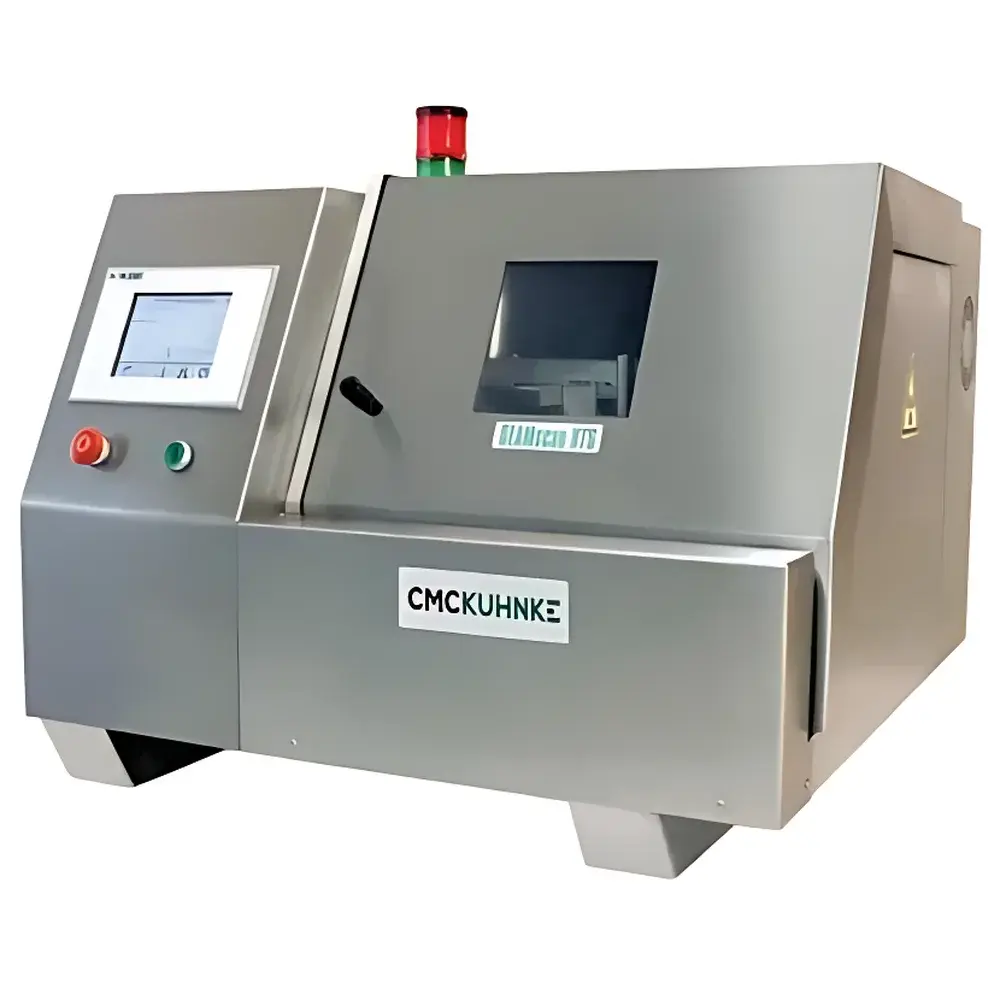
CMC KUHNKE XTS Non-Destructive Double Seam Inspection System
| Brand | CMC KUHNKE |
|---|---|
| Origin | Germany |
| Model | XTS |
| Power Supply | 100–240 VAC, 50/60 Hz |
| Dimensions (W×D×H) | 760 × 850 × 650 mm |
| Weight | Not specified |
| Max. Can Height | 240 mm |
| Min. Can Height | 40 mm |
| Max. Can Diameter | 153 mm |
| Min. Can Diameter | 40 mm |
| Structural Dimension Resolution | ±0.001 mm |
| Structural Dimension Accuracy | ±0.01 mm |
| Seam Tightness Resolution | ±1% |
| Seam Tightness Accuracy | ±5% |
| Radiation Dose Rate | <0.1 mSv/year (TÜV Rheinland certified) |
| Interface | Ethernet, ASCII, SQL database |
| Supported Languages | English, German, Chinese, Dutch, Spanish, Japanese |
| Compliance | FDA 21 CFR Part 11 (audit trail & electronic signature ready), ASTM F1947–23 (Standard Practice for X-ray Imaging of Double Seams), ISO 1133–2 (for packaging integrity reference), GLP/GMP-aligned workflow architecture |
Overview
The CMC KUHNKE XTS Non-Destructive Double Seam Inspection System is an industrial-grade X-ray metrology platform engineered for precise, repeatable, and fully non-invasive evaluation of double seam integrity in metal food and beverage containers. Unlike destructive pull-tab or resistance testing methods, the XTS employs high-resolution digital radiography to generate cross-sectional tomographic projections of the entire seam geometry — including body hook, cover hook, overlap, tightness, and wrinkle morphology — without compromising can integrity. The system operates on the principle of differential X-ray attenuation: variations in material density and thickness across the seam region produce quantifiable grayscale contrast in the acquired image, which is algorithmically segmented and measured against traceable calibration standards. Designed for both laboratory validation and inline integration, the XTS delivers metrologically traceable data compliant with global regulatory expectations for packaging quality assurance.
Key Features
- True non-destructive inspection: Zero sample consumption; 100% of production units remain viable for distribution after testing.
- Full 360° circumferential seam mapping: Captures radial variation in hook engagement, overlap length, and tightness index at 0.5° angular resolution.
- Automated defect recognition engine: Identifies and classifies weld seams (three-piece cans), “dimples” (bottom panel buckling), and pull-tab openings using adaptive edge-detection and morphological filtering.
- TÜV Rheinland–certified radiation safety: Enclosed lead-shielded chamber with interlocked viewing window and automatic door; annual effective dose <0.1 mSv — well below ICRP occupational limits.
- Self-calibrating measurement architecture: Includes NIST-traceable step gauges and reference phantoms; validation mode enables daily operational qualification per ISO/IEC 17025 requirements.
- Dual-mode deployment: Configurable as a benchtop lab unit (ASTM F1947-compliant verification) or integrated into high-speed production lines via Ethernet/IP or Modbus TCP.
- Robust R&R performance: Repeatability <2.1% and reproducibility <3.4% (per AIAG MSA v4 guidelines) across operator, shift, and instrument variables.
Sample Compatibility & Compliance
The XTS accommodates all standard two- and three-piece metal cans used in ambient-stable food, beverage, pet food, and pharmaceutical packaging — including but not limited to DRD, DWI, and composite laminate formats. It supports can diameters from 40 mm to 153 mm (109–603 US can codes) and heights from 40 mm to 240 mm (1.5–9.5 in). All measurement algorithms are aligned with FDA guidance for double seam evaluation (FDA Technical Bulletin No. 2020-01), ASTM F1947–23 (Standard Practice for Radiographic Examination of Double Seams), and ISO 1133–2 (Plastics – Determination of Melt Mass-Flow Rate — Part 2: Materials Sensitive to Thermal Degradation, referenced for thermal stability of seal integrity under sterilization conditions). System firmware includes configurable audit trails, electronic signatures, and role-based access control to satisfy 21 CFR Part 11 requirements for regulated environments.
Software & Data Management
The XTS runs on a real-time Linux-based imaging OS with embedded vision libraries optimized for low-latency X-ray processing. Its proprietary SeamIQ™ software provides a dual-interface environment: a technician-facing GUI for manual review and annotation, and an API-accessible backend supporting ASCII log export, SQL database insertion (ODBC/JDBC), and RESTful webhooks for MES/SCADA integration. Measurement reports include full metadata (timestamp, operator ID, calibration status, environmental temperature/humidity), raw DICOM-compatible images, and statistical summaries (X̄–R charts, Cp/Cpk indices). All data is stored with SHA-256 hashing and immutable timestamping to ensure ALCOA+ compliance (Attributable, Legible, Contemporaneous, Original, Accurate, Complete, Consistent, Enduring, Available).
Applications
- Pre-sterilization seam validation in retort and aseptic filling lines.
- Root cause analysis of seam-related spoilage incidents (e.g., microbial ingress, vacuum loss).
- Supplier qualification and incoming inspection of contract-manufactured cans.
- Process capability studies during new line commissioning or can design changeovers.
- Regulatory submission support: Generating auditable datasets for FDA, EFSA, or Health Canada packaging dossiers.
- Failure mode and effects analysis (FMEA) of seaming equipment wear patterns over time.
FAQ
Does the XTS require radioactive source licensing?
No. The XTS uses a sealed, low-power microfocus X-ray tube (≤50 kVp) classified as a “radiation-generating device” under IAEA SSG-46; no radioactive isotopes are employed.
Can the system be validated for GMP environments?
Yes. IQ/OQ/PQ protocols are provided; the system supports 21 CFR Part 11-compliant electronic records and signatures when deployed with validated IT infrastructure.
Is third-party certification available for measurement traceability?
Yes. CMC KUHNKE provides optional UKAS-accredited calibration certificates (ISO/IEC 17025) for dimensional and tightness measurement modules.
What maintenance intervals are recommended?
Annual preventive maintenance by certified field service engineers; quarterly internal verification using supplied reference standards is advised.
How does the XTS handle can orientation variability?
The system uses machine vision–guided servo positioning to auto-align can centerline and rotational axis prior to scanning, eliminating operator-dependent setup error.







