
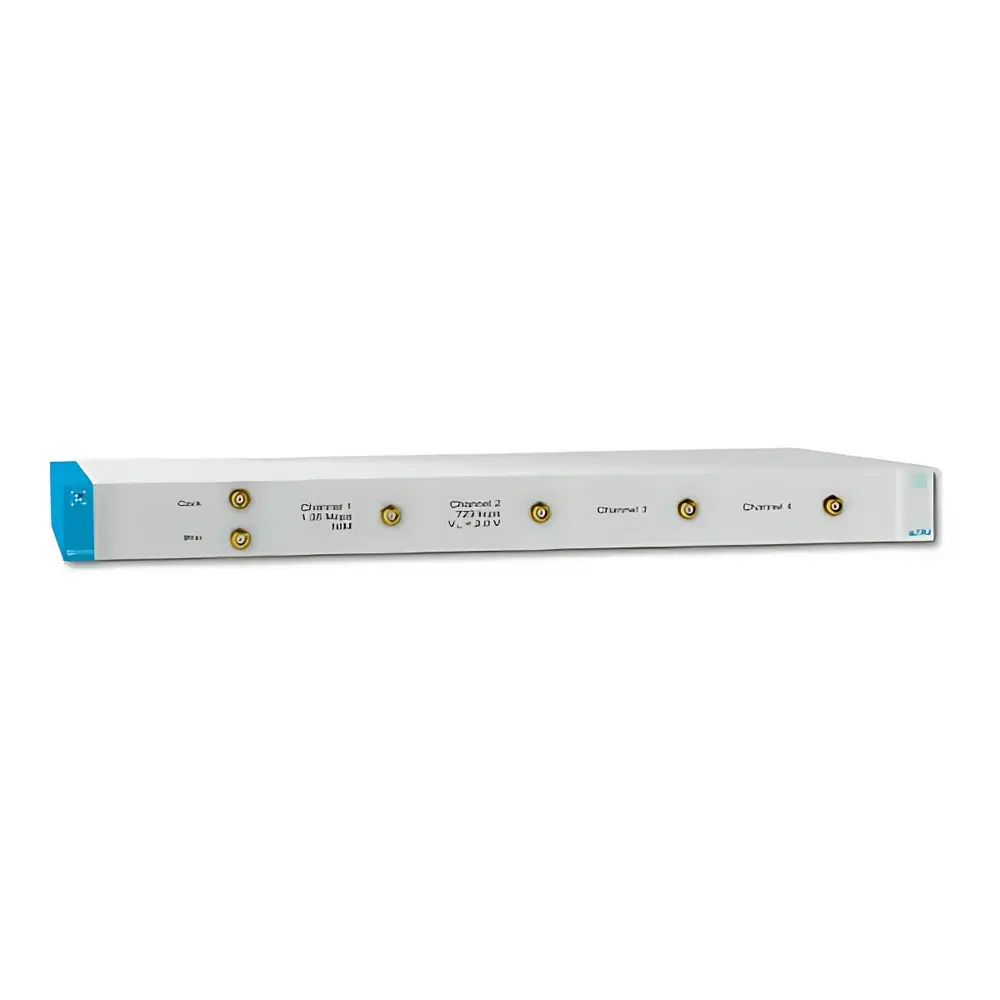
Auniontech TDC-TCSPC Quad-Channel High-Performance Time-Correlated Single-Photon Counting System
| Brand | Auniontech |
|---|---|
| Origin | Shanghai, China |
| Model | TDC-TCSPC |
| Timing Resolution (RMS) | < 10 ps |
| Timing Resolution (FWHM) | < 25 ps |
| Bin Width | 1 ps |
| Input Channels | 4 Stop + 1 Start (configurable) |
| Max Event Rate per Channel | 25 Mcps |
| Aggregate Max Event Rate (All Channels) | 100 Mcps |
| Threshold Range | −2 V to +3 V |
| Threshold Resolution | 1.22 mV |
| Input Impedance | 50 Ω |
| Edge Detection | Rising/Falling |
| Delay Range | −100 ns to +100 ns |
| Delay Resolution | 1 ps |
| Input Connectors | SMA |
| Max Acquisition Time | 213 days |
| Synchronization | Up to 4 units via 10 MHz external clock |
| Compliance | GLP/GMP-ready architecture with timestamp integrity and audit-trail-capable software logging |
Overview
The Auniontech TDC-TCSPC is a quad-channel time-correlated single-photon counting (TCSPC) system engineered for ultra-high temporal resolution in quantum optics, fluorescence lifetime imaging (FLIM), and quantum information experiments. Based on time-to-digital conversion (TDC) architecture with constant-fraction discrimination and FPGA-accelerated timestamping, the system delivers sub-10 ps RMS timing jitter—enabling precise reconstruction of photon arrival distributions at picosecond-scale binning. Its core functionality centers on recording precise timestamps of individual photon detection events relative to a synchronous start signal (e.g., laser pulse or reference trigger), forming the foundation for lifetime decay curve fitting, second-order intensity correlation analysis (g(2)(τ)), and coincidence logic in Hanbury Brown–Twiss (HBT) configurations. Designed for laboratory integration rather than turnkey operation, the TDC-TCSPC supports deterministic, low-latency data acquisition with hardware-level filtering and real-time timestamp compression—minimizing USB bandwidth overhead while preserving full temporal fidelity.
Key Features
- Four independent stop input channels plus one configurable start channel—each capable of operating as either start or stop, enabling up to five fully symmetric inputs when required.
- Timing resolution of <10 ps (RMS) and <25 ps (FWHM), with 1 ps histogram binning capability for high-fidelity decay curve reconstruction.
- Programmable threshold comparator per channel (−2 V to +3 V range, 1.22 mV resolution) with selectable rising/falling edge detection and 50 Ω termination.
- Maximum sustained event rate of 25 Mcps per channel; aggregate throughput up to 100 Mcps across all four stop channels.
- On-device digital filtering including virtual channels, coincidence windows, and dead-time emulation—executed in FPGA prior to host transfer to reduce host-side processing load.
- Multi-unit synchronization support: up to four TDC-TCSPC units can be phase-locked using a common 10 MHz reference clock, enabling scalable expansion to 16 synchronized stop channels with shared timebase and sub-nanosecond inter-unit skew.
- Flexible clocking: accepts external clock inputs from 1 MHz to 100 MHz, allowing compatibility with diverse pulsed laser sources and RF-synchronized detection schemes.
Sample Compatibility & Compliance
The TDC-TCSPC interfaces directly with standard photodetectors (e.g., SPADs, MCP-PMTs, SiPMs) delivering TTL/NIM-compatible output signals. Its wide dynamic input range (−2 V to +3 V) accommodates both fast-rising avalanche pulses and slower analog-derived triggers without external amplification. The system adheres to fundamental requirements for traceable metrology in regulated environments: timestamp integrity is preserved through deterministic hardware timestamping with no software-induced latency; acquisition logs include embedded UTC-synchronized metadata when used with GPS-disciplined clocks. While not certified for clinical use, its architecture supports GLP/GMP-aligned workflows—including full audit trails, user-access controls, and raw timestamp export in HDF5/ASCII formats—facilitating validation under ISO/IEC 17025 or FDA 21 CFR Part 11-compliant software environments.
Software & Data Management
Native software suite includes three modular applications: Lifetime Analyzer (for mono-/multi-exponential decay fitting using iterative reconvolution and χ² minimization), Correlation Studio (for g(2)(τ) computation with configurable binning, background subtraction, and normalization), and TimeTagger Control (for real-time configuration, live histogramming, and hardware-level filter programming). All applications export timestamp lists in standardized formats (e.g., .tttr, .ptu) compatible with third-party analysis platforms such as SymPhoTime, MATLAB, Python (via tttrlib), and Origin. Raw data streams are buffered in onboard RAM and streamed over USB 3.0 with zero-copy DMA transfers; optional firmware upgrades enable direct integration with LabVIEW and Python APIs (PyTDC) for custom automation and closed-loop control systems.
Applications
- Quantum Optics: HBT interferometry, antibunching verification, entanglement characterization, and Bell inequality testing.
- Fluorescence Lifetime Imaging (FLIM): Time-domain FLIM in confocal, multiphoton, and widefield modalities; lifetime-based FRET sensing and microenvironment mapping.
- LIDAR & Time-of-Flight Sensing: Single-photon depth profiling with picosecond timing precision for atmospheric monitoring and autonomous navigation R&D.
- STED & Super-Resolution Microscopy: Gating and time-gated detection for background suppression and temporal unmixing in stimulated emission depletion systems.
- Single-Photon Source Characterization: Purity assessment (g(2)(0) < 0.5), photon indistinguishability evaluation, and heralding efficiency measurement.
- Fluorescence Correlation Spectroscopy (FCS): Autocorrelation and cross-correlation analysis of diffusing species with sub-microsecond temporal resolution.
FAQ
What is the maximum sustained count rate per channel?
Each stop channel supports up to 25 million counts per second (Mcps) with <1% differential/integral nonlinearity (DNL/INL).
Can the start channel be repurposed as a stop channel?
Yes—the start input is functionally identical to stop channels and can be reconfigured in firmware to operate as a fifth stop channel.
Is multi-device synchronization supported out of the box?
Synchronization of up to four units requires the optional External Clock Sync Expansion module and a stable 10 MHz reference source.
Does the system support real-time coincidence filtering?
Yes—coincidence windows, anti-coincidence logic, and virtual channel routing are implemented in FPGA and applied before data transfer.
What file formats are supported for raw timestamp export?
Standard formats include PTU (PicoQuant), TTTR (TimeTagger), and plain ASCII/HDF5 with metadata headers for traceability and reproducibility.




