
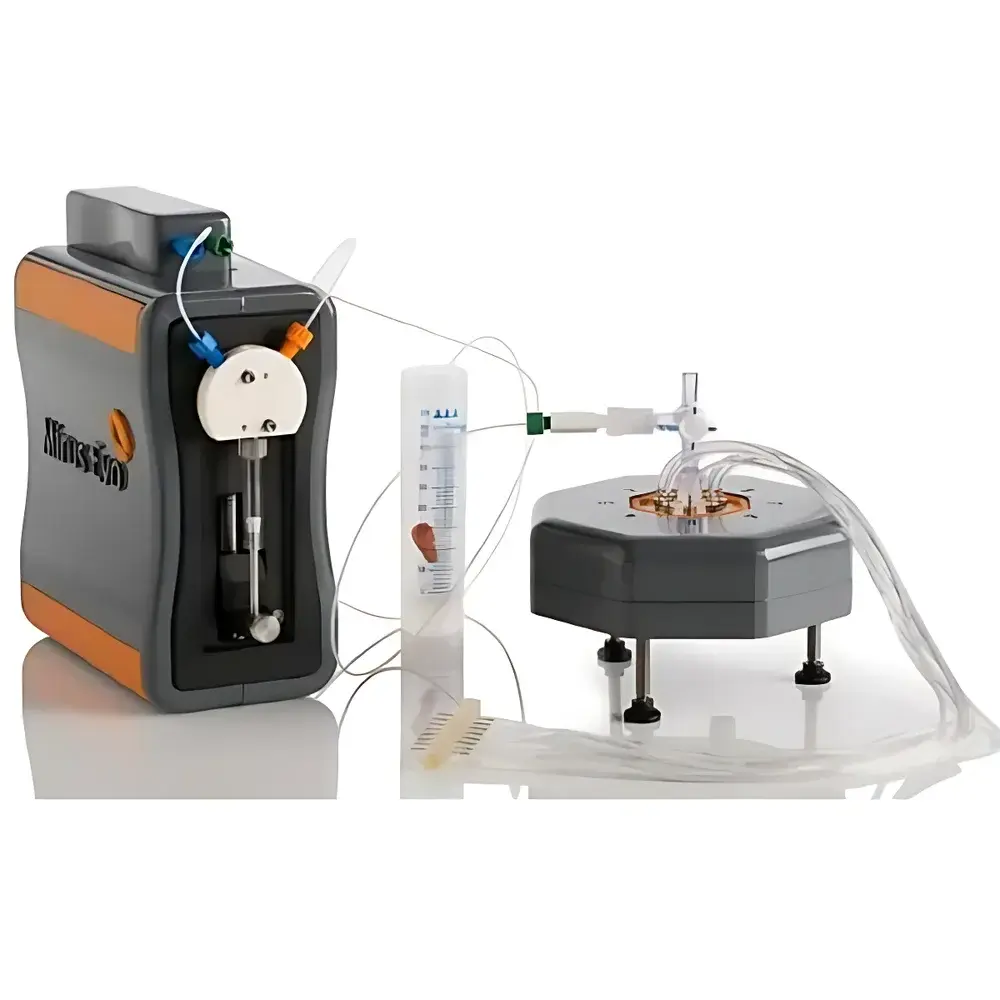
Cellix VenaFlux Microfluidic Pressure Pump System
| Brand | Cellix |
|---|---|
| Origin | Ireland |
| Model | VenaFlux Series (e.g., VenaFlux Pro, VenaFlux Dual) |
| Flow Rate Range | 100 nL/min – 20 µL/min |
| Dynamic Response Time | ≤30 ms |
| Control Modes | Constant, Ramp, Step, Sine, and Custom Waveforms |
| Software Integration | LabVIEW, C++, Python, VenaFLUXAssay (native), iKima (for Kima Circulation Pumps) |
| Multi-Channel Capability | Up to 8 independent channels (with Multiflow8 module) |
| Compliance | Designed for GLP-compliant microphysiological system operation |
| Operating Environment | Compatible with standard CO₂ incubators (37 °C, 5% CO₂, >95% RH) |
| Regulatory Context | Supports FDA 21 CFR Part 11–ready audit trails when deployed with validated software configurations |
Overview
The Cellix VenaFlux Microfluidic Pressure Pump System is an engineered precision instrument designed for quantitative shear stress delivery and programmable flow control in microphysiological systems. Based on closed-loop piezoelectric pressure regulation coupled with real-time volumetric feedback from integrated thermal mass-flow sensors, the VenaFlux platform delivers non-pulsatile, laminar flow across nanoliter-to-microliter per minute ranges—enabling reproducible hydrodynamic stimulation of endothelial monolayers, circulating cells, and 3D tissue constructs. Unlike peristaltic or syringe-based actuators, this system eliminates mechanical pulsatility and backflow artifacts, making it suitable for long-duration (>72 h), uninterrupted perfusion experiments under physiologically relevant shear profiles (0.1–20 dyn/cm²). Its architecture conforms to ISO/IEC 17025-aligned calibration traceability protocols and supports integration into ISO 13485–certified device development workflows.
Key Features
- Sub-30 ms dynamic response time ensures rapid adaptation to programmed waveform transitions—critical for mimicking transient hemodynamic events such as arterial pulse waves or inflammatory leukocyte arrest.
- Nanofluidic precision: stable output down to 100 nL/min with <±2% full-scale repeatability over 24 h, verified per ASTM D7617 (standard practice for microfluidic flow rate verification).
- Multi-mode programmability: user-defined waveforms—including constant, linear ramp, discrete step, sinusoidal, and composite sequences—executed via deterministic timing engines with microsecond-level synchronization.
- Modular scalability: seamless integration with Multiflow8 manifold for parallelized 8-channel independent flow control, each with dedicated pressure transduction and auto-zeroing capability.
- Dual-platform software support: native VenaFLUXAssay GUI for assay setup and real-time monitoring; SDK-level access via LabVIEW, Python (PyVena), and C++ APIs for custom automation and LIMS interfacing.
- Incubator-ready hardware design: fully sealed, low-EMI electronics rated for continuous operation inside standard humidified CO₂ incubators without condensation risk or thermal drift compensation.
Sample Compatibility & Compliance
The VenaFlux system is validated for use with aqueous buffers, cell culture media (including serum-containing formulations), heparinized whole blood analogs, and low-viscosity organic solvents (e.g., DMSO ≤10% v/v). All wetted materials comply with USP Class VI biocompatibility standards and ISO 10993-5 cytotoxicity requirements. When operated with VenaFLUXAssay v3.2+ under controlled configuration management, the system satisfies ALCOA+ data integrity principles and supports 21 CFR Part 11 compliance through electronic signatures, role-based access control, and immutable audit trails. It is routinely deployed in laboratories adhering to OECD TG 497 (in vitro thrombosis models) and ISO/TS 21505 (microphysiological system characterization).
Software & Data Management
VenaFLUXAssay provides a validated, GxP-supportable interface featuring protocol templating, automated calibration logging, and CSV/TDMS export with embedded metadata (timestamp, operator ID, sensor serial, environmental logs). The optional iKima software suite extends functionality to multi-pump orchestration—enabling synchronized start/stop, inter-pump delay sequencing, and cross-device flow balancing for complex organ-on-chip cascades. All software versions undergo annual regression testing against NIST-traceable flow standards and are distributed with formal validation documentation packages (IQ/OQ/PQ templates included).
Applications
- Thrombosis modeling: quantitative assessment of platelet adhesion/aggregation under defined wall shear rates (0.5–15 dyn/cm²) on collagen/vWF-coated surfaces.
- Leukocyte trafficking assays: real-time imaging of neutrophil rolling, firm adhesion, and transmigration across TNFα-activated HUVEC monolayers under pathophysiological shear gradients.
- Organoid perfusion: maintenance of intestinal, hepatic, or neural organoids in microfluidic chips with physiologically matched interstitial flow (0.1–1 µL/min) and nutrient gradient establishment.
- Microreactor chemistry: precise reagent metering in droplet-based synthesis, enzymatic cascade reactions, and electrochemical detection platforms requiring stoichiometric flow ratios.
- Single-cell analysis: integration with microfluidic sorters and impedance cytometers for shear-controlled loading, lysis, and barcoded RNA capture workflows.
FAQ
What is the maximum operating pressure range of the VenaFlux pump?
The standard VenaFlux Pro operates up to 800 kPa (116 psi); high-pressure variants support up to 2 MPa for viscous polymer solutions or high-resistance chip architectures.
Can the system be validated for GMP manufacturing environments?
Yes—Cellix provides vendor-supplied IQ/OQ documentation, calibration certificates traceable to NPL (UK), and change control records compatible with Annex 11 and EU GMP Annex 15 frameworks.
Is remote monitoring supported during long-term perfusion experiments?
All models include Ethernet and USB-C connectivity; live sensor telemetry and alarm states can be streamed to SCADA systems or cloud-hosted dashboards via MQTT or RESTful API endpoints.
How does the VenaFlux differ from syringe pump-based microfluidic controllers?
Unlike displacement-based actuators, VenaFlux regulates pressure directly—eliminating compliance-induced lag, plunger stiction errors, and dead-volume variability inherent in syringe systems.
Are replacement flow sensors and calibration kits available separately?
Yes—NIST-traceable thermal mass-flow sensors (part no. VF-SNSR-100nL) and quarterly calibration kits (VF-CAL-KIT) are stocked globally with 48-h shipping from Dublin and Singapore distribution centers.





