
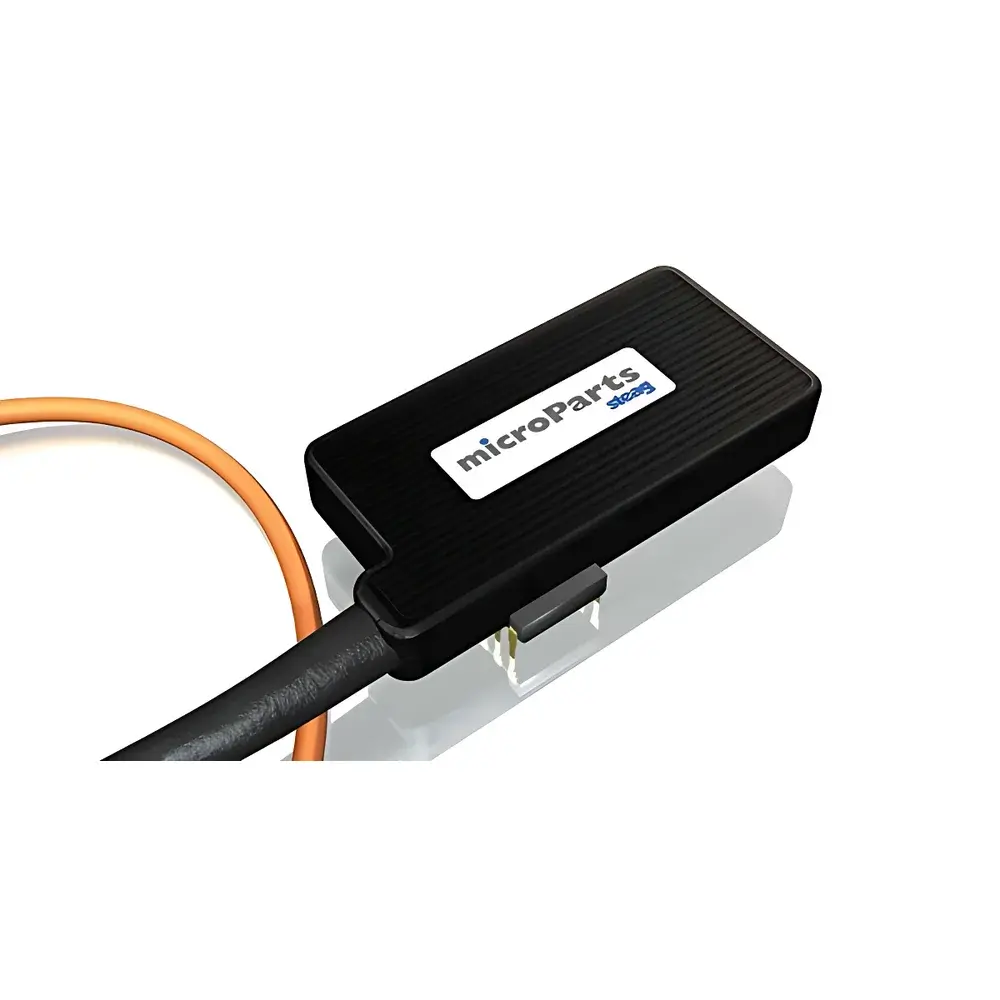
INSION UV/VIS/NIR Fiber Optic Spectrometer
| Origin | Germany |
|---|---|
| Manufacturer Type | Authorized Distributor |
| Origin Category | Imported |
| Model | UV/VIS/NIR-Spectrometer |
| Spectral Range | 350–850 nm |
| Detector Type | CMOS-based Monolithic Optical Chip |
| Resolution | <10 nm (typ. 8.5 nm) |
| Sensitivity | >65 E12 cts·nm/W·s (typ. 110 E12 cts·nm/W·s) |
| Signal-to-Noise Ratio | ≥5000 at T<sub>integration</sub> = 2 ms |
| Dynamic Range | 900–1700 nm |
| Stray Light | 3.5 nm/pixel |
| Operating Temperature | 0–45 °C |
| Storage Temperature | −40–60 °C |
| Slit Dimensions | 60 µm × 300 µm |
| Interface | USB Type-B, RS232 |
| Power Supply | 5 V DC, ripple <50 mV |
| Max. Power Consumption | 7.5 W |
| Dimensions (L×W×H) | 108 × 76.6 × 21.5 mm³ |
| Weight | 130 g |
Overview
The INSION UV/VIS/NIR Fiber Optic Spectrometer is a monolithic, chip-integrated optical spectrometer engineered for high-reliability field deployment and industrial integration. Unlike conventional benchtop or modular fiber-coupled spectrometers relying on discrete optical alignment, this instrument implements all core optical components—including collimating grating, focusing optics, and detector array—on a single silicon substrate using deep-UV lithography and wafer-level microfabrication. This one-chip architecture eliminates mechanical drift, thermal misalignment, and vibration-induced spectral shift, enabling true long-term wavelength stability without periodic recalibration. The device operates across three spectral bands: ultraviolet (350–400 nm), visible (400–850 nm), and near-infrared (900–1700 nm), with seamless coverage enabled by dual-detector configuration and optimized grating dispersion design. Its measurement principle is based on fixed-grating, linear-array detection with pixel-wise spectral calibration embedded during wafer fabrication—ensuring traceable, reproducible spectral response across production batches.
Key Features
- Monolithic optical engine: All optical functions integrated onto a single silicon chip; no glued lenses, no air gaps, no alignment-sensitive mounts.
- Lifetime calibration stability: Thermal wavelength drift <0.03 nm/K; no field recalibration required over full operating temperature range (0–45 °C).
- Robust mechanical performance: Shock resistance up to 50 g (half-sine, 11 ms); vibration immunity validated per IEC 60068-2-64 (random vibration, 10–2000 Hz).
- Compact footprint & low power: 108 × 76.6 × 21.5 mm³ form factor; 130 g mass; powered via standard 5 V USB interface with <7.5 W consumption.
- Industrial-grade compliance: Designed and manufactured under ISO 9001:2015 and ISO 13485:2016 quality management systems; CE-marked for EMC and LVD conformity.
- Plug-and-play interfacing: Native USB Type-B and RS232 support; compatible with Windows, Linux, and real-time OS environments via vendor-provided SDK and HAL abstraction layer.
Sample Compatibility & Compliance
This spectrometer is designed for fiber-optic coupling only, accepting standard SMA-905 terminated fibers with 300/330 µm core diameter and NA = 0.22. It supports both reflection and transmission configurations when paired with appropriate sampling accessories (e.g., bifurcated probe, integrating sphere, flow cell). The 60 µm × 300 µm entrance slit enables optimal throughput–resolution trade-off for diffuse or low-light samples. Regulatory compliance includes adherence to IEC 61326-1 (EMC for laboratory equipment), RoHS Directive 2011/65/EU, and REACH SVHC screening. For regulated environments (e.g., pharmaceutical QC labs), the instrument supports audit-ready data logging when used with SPECview software configured for 21 CFR Part 11-compliant operation (electronic signatures, change control, and immutable audit trails).
Software & Data Management
The spectrometer ships with SPECview—a cross-platform spectral acquisition and analysis suite supporting real-time spectrum visualization, dark/baseline correction, peak identification, and multivariate regression (PLS, PCA). Raw data export is available in CSV, HDF5, and vendor-neutral JDX formats. An open C/C++ and Python SDK enables integration into custom automation frameworks (e.g., LabVIEW, MATLAB, Python-based MES or SCADA systems). Firmware updates are delivered via signed binary packages with SHA-256 verification. All spectral calibrations—including pixel-to-wavelength mapping, sensitivity correction, and stray light compensation—are stored in non-volatile memory and verified at boot time using cryptographic checksums.
Applications
- Food & agricultural QA: Non-destructive sugar content (Brix), moisture, and starch quantification in fruits, grains, and dairy products via NIR reflectance.
- Pharmaceutical process analytics: Real-time monitoring of API concentration, polymorphic form, and blend uniformity in fluidized bed dryers and continuous tablet presses.
- Biomedical point-of-care: Integration into handheld oximeters, tissue oxygenation sensors, and portable hemoglobin analyzers leveraging VIS-NIR absorption bands.
- Industrial process control: In-line monitoring of polymer melt index, solvent composition, and coating thickness in extrusion and spray-coating lines.
- Raman excitation filtering: Used as a low-cost, rugged rejection filter stage in compact Raman spectrometers operating at 785 nm or 1064 nm laser lines.
- Environmental sensing: Deployment in UAV-mounted payloads for soil organic carbon mapping and water quality assessment (chlorophyll-a, CDOM).
FAQ
Is this spectrometer suitable for GLP/GMP-regulated laboratories?
Yes—when operated with SPECview in audit mode and paired with documented calibration certificates (traceable to NIST SRM 2035), it meets core requirements for instrument qualification (IQ/OQ) and data integrity under FDA 21 CFR Part 11 and EU Annex 11.
Can the spectral range be extended beyond 1700 nm?
The standard configuration covers 350–850 nm (UV/VIS) and 900–1700 nm (NIR) via two independent optical paths. Custom variants with extended InGaAs detectors (up to 2200 nm) are available under NRE agreement.
What is the maximum recommended integration time?
The detector saturation limit occurs at ~10 s for ambient-light conditions; however, optimal SNR is achieved between 2 ms and 500 ms depending on source intensity and optical throughput.
Does the device support external triggering?
Yes—TTL-compatible trigger input (rising-edge active) is provided on the RS232 header for synchronization with lasers, shutters, or motion stages.
How is wavelength accuracy verified post-manufacture?
Each unit undergoes full spectral calibration using mercury-argon and tungsten-halogen reference sources; calibration coefficients are permanently written to on-chip EEPROM and digitally signed.





