

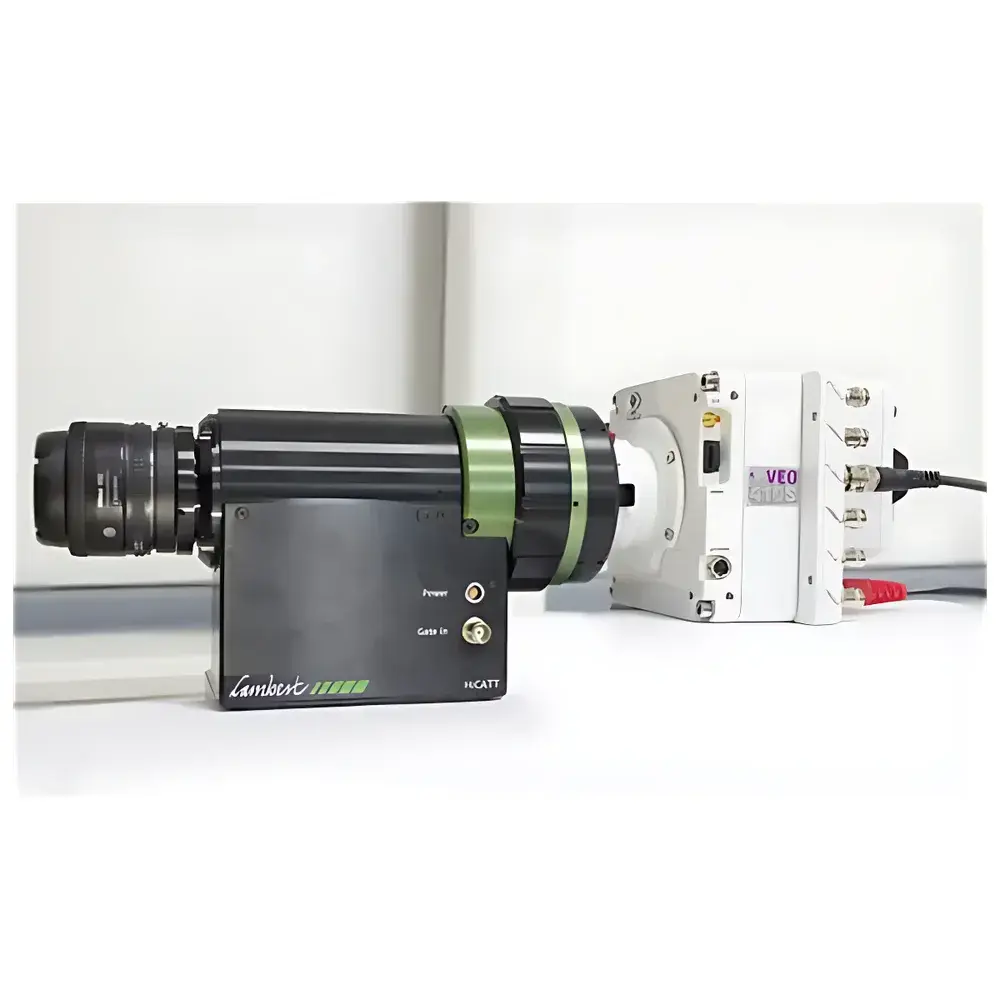
Auniontech HiCATT High-Speed Gated Image Intensifier
| Brand | Auniontech |
|---|---|
| Origin | Shanghai, China |
| Manufacturer Type | Authorized Distributor |
| Product Category | Domestic |
| Model | HiCATT Scientific Gated Image Intensifier |
| Pricing | Upon Request |
| First-Stage Intensifier | Proximity-Focused Gen II or Filmless Gen III MCP |
| Second-Stage Intensifier | Proximity-Focused Gen I |
| Input Diameter | 18 mm or 25 mm |
| Minimum Gate Width (FWHM) | <3 ns (Gen II), 5 ns (Gen III) |
| Maximum Repetition Rate | 300 kHz continuous, 2.5 MHz burst mode |
| Photon Gain (max) | 30,000–50,000 (dependent on photocathode type) |
| Quantum Efficiency (peak) | ~50% |
| Spectral Range | UV–NIR (S20, S25, GaAs, GaAsP photocathodes available) |
| Phosphor | P46 (standard), P20/P24/P43 optional |
| Output Resolution (1 | 1 relay): 26–33 lp/mm |
| Input/Output Mount | F-mount (C-mount optional) |
| Relay Lenses | 1:1, 2:1, 3:1 |
| Background Equivalent Noise | 0.006–0.024 e⁻/px/s |
Overview
The Auniontech HiCATT High-Speed Gated Image Intensifier is a two-stage hybrid microchannel plate (MCP)-based optical intensification module engineered for ultra-low-light, time-resolved imaging at microsecond to nanosecond temporal resolution. Operating on the principle of photoelectron multiplication via proximity-focused photocathode–MCP–phosphor cascades, the HiCATT enables single-photon detection sensitivity while maintaining sub-3 ns optical gating capability. Its dual-stage architecture separates gain amplification (first stage) from high-brightness output generation (second stage), decoupling quantum efficiency optimization from phosphor decay constraints. This design permits simultaneous high dynamic range, high frame-rate compatibility (up to 1 Mfps when coupled with external high-speed cameras), and precise temporal control—critical for capturing transient phenomena in combustion dynamics, plasma physics, fluorescence lifetime imaging, and laser-induced breakdown spectroscopy.
Key Features
- Sub-3 ns minimum optical gate width (FWHM) with Gen II photocathodes; configurable down to 5 ns with Gen III for extended NIR response
- Two-stage proximity-focused intensifier architecture: Gen II/III first stage (MCP-based, adjustable gain up to 5×10⁴ photons/e⁻) + Gen I second stage (high-luminance P46 phosphor output)
- Maximum repetition rate of 300 kHz in continuous mode; 2.5 MHz achievable in burst mode for transient event capture
- Quantum efficiency up to 50% (peak, S20/S25/GaAsP variants); spectral response tunable across 185–950 nm via interchangeable photocathodes (S20 quartz, S25 borosilicate, GaAs, GaAsP)
- F-mount and C-mount compatibility on both input and output interfaces; supports standard relay lenses (1:1, 2:1, 3:1 magnification) for optimized coupling to sCMOS, EMCCD, or ultra-high-speed CMOS cameras (up to 300 kfps native)
- Digital and analog gain control options; integrated programmable trigger generator supporting multi-pulse sequences, delay modulation, and external synchronization (TTL/LVDS)
- Compact, modular mechanical design (HiCATT-18: Ø18 mm input; HiCATT-25: Ø25 mm input) with minimal optical path length for integration into confocal, endoscopic, or spectroscopic setups
Sample Compatibility & Compliance
The HiCATT accommodates diverse optical configurations without modification to core vacuum integrity or photocathode stability. Its input window options—quartz (UV-transmissive, S20), borosilicate (S25/GaAs/GaAsP), and custom AR-coated variants—ensure compatibility with pulsed UV lasers (e.g., 266 nm Nd:YAG harmonics), visible excitation sources (e.g., 532 nm LIF), and NIR probes (e.g., 800 nm two-photon). The system meets ISO 9022-18:2015 for optical instrument environmental robustness and conforms to IEC 61000-6-3:2019 for electromagnetic compatibility. When deployed in regulated environments (e.g., GLP-compliant combustion test labs or FDA-registered biophotonics facilities), the digital control unit supports audit-trail logging of gate timing, gain settings, and trigger parameters—facilitating alignment with 21 CFR Part 11 data integrity requirements.
Software & Data Management
HiCATT operation is managed via the Auniontech Intensifier Control Suite (ICS), a Windows-based application providing real-time parameter adjustment, pulse sequence programming, and hardware synchronization. ICS exports timestamped metadata (gate width, delay, gain index, trigger source) in HDF5 format alongside camera-acquired image stacks, enabling traceable correlation between optical gating events and spatial intensity data. For automated workflows, the suite exposes a TCP/IP API compliant with IEEE 1588 Precision Time Protocol (PTP), allowing seamless integration into LabVIEW, Python (PyVISA), or MATLAB environments. All firmware updates are digitally signed and validated prior to installation—ensuring version control and reproducibility across multi-instrument deployments.
Applications
The HiCATT serves as a critical enabling component in time-resolved scientific imaging where photon budget and temporal fidelity are mutually constrained. In fundamental combustion research, it facilitates OH* and CH₂O chemiluminescence imaging at >100 kHz framing rates with <15 µs exposure—resolving flame front instabilities during lean blowoff. In plasma diagnostics, its nanosecond gating eliminates bremsstrahlung background in Z-pinch or laser-plasma interaction studies. Within life sciences, it extends FRAP and FLIM capabilities to dynamic subcellular processes (e.g., calcium wave propagation) under low-dose illumination, minimizing phototoxicity. Additional validated use cases include megahertz-rate PIV in shock tubes, meteor ablation spectroscopy in plasma wind tunnels, and ultraviolet absorption imaging of high-speed reactive flows—each leveraging the HiCATT’s calibrated photon gain linearity (<2% deviation over 4-decade intensity range) and spatial uniformity (±3.5% pixel-to-pixel variation).
FAQ
What is the shortest controllable gate width achievable with HiCATT?
The HiCATT-G2n variant achieves a full-width-at-half-maximum (FWHM) optical gate width of <3 ns using Gen II photocathodes; Gen III configurations yield 5 ns due to electron transit time limitations.
Can HiCATT be synchronized with external laser systems?
Yes—integrated TTL/LVDS inputs support external triggering with jitter <100 ps; delay resolution is 10 ps (software-controlled) and 1 ns (hardware-controlled).
Is vacuum maintenance required by the end user?
No—the HiCATT is a sealed, factory-evacuated tube with >10-year operational lifetime under standard laboratory conditions (20–25°C, <60% RH).
How does HiCATT handle high-flux illumination without saturation?
The gated architecture inherently limits integrated charge per frame; combined with MCP gain attenuation and programmable inter-frame dead time, it maintains linear response up to 10⁶ photons/pixel/frame.
Are calibration certificates provided for radiometric traceability?
Each unit ships with NIST-traceable spectral responsivity data (per photocathode type) and spatial uniformity maps; optional ISO/IEC 17025-accredited calibration is available upon request.
Related Products




