
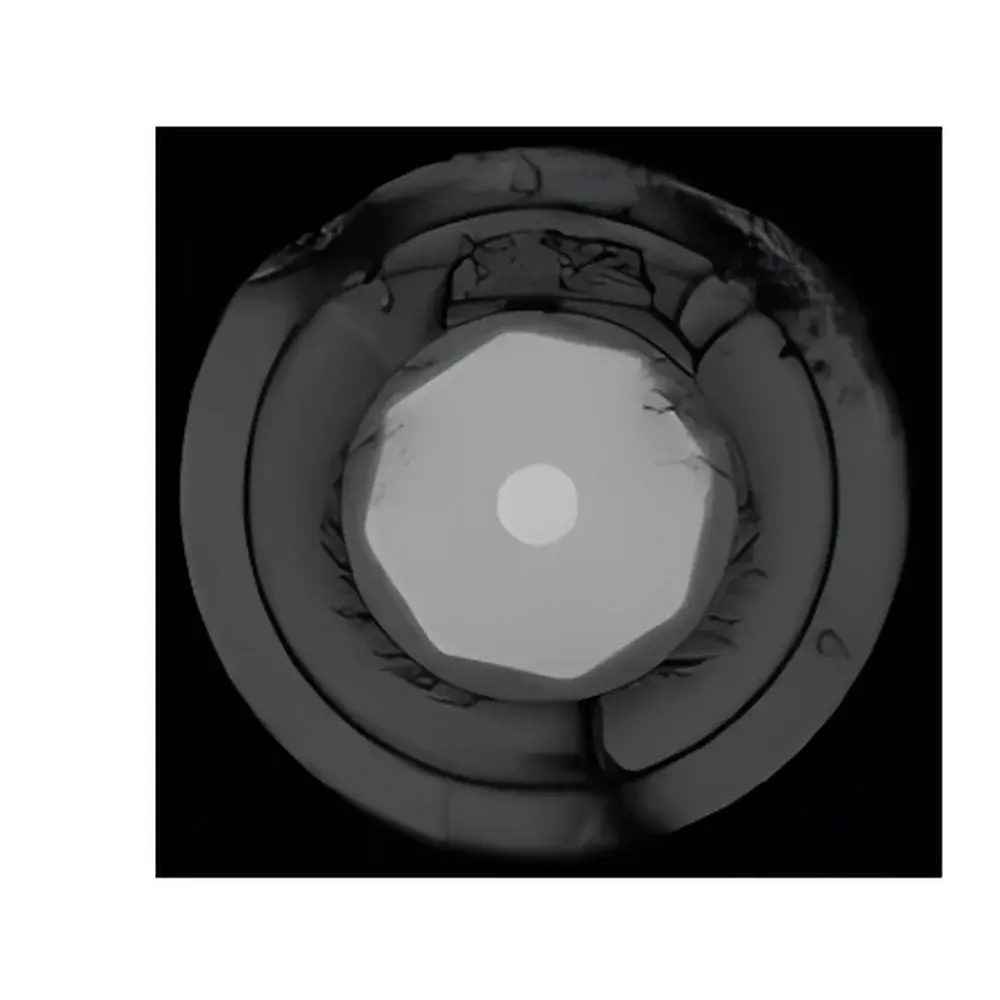
IXFiber 2 µm Triple-Clad Tm/Ho-Doped Optical Fiber
| Brand | IXFiber |
|---|---|
| Origin | France |
| Type | Triple-Clad Rare-Earth-Doped Active Fiber |
| Wavelength Range | 1.9–2.1 µm |
| Core Diameter | 18–20 µm |
| Inner Cladding Diameter | 250–270 µm |
| Outer Cladding Diameter | 300 µm |
| Dopants | Thulium (Tm³⁺) and Holmium (Ho³⁺) |
| Application | High-Power CW and Pulsed 2 µm Fiber Lasers & Amplifiers |
Overview
The IXFiber 2 µm Triple-Clad Tm/Ho-Doped Optical Fiber is an engineered active fiber designed for high-efficiency operation in the eye-safe 1.9–2.1 µm spectral window. Based on a robust triple-clad waveguide architecture—comprising a rare-earth-doped core, a low-index inner cladding, and a polymer-coated outer cladding—the fiber enables efficient multimode pump absorption while maintaining near-diffraction-limited signal beam quality. This geometry decouples pump delivery from signal guidance: high-brightness diode pumps (typically at 790 nm or 1150–1200 nm) are launched into the large-area inner cladding, where they undergo multiple passes and uniform absorption by Tm³⁺/Ho³⁺ ions; the resulting population inversion drives stimulated emission in the single-mode or low-M² core. The design supports both continuous-wave (CW) and nanosecond-to-microsecond pulsed operation, with thermal management enhanced by the large outer cladding diameter (300 µm) and optimized dopant distribution to minimize photodarkening and mode instability.
Key Features
- Triple-clad structure: 18–20 µm doped core, 250–270 µm inner cladding, 300 µm outer cladding — enabling >90% pump absorption over <2 m lengths
- Co-doped Tm³⁺/Ho³⁺ ion system: Enables efficient 2 µm lasing via cross-relaxation energy transfer (Tm³⁺ → Ho³⁺), reducing quantum defect heating
- Low numerical aperture (NA ≤ 0.09 for signal mode): Ensures high beam quality (M² < 1.3) and compatibility with standard collimation and coupling optics
- Polarization-maintaining variant (IXF-3CF-TmHo-PM-18-270-300): Incorporates stress-applying parts for >20 dB PM extinction ratio over full operating temperature range (−5 °C to +70 °C)
- High-power handling: Optimized coating materials and acrylate/polyimide dual-layer options support peak power densities up to 10 MW/cm² and average powers exceeding 100 W in coiled configurations
- Low background loss: <20 dB/km at 1200 nm and <50 dB/km at 2000 nm — critical for amplifier noise figure and gain efficiency
Sample Compatibility & Compliance
This fiber is compatible with industry-standard fusion splicing platforms (e.g., Vytran GPX-3400, Fujikura CT-109) using optimized arc parameters for low splice loss (<0.1 dB) and minimal mode field mismatch. It meets IEC 60793-2-50 (A1a.2 category for rare-earth-doped fibers) and complies with RoHS Directive 2011/65/EU. All batches undergo full spectral absorption profiling (200–2100 nm), cut-off wavelength verification (λc < 1.7 µm), and proof testing at ≥100 kpsi tensile strength. Documentation includes traceable test reports per ITU-T G.652.D and ISO/IEC 17025-accredited calibration records for refractive index profile and core concentricity.
Software & Data Management
While the fiber itself is a passive optical component, its integration into laser/amplifier systems benefits from standardized modeling workflows. IXFiber provides application-ready data files (.dat, .txt) containing measured absorption/emission cross-sections, lifetime decay curves (at 790 nm, 1150 nm, and 1950 nm excitation), and thermal conductivity profiles for use in commercial simulation tools including RP Fiber Power, Lumerical MODE, and COMSOL Multiphysics®. These datasets support accurate gain prediction, nonlinear threshold estimation (SRS, SBS), and thermal lensing analysis under high-power operation. All data packages include metadata compliant with FAIR principles (Findable, Accessible, Interoperable, Reusable) and are archived with version-controlled SHA-256 checksums.
Applications
- High-power 2 µm fiber lasers (CW and Q-switched) for medical tissue ablation (urology, dentistry, dermatology) and material processing (polymer welding, glass cutting)
- Master oscillator power amplifier (MOPA) architectures delivering >500 W average power with near-transform-limited linewidth (<100 kHz)
- Coherent Doppler wind lidar and differential absorption lidar (DIAL) systems operating at 2050 nm for atmospheric CO₂ and H₂O vapor sensing
- Mid-IR supercontinuum generation pumping stages (2–5 µm) using ZBLAN or chalcogenide photonic crystal fibers
- Defense-grade directed-energy systems requiring high brightness, polarization stability, and radiation-hardened packaging options (available upon request)
FAQ
What pump wavelengths are recommended for optimal Tm/Ho energy transfer?
790 nm (for Tm³⁺ ground-state absorption) and 1150–1200 nm (for direct Ho³⁺ excitation or Tm³⁺ ³F₄ → ³H₆ transition) are most effective. Dual-wavelength pumping improves slope efficiency by >15% compared to single-pump schemes.
Can this fiber be used in free-space coupled MOPA configurations?
Yes — the 300 µm outer cladding enables robust mechanical handling and alignment stability. We recommend using aspheric lenses with NA-matched focusing for inner-cladding coupling and mode-field adapters for low-loss signal injection.
Is there a specified maximum bend radius for coiled operation?
For standard acrylate-coated versions, minimum bend radius is 45 mm at 25 °C; polyimide-coated variants support 25 mm radius without measurable macrobending loss increase (<0.02 dB/m).
Do you provide splice-compatible matching passive fibers?
Yes — IXFiber offers correlative passive delivery fibers (IXF-PMF-20/300 and IXF-SMF-20/300) with identical geometry and thermal expansion coefficients to minimize splice-induced stress and mode distortion.
Are batch-to-batch absorption spectra available for qualification purposes?
All production lots include full UV-Vis-NIR absorption scans (200–2100 nm) certified to ±0.5% repeatability. Spectral reports are supplied digitally with each shipment and archived for 10 years per ISO 9001:2015 clause 8.5.2.





