
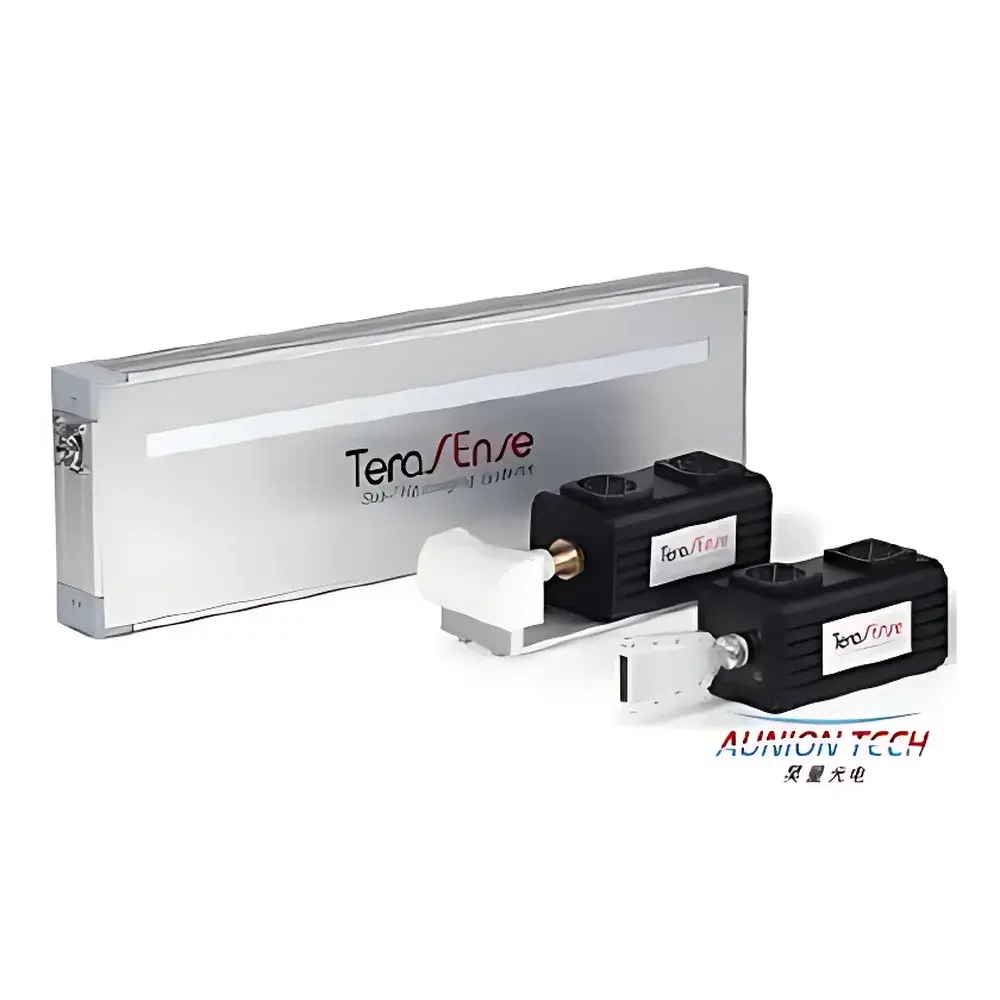
Auniontech THzFast-5K High-Speed Linear Terahertz Imaging Scanner (THz Camera + THz Source)
| Brand | Auniontech |
|---|---|
| Origin | Shanghai, China |
| Model | THzFast-5K |
| Imaging Rate | 5000 fps |
| Spatial Resolution | 1.5 mm |
| Center Frequency | 100 GHz |
| Pixel Array | 256 × 1 |
| Pixel Size | 1.5 × 3 mm² |
| Imaging Area | 384 × 3 mm² |
| Min. Detectable Power/Pixel | 100 nW (at 5000 fps) |
| Dynamic Range | 24 dB (Type I) / 30 dB (Type II) |
| THz Source Technology | IMPATT Diode (Type I) / Super-Hero IMPATT (Type II) |
| Optical Configuration | PTFE-based Reflective Optics |
| Sync Interface | TTL (+5 V) |
| Software | TeraFast Viewer (Windows-based, SDK available) |
| Power Supply | 24 V DC / 20 W |
| Dimensions (Camera) | 450 × 160 × 44 mm³ |
| Max. Conveyor Speed Support | 15 m/s |
Overview
The Auniontech THzFast-5K is a high-speed linear terahertz imaging scanner engineered for real-time, non-contact, non-destructive inspection in industrial environments. Unlike pulsed terahertz time-domain spectroscopy (THz-TDS) systems, the THzFast-5K operates in continuous-wave (CW) mode at a fixed center frequency of 100 GHz, leveraging coherent heterodyne detection principles with semiconductor-based linear array sensing. Its architecture integrates a custom 256-pixel uncooled THz camera and a synchronized IMPATT-diode-based THz source—enabling line-scan acquisition at up to 5000 frames per second (5 kHz). This frame rate supports full-field imaging at conveyor speeds up to 15 m/s, making it suitable for inline quality assurance on high-throughput production lines. The system’s 1.5 mm spatial resolution (FWHM), combined with its compact mechanical footprint (450 × 160 × 44 mm³ for the camera head), facilitates integration into existing automation infrastructure—including OEM machinery, packaging lines, and sorting stations—without requiring major reconfiguration.
Key Features
- Real-time linear scanning at 5000 fps (5 kHz line rate), enabling sub-millisecond dwell time per scan line
- 256-pixel uncooled semiconductor linear array with uniform responsivity (8000 V/W) and low-noise readout
- Dual-source compatibility: Type I (20 µW/pixel, 24 dB dynamic range) and Type II Super-Hero IMPATT (140 µW/pixel, 30 dB dynamic range)
- PTFE-based reflective optical path optimized for broadband THz transmission (>90% reflectivity at 100 GHz) and minimal dispersion
- TTL synchronization interface for precise coordination with motion controllers, encoders, or PLC-triggered acquisition
- Integrated thermal management and electromagnetic shielding compliant with industrial EMC Class A requirements
- Modular design supporting field-upgradable firmware, calibrated radiometric correction, and ROI-based binning
Sample Compatibility & Compliance
The THzFast-5K is optimized for transmission- and reflection-mode imaging of dielectric and semi-crystalline materials commonly encountered in regulated manufacturing. It reliably penetrates paper, cardboard, plastic films (PET, PP, PE), textiles, ceramics, foam, wood composites, and pharmaceutical blister packs—while remaining insensitive to metallic layers thicker than ~10 µm. Applications align with ASTM E3092–23 (Standard Guide for Terahertz Nondestructive Evaluation of Composite Materials) and ISO/IEC 17025:2017 requirements for measurement traceability. System calibration protocols include NIST-traceable power meter verification (via WR-10 waveguide couplers) and spatial resolution validation using certified edge targets. For GMP-regulated environments, audit trails, user access control, and electronic signature support are available via optional TeraFast Enterprise Edition (compliant with FDA 21 CFR Part 11 Annex 11).
Software & Data Management
The included TeraFast Viewer provides native support for real-time visualization, contrast enhancement (CLAHE, gamma correction), false-color mapping, and profile extraction along the scan direction. All raw data is stored in HDF5 format with embedded metadata (timestamp, motor position, source power, ambient temperature/humidity). The SDK (C/C++, Python, MATLAB APIs) enables integration with LabVIEW, OPC UA servers, or MES platforms such as Siemens Opcenter or Rockwell FactoryTalk. Batch processing scripts support automated defect classification using thresholding, morphological filtering, and supervised ML models trained on customer-supplied ground-truth datasets. Data export complies with ASAM ATX and ASTM E2983 standards for interoperable NDE reporting.
Applications
- Pharmaceuticals: Detection of tablet coating thickness variation, blister pack seal integrity, and foreign particulate inclusion beneath Al-PVC lidding
- Food & FMCG: Identification of voids, delamination, or moisture ingress in multi-layer pouches; inspection of chocolate bar fill uniformity
- Automotive: Verification of adhesive bond coverage in composite battery enclosures and fiber-reinforced polymer (FRP) structural panels
- Wood & Construction: Mapping of glue-line continuity in laminated veneer lumber (LVL) and OSB; detection of subsurface knots or resin pockets
- Security & Logistics: Non-invasive screening of mail parcels for concealed powders, gels, or ceramic weapons without ionizing radiation
- Agriculture: Assessment of seed coat integrity, grain moisture distribution, and fungal contamination in bulk cereal streams
FAQ
What is the effective penetration depth in common packaging materials?
Typical penetration ranges: 3–8 mm in dry polymers (PP, PET), 1–4 mm in paperboard, and <1 mm in wet cellulose or high-loss composites—dependent on material absorption coefficient at 100 GHz.
Can the system operate in reflection geometry only?
Yes—the PTFE reflective optics and adjustable source-detector offset support both transmission and oblique-angle reflection modes; no hardware modification is required.
Is spectral information captured, or is this strictly intensity-based imaging?
The THzFast-5K is a single-frequency CW imager; it delivers amplitude contrast maps at 100 GHz—not broadband spectra. Spectral diversity requires coupling with tunable sources or THz-TDS platforms.
How is geometric distortion corrected during high-speed scanning?
Real-time encoder synchronization ensures pixel-to-position mapping accuracy; software-based keystone correction and lens distortion compensation are applied during reconstruction using factory-calibrated polynomial models.
Does the system meet CE or FCC certification for deployment in EU/US facilities?
Yes—fully certified to EN 61326-1:2013 (EMC) and EN 61000-6-4:2020 (industrial emission); FCC ID: 2ANJZ-THZFAST5K (Class A digital device).





