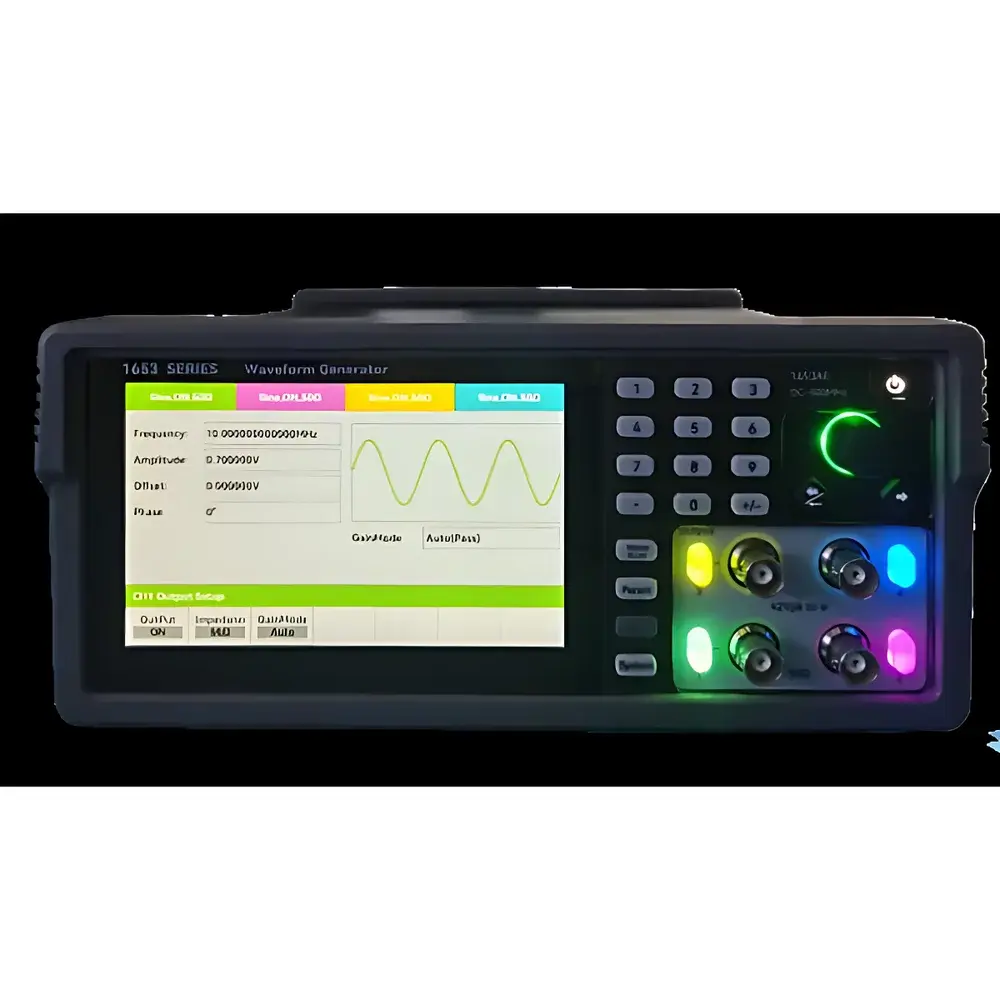
Auniontech 1653 Series Economical Function / RF Arbitrary Waveform Generator
| Brand | Auniontech |
|---|---|
| Origin | Shanghai, China |
| Model | 1653AB-AE / 1653AF |
| Output Channels | 2 (up to 4 on ≤500 MHz models) |
| Maximum Bandwidth | 120 MHz / 250 MHz / 350 MHz / 500 MHz / 1 GHz |
| Sample Rate | 2.4 GSa/s (1653AB–AE) or 2.5 GSa/s (1653AF) |
| Vertical Resolution | 16-bit (1653AB–AE) or 14-bit (1653AF) |
| Waveform Memory Depth | 2 Gpts (total) |
| Output Amplitude | 24 Vpp (open-circuit) |
| Display | 5-inch capacitive touchscreen (800 × 480) |
| Form Factor | 2U half-rack |
| Built-in Frequency Counter | Yes |
| Modulation Types | AM, DSB-AM, FM, PM, SUM, ASK, FSK, BPSK, Sweep, Burst |
| Signal Types | Sine, Square, Triangle, Ramp (Up/Down), Pulse, Noise, DC, PRBS |
| I/Q Baseband Support | Yes |
| Trigger Modes | Internal timer, external trigger, continuous loop, user-defined repeat count |
| Channel Synchronization & Differential Pairing | Supported (e.g., CH2 = CH1, CH2 = ¬CH1, CH2 = CH1 + CH2 |
Overview
The Auniontech 1653 Series Economical Function / RF Arbitrary Waveform Generator is a high-integration, multi-channel signal synthesis platform engineered for precision waveform generation in education, R&D laboratories, industrial validation, and medical electronics testing. Based on direct digital synthesis (DDS) and high-speed arbitrary waveform memory architecture, the series delivers deterministic, low-jitter output across a broad frequency spectrum—from DC to 1 GHz—while maintaining amplitude flatness, phase stability, and timing fidelity essential for stimulus-response characterization. Its dual-core DAC architecture supports simultaneous independent channel operation with hardware-level synchronization, enabling coherent multi-tone, differential, or vector-modulated signal generation without external triggering latency. Designed for reproducible benchtop and system-integrated use, the 1653 Series complies with standard laboratory electromagnetic compatibility (EMC) requirements per CISPR 11 Class B and operates within ambient temperature ranges specified by IEC 61010-1 for measurement equipment safety.
Key Features
- Multi-bandwidth scalability: Five bandwidth variants (120 MHz, 250 MHz, 350 MHz, 500 MHz, and 1 GHz) allow users to select optimal performance-to-cost ratio for specific application constraints—including RF front-end stimulation, high-speed digital interface testing, and wideband analog circuit validation.
- Deep waveform memory & high-fidelity DAC: Unified 2 Gpts waveform memory pool enables long-duration complex sequences (e.g., radar chirps, communication frames, or neural stimulation patterns) with minimal interpolation artifacts. 16-bit vertical resolution (1653AB–AE) ensures >96 dB spurious-free dynamic range (SFDR), while 14-bit resolution (1653AF) maintains >80 dB SFDR at higher sample rates.
- Flexible playback control: Supports internal timer-based scheduling, edge-triggered acquisition synchronization, and programmable burst repetition with user-defined cycle counts—critical for automated test systems requiring deterministic stimulus timing aligned to DUT clock domains.
- Differential & mathematically coupled outputs: Hardware-configurable channel relationships—including inversion (¬CH1), summation (CH1 + CH2), and differential pair formation (CH1/CH2 or CH3/CH4)—facilitate balanced signal injection, common-mode rejection testing, and mixed-signal stimulus generation.
- Integrated frequency measurement: Onboard hardware frequency counter (DC–1 GHz input range) eliminates need for external instruments during setup verification and provides real-time feedback during sweep or modulation experiments.
- Intuitive human-machine interface: 5-inch capacitive touchscreen with 800 × 480 resolution supports gesture-based navigation, parameter entry via soft keyboard, and waveform preview overlays—reducing learning curve in academic and cross-disciplinary lab environments.
Sample Compatibility & Compliance
The 1653 Series is compatible with standard 50 Ω coaxial interfaces (SMA connectors) and supports both single-ended and differential load configurations. It meets CE marking requirements under Directive 2014/30/EU (EMC) and 2014/35/EU (LVD), and conforms to RoHS 2011/65/EU substance restrictions. For regulated environments—including GLP-compliant research labs and ISO/IEC 17025-accredited calibration facilities—the instrument supports timestamped configuration logging and firmware revision tracking, though native 21 CFR Part 11 audit trail functionality requires integration with external test management software (e.g., Keysight PathWave or NI TestStand).
Software & Data Management
Auniontech provides PC-based WaveStudio software (Windows 10/11, 64-bit) for waveform editing, sequence scripting, and remote SCPI command execution over USB 2.0 or LAN (VXI-11/TCP). The software includes built-in libraries for IEEE 802.11, Bluetooth LE, and LTE baseband waveforms, and supports MATLAB® and Python (via PyVISA) interoperability for custom algorithmic waveform generation. All waveform files are stored in industry-standard .wfm binary format with embedded metadata (sample rate, resolution, timestamp), ensuring traceability across instrument generations and collaborative projects.
Applications
- Educational laboratories: Demonstrating Fourier series reconstruction, filter impulse response, modulation theory, and Nyquist sampling limits using interactive, visually annotated waveforms.
- RF and wireless R&D: Generating calibrated I/Q baseband stimuli for transceiver IC evaluation, EVM testing of power amplifiers, and adjacent channel leakage ratio (ACLR) analysis under realistic traffic conditions.
- Semiconductor characterization: Providing synchronized multi-channel stimuli for parametric testing of ADC/DAC linearity, jitter tolerance, and supply rejection ratio (PSRR) across process corners.
- Medical electronics validation: Reproducing physiological signals (e.g., ECG complexes, neural spike trains) with precise amplitude and timing control for sensor front-end and analog signal chain verification.
- Automated production test: Integration into ATE platforms via SCPI commands and hardware triggers for functional screening of mixed-signal PCBs, including timing margin analysis and fault injection testing.
FAQ
Does the 1653 Series support user-defined FPGA-based waveform processing?
No—waveform generation is implemented in fixed-function ASIC logic with onboard memory and DAC stages. Real-time mathematical operations (e.g., filtering, envelope detection) require external post-processing or host-based waveform pre-compensation.
What is the typical phase noise performance at 100 MHz carrier offset by 10 kHz?
Measured phase noise is ≤ –110 dBc/Hz (typ.) under standard operating conditions (25°C, 50 Ω load, full-scale output), consistent with high-stability oven-controlled crystal oscillator (OCXO) reference design.
Can multiple 1653 units be synchronized for phased-array stimulus applications?
Yes—via external 10 MHz reference input/output and dedicated SYNC_IN/SYNC_OUT BNC ports, enabling sub-nanosecond inter-unit skew alignment when used with matched cable lengths and proper termination.
Is waveform memory shared between channels or allocated per channel?
Memory is pooled: total 2 Gpts is dynamically allocable across active channels, with allocation managed automatically during sequence compilation in WaveStudio software.
Does the instrument support SCPI over GPIB?
GPIB is not supported; remote control is available exclusively via USB-TMC and TCP/IP (VXI-11 and raw socket modes).
Related Products