
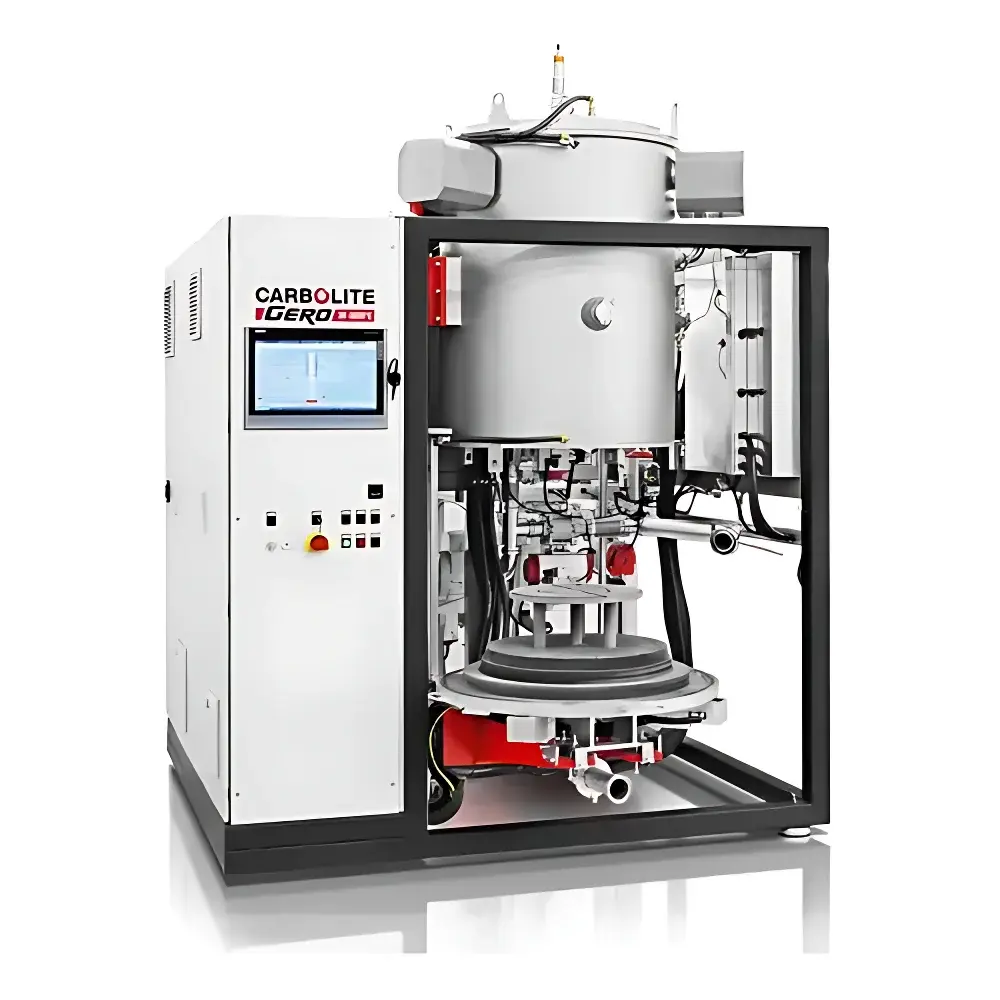
Carbolite Gero HTBL MO/W Bottom-Loading Metal-Insulated High-Temperature Tube Furnace
| Brand | Carbolite Gero |
|---|---|
| Origin | Germany |
| Model | HTBL MO/W |
| Type | Bottom-Loading Tube Furnace |
| Max Temperature | 1600°C |
| Heating Element & Shielding | Molybdenum (Mo) |
| Insulation | Metallic (Mo-based) |
| Chamber Volume | 60 L |
| Atmosphere Compatibility | Inert (N₂, Ar), Reducing (H₂), Vacuum (down to 10⁻³ mbar) |
| Gas Pressure Range | 10–1000 mbar (gauge), slight overpressure operation |
| Excluded Atmospheres | Air / O₂ |
| Control | Fully Automated Hydraulic Lift + Dual-Zone PID Temperature Control |
| Compliance | Designed for GLP/GMP-aligned thermal processing workflows |
| Optional | H₂ partial pressure control, integrated vacuum pump, atmosphere chamber (gas-tight sample enclosure), calibrated thermocouple porting |
Overview
The Carbolite Gero HTBL MO/W is a precision-engineered bottom-loading tube furnace designed for high-purity thermal processing under controlled inert, reducing, or vacuum atmospheres. Unlike conventional top- or front-loading furnaces, its vertically actuated metallic chamber descends hydraulically—exposing the full hot zone for unrestricted sample loading from any orientation. This architecture eliminates mechanical stress on fragile substrates, enables precise thermocouple placement directly adjacent to the sample, and supports rapid throughput in R&D and pilot-scale manufacturing. The furnace employs molybdenum (Mo) heating elements and Mo-based multi-layer reflective shielding, delivering stable operation up to 1600°C with exceptional thermal uniformity (±3°C across 60 L working volume at 1500°C). Its all-metal hot-zone construction ensures ultra-low outgassing and compatibility with 6N (99.9999%) purity gas environments—critical for applications requiring minimal metallic contamination, such as advanced ceramic sintering, metal injection molding (MIM), and semiconductor precursor annealing.
Key Features
- Fully automated hydraulic lift system: Chamber lowers to minimum position, then manually extends 90° outward for unobstructed axial and radial sample access
- Molybdenum heating elements and radiation shields: Engineered for long-term stability at 1600°C under vacuum or low-oxygen partial pressures
- Dual independent PID-controlled heating zones: Enables precise thermal profiling and improved axial temperature uniformity
- Integrated gas manifold with mass flow controllers (MFCs): Supports N₂, Ar, H₂—individually or in mixtures—with adjustable partial pressure (10–1000 mbar gauge)
- Vacuum-capable design: Compatible with turbomolecular or diffusion pumps; base pressure ≤1×10⁻³ mbar achievable with standard configuration
- Optional hydrogen partial pressure control module: Enables safe, repeatable H₂ dosing down to 10⁻² mbar partial pressure for carburization or reduction processes
- Modular atmosphere chamber (optional): Gas-tight, water-cooled enclosure for localized atmosphere isolation during sample insertion/removal
Sample Compatibility & Compliance
The HTBL MO/W accommodates cylindrical, disc-shaped, or irregularly shaped samples up to Ø120 mm × 300 mm (L), including powder compacts, green bodies (CIM/MIM), thin-film substrates, and metallurgical coupons. Its metallic insulation eliminates carbon contamination risks associated with graphite hot zones—making it suitable for oxygen-sensitive oxide ceramics (e.g., YBCO, BaTiO₃) and high-purity metal alloys (e.g., Ni-based superalloys, Ti-6Al-4V). The system complies with ISO 9001 quality management requirements for thermal equipment validation and supports audit-ready data logging per FDA 21 CFR Part 11 when paired with Carbolite Gero’s optional TCC software suite. All gas-handling components meet EN ISO 15848-1 leakage standards; electrical safety conforms to IEC 61000-6-4 (EMC) and IEC 61010-1 (lab equipment safety).
Software & Data Management
Control is executed via Carbolite Gero’s TC1000 touchscreen interface, supporting programmable ramp-soak profiles (up to 32 segments), real-time deviation alarms, and automatic shutdown on thermocouple failure. Data logging records temperature (±0.5°C accuracy), gas flow rates (±1% FS), chamber pressure (±0.5 mbar), and lift position at user-defined intervals (1–60 s). Export formats include CSV and XML for integration into LIMS or MES platforms. Optional TCC software adds electronic signature capability, audit trail generation, and configurable report templates aligned with ISO/IEC 17025 calibration documentation standards.
Applications
- Sintering of technical ceramics (Al₂O₃, SiC, ZrO₂) and refractory metals (Mo, W, Ta)
- Debinding and sintering cycles for MIM/CIM feedstocks under nitrogen or hydrogen
- High-vacuum annealing of optical coatings and photovoltaic absorber layers
- Controlled-atmosphere carburizing, nitriding, and siliconization of tool steels
- Thermal decomposition and pyrolysis of polymer-derived ceramics (PDCs)
- Heat treatment of battery electrode materials (e.g., LiCoO₂, NMC cathodes) under argon
- Rapid thermal processing (RTP) of semiconductor wafers using localized Mo-heated zones
FAQ
Can the HTBL MO/W operate in air or oxidizing atmospheres?
No. The molybdenum hot zone rapidly oxidizes above 400°C in air. Only inert (N₂, Ar), reducing (H₂), or vacuum conditions are permitted.
What vacuum level can be achieved with the standard configuration?
With an optional two-stage rotary vane pump, base pressure reaches ≤1×10⁻² mbar; with turbomolecular pumping, ≤1×10⁻³ mbar is typical.
Is remote monitoring supported?
Yes—via Ethernet-enabled TC1000 controller with Modbus TCP protocol for integration into SCADA or building management systems.
Does the furnace support GLP-compliant calibration?
Yes. Optional UKAS-accredited calibration certificates (including as-found/as-left data) are available for both control and recording thermocouples.
Can powder samples be processed without container contamination?
Yes. The optional atmosphere chamber isolates the sample environment during loading/unloading, and all internal surfaces are electropolished Mo—eliminating particulate shedding.



