
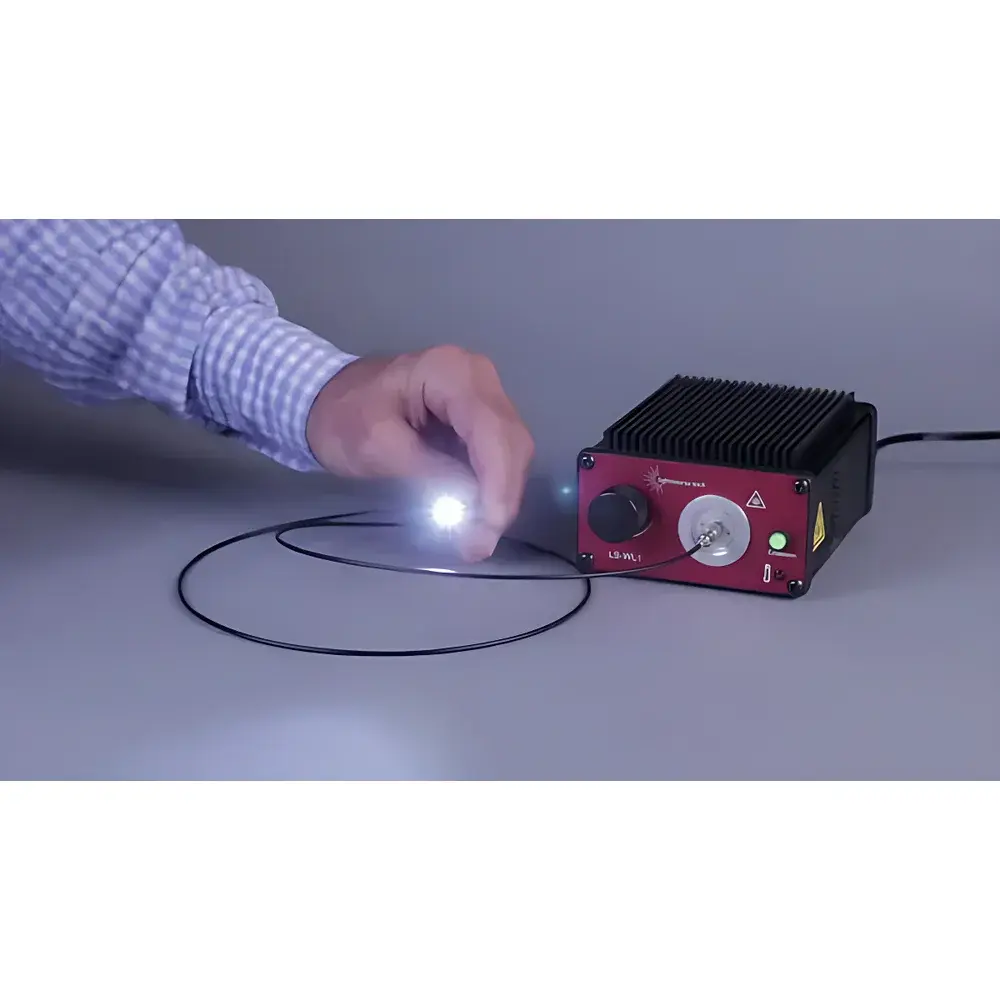
Auniontech LS-WL High-Brightness White Light Point Source
| Brand | Auniontech |
|---|---|
| Model | LS-WL |
| Output Power | >440 mW (at 600 µm fiber, NA 0.5) |
| Wavelength Range | 450–700 nm |
| Fiber Coupling | Multimode, core diameter adjustable from 50 µm to 1 mm |
| Trigger Frequency | Up to 200 kHz (TTL, SMA) |
| Pulse Width & Delay | User-configurable |
| Interface | USB-to-RS232 (Mini-B), ASCII command protocol |
| Power Supply | 12 V DC, 2.5 A (~20 W max) |
| Dimensions | 125 × 110 × 60 mm³ |
| Weight | 450 g |
| Lifetime | >10,000 h |
| Thermal Management | Dual high-performance fans + integrated temperature sensor with programmable auto-shutdown (default range: 10–30 °C) |
| Compliance | CE-marked |
Overview
The Auniontech LS-WL is a compact, fiber-coupled white light point source engineered for applications demanding high spatial coherence, spectral continuity, and temporal stability in the visible spectrum (450–700 nm). Unlike conventional broadband sources such as halogen lamps or standard LEDs, the LS-WL employs a solid-state architecture where two laser diodes pump a monolithic ceramic phosphor converter chip. This design eliminates optical misalignment drift and enables exceptional brightness (>440 mW into a 600 µm, NA 0.5 multimode fiber) with sub-millimeter effective emission core size—achieving radiance values orders of magnitude higher than typical LED-based alternatives. Its principle of operation relies on efficient photoluminescent conversion under pulsed or CW laser excitation, yielding spectrally smooth, low-coherence output ideal for interferometric sensing, time-resolved imaging, and structured illumination. The integrated thermal management system—including dual active cooling fans and real-time temperature monitoring—ensures long-term photometric stability across extended operational cycles, making it suitable for laboratory-grade metrology and industrial OEM integration.
Key Features
- High-brightness white light output: >440 mW into 600 µm multimode fiber (NA 0.5), scalable from 1% to 100% intensity via digital control
- Fiber-coupled design with configurable core diameters (50 µm to 1 mm), enabling flexible integration into existing optical benches, endoscopes, or spectroscopic systems
- Precise TTL-triggered pulsing up to 200 kHz, with independently adjustable pulse width and delay—optimized for synchronization with high-speed cameras, lock-in detectors, or gated sensors
- Embedded microcontroller with USB-to-RS232 interface (Mini-B connector) supporting ASCII command set for seamless integration into LabVIEW, Python, MATLAB, or custom C++/C# control environments
- Compact footprint (125 × 110 × 60 mm³) and lightweight construction (450 g), facilitating portable deployment in field instrumentation or mobile diagnostic platforms
- Thermally robust architecture featuring dual high-efficiency fans, onboard temperature sensor (readable via serial command), and programmable thermal shutdown threshold (factory default: 10–30 °C)
Sample Compatibility & Compliance
The LS-WL is designed for use with standard SMA-terminated multimode fibers and integrates readily into optical setups requiring broadband illumination with minimal spatial coherence—particularly advantageous in low-coherence interferometry (LCI), optical coherence tomography (OCT) reference arms, fluorescence excitation support, and machine vision calibration. Its spectral profile conforms to ISO 15782:2021 requirements for broadband illumination uniformity in measurement-grade optical testing. While not intrinsically certified for medical device use, the LS-WL’s stable output, deterministic triggering, and traceable thermal safety logic support compliance with FDA 21 CFR Part 11 when deployed within validated systems that implement audit-trail logging of intensity settings and trigger events. It meets CE marking directives for electromagnetic compatibility (EN 61326-1) and low-voltage safety (EN 61010-1), and its deterministic timing behavior aligns with GLP/GMP documentation standards for instrument qualification protocols.
Software & Data Management
Control is implemented via a lightweight ASCII command protocol over virtual COM port (USB-emulated RS232), eliminating dependency on proprietary drivers. Commands include INTENSITY 50 (sets output to 50%), TRIG ON, PULSEWIDTH 1000 (in ns), and TEMP? (reads internal sensor). A cross-platform GUI is provided for rapid commissioning and multi-unit orchestration—supporting simultaneous configuration of up to 16 LS-WL units with synchronized trigger distribution. All commands generate timestamped responses, enabling full reproducibility in automated test sequences. Integration into Python-based data acquisition frameworks is demonstrated using PySerial; MATLAB users can leverage Instrument Control Toolbox with minimal wrapper code. No cloud connectivity or remote firmware updates are implemented—ensuring air-gapped operability in secure lab environments.
Applications
- Low-Coherence Interferometry (LCI): Serves as stable broadband reference source in fiber-optic Michelson or Mach-Zehnder configurations, enabling high-dynamic-range surface profiling and thin-film thickness measurement
- Biomedical Imaging: Provides uniform, high-flux illumination for fluorescence lifetime imaging (FLIM) auxiliary excitation, confocal reflectance calibration, and endomicroscopy probe illumination
- Machine Vision & Metrology: Delivers consistent, strobed illumination for high-speed inspection of microstructures, PCB solder joints, or precision mechanical components
- Spectroscopic Calibration: Functions as continuum source for wavelength validation and detector linearity checks in UV-Vis-NIR spectrometers
- Optical Testing: Supports MTF measurement of lenses, wavefront analysis of aspheric surfaces, and scatter characterization of optical coatings
- Environmental Sensing: Used in portable LIDAR auxiliary illumination, underwater optical communication testbeds, and atmospheric particulate scattering studies
FAQ
What is the maximum achievable brightness into a 50 µm fiber?
Brightness scales inversely with core area and numerical aperture. With the LS-WL’s fixed NA 0.5 output optics, coupling into a 50 µm fiber yields ~15–20 mW—limited by étendue conservation and alignment tolerance. For highest irradiance at the sample plane, use the smallest practical core size compatible with system throughput requirements.
Can the LS-WL be operated in true continuous-wave (CW) mode without triggering?
Yes. The device defaults to CW operation upon power-up. Trigger mode is optional and only activates when a valid TTL signal is applied to the SMA input port.
Is fiber alignment required during installation?
No. The LS-WL features factory-aligned, kinematic SMA receptacle with integrated index-matching gel interface—ensuring repeatable coupling efficiency without user adjustment.
Does the unit support analog intensity modulation?
No. Intensity control is digital-only via serial command. Analog modulation is intentionally omitted to preserve pulse fidelity and eliminate ground-loop noise in sensitive measurement chains.
How is thermal performance verified during qualification?
Each unit undergoes 72-hour burn-in at 100% output power under ambient temperatures of 25 °C ± 2 °C, with photometric drift monitored at 1-minute intervals. Units exhibiting >1.5% RMS intensity variation over the test period are rejected.



