
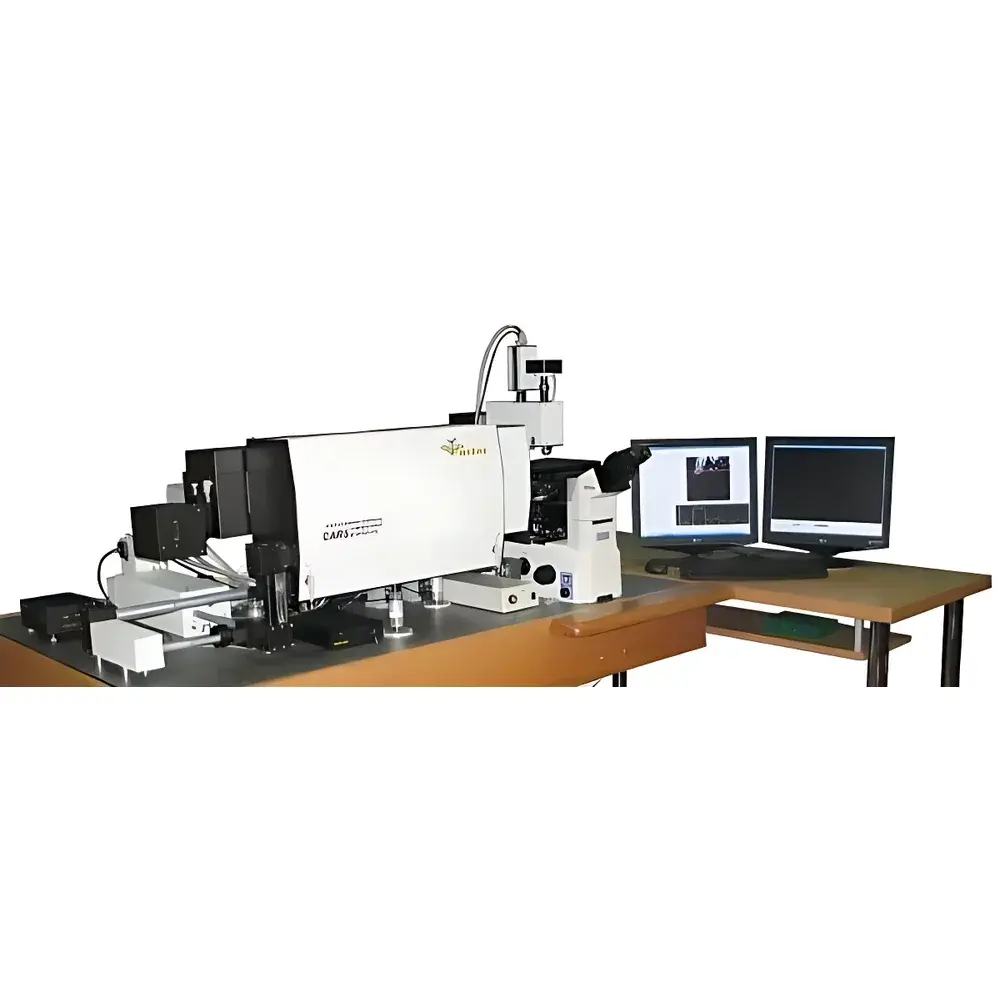
Auniontech RAMOS CARS 3D Coherent Raman Imaging System
| Brand | Auniontech |
|---|---|
| Model | RAMOS CARS 3D |
| Instrument Type | Confocal Micro-Raman Spectrometer with CARS Capability |
| Spectral Range | CARS 985–5000 cm⁻¹ |
| Spectral Resolution | CARS 7–8 cm⁻¹ |
| Spatial Resolution | CARS XYZ < 0.7 µm |
| Detection Channels | 5 simultaneous (F-CARS, E-CARS, Raman reflection, laser transmission, fluorescence) |
| Application Domain | Label-free 3D chemical imaging of biological and soft matter samples |
Overview
The Auniontech RAMOS CARS 3D Coherent Raman Imaging System is an integrated confocal platform engineered for quantitative, label-free, three-dimensional chemical mapping at sub-micron spatial resolution. It combines coherent anti-Stokes Raman scattering (CARS), spontaneous Raman scattering, and complementary optical modalities—including fluorescence, laser transmission, and reflected signal detection—within a single, synchronized scanning architecture. Unlike conventional spontaneous Raman microspectroscopy, which suffers from weak signal intensity and long acquisition times, the RAMOS CARS 3D leverages the nonlinear optical process of CARS to generate directional, background-suppressed signals that scale quadratically with molecular concentration. This enables high-speed volumetric imaging without exogenous labeling, while maintaining spectral fidelity across biologically relevant vibrational bands (e.g., CH₂/CH₃ stretch at ~2850–2950 cm⁻¹, C=O at ~1650 cm⁻¹, or aromatic ring modes near 1000 cm⁻¹). The system operates on a dual-laser excitation scheme: a narrow-linewidth picosecond pump beam (typically ~1064 nm) and a tunable Stokes beam (e.g., 1200–1400 nm), generating anti-Stokes photons in the visible/NIR range. Its confocal design supports optical sectioning with axial resolution down to <700 nm in Raman mode and <0.7 µm isotropically in CARS mode—making it suitable for structural and compositional analysis of heterogeneous soft materials.
Key Features
- Simultaneous five-channel detection: F-CARS (forward-detected CARS), E-CARS (epi-detected CARS), spontaneous Raman reflection, laser transmission, and fluorescence—enabling correlative multimodal contrast generation in a single scan.
- High spectral resolution: 0.25 cm⁻¹ for spontaneous Raman spectra; 7–8 cm⁻¹ for CARS spectra—sufficient to resolve overlapping vibrational bands in complex biological matrices and synthetic polymers.
- Wide tunable spectral coverage: CARS from 985 to 5000 cm⁻¹; spontaneous Raman from 75 to 6000 cm⁻¹—covering fingerprint, skeletal, and high-wavenumber regions critical for lipid, protein, nucleic acid, and small-molecule identification.
- True 3D volumetric imaging: Motorized Z-stage with piezo-enhanced focus control supports automated stack acquisition and deconvolution-based depth reconstruction.
- Nonlinear signal confinement: CARS signal generation occurs only at the diffraction-limited focal volume, eliminating out-of-focus background and enabling non-descanned detection without pinhole gating—improving photon collection efficiency and signal-to-noise ratio.
- Quantitative concentration mapping: CARS intensity ∝ [C]², permitting relative quantification of target molecular species (e.g., lipid droplets, drug crystals, polymer phases) when calibrated against reference standards.
Sample Compatibility & Compliance
The RAMOS CARS 3D accommodates a broad range of sample formats—including live cells in chambered coverslips, tissue cryosections, polymer thin films, liquid crystal droplets, semiconductor wafers, and pharmaceutical tablet cross-sections—without requiring fixation, staining, or metal coating. Its non-destructive, non-ionizing optical interrogation meets GLP-compliant documentation requirements for preclinical research and formulation development. While the system itself does not carry FDA 510(k) or CE-IVD certification, its data output is compatible with audit-trail-enabled software environments compliant with 21 CFR Part 11 when integrated with validated LIMS or ELN platforms. All optical components adhere to ISO 10110 surface quality standards; laser safety complies with IEC 60825-1 Class 4 requirements, with interlocked enclosures and emission indicators meeting EN 60825-1:2014.
Software & Data Management
Acquisition and analysis are managed via Auniontech’s proprietary RAMOS Control Suite—a modular, scriptable application built on LabVIEW and Python APIs. It supports real-time spectral preview, automated wavenumber calibration using NIST-traceable polystyrene or silicon references, and batch processing of 3D CARS stacks using GPU-accelerated denoising (BM3D) and spectral unmixing (non-negative matrix factorization). Export formats include HDF5 (with metadata schema compliant with NeXus standard), TIFF (for intensity maps), and JCAMP-DX (for spectral libraries). Raw data retains full timestamping, laser power logs, and environmental sensor records (temperature, humidity)—essential for traceability in regulated environments. Optional integration with MATLAB or Python (via PyCARS library) enables custom algorithm deployment for machine learning–based classification of spectral signatures.
Applications
- Live-cell metabolic imaging: Tracking lipid accumulation, cholesterol distribution, and protein conformational changes in unstained hepatocytes, adipocytes, or neuronal cultures over time.
- Pharmaceutical solid-state characterization: Mapping crystalline vs. amorphous domains in oral solid dosage forms; quantifying API dispersion homogeneity in polymer matrices.
- Soft matter physics: Resolving smectic layer periodicity, nematic director alignment, and phase separation dynamics in liquid crystal devices and block copolymer thin films.
- Nanomaterial-bio interface studies: Visualizing nanoparticle internalization pathways, membrane perturbation, and intracellular degradation kinetics without fluorescent tagging.
- Microplastics identification: Differentiating polyethylene, polypropylene, and PET particles in environmental filter extracts based on unique C-H stretching profiles.
FAQ
What distinguishes CARS from spontaneous Raman in this system?
CARS provides orders-of-magnitude higher signal intensity, directional emission, and inherent optical sectioning—enabling faster 3D imaging with reduced photodamage. Spontaneous Raman offers superior spectral resolution and absolute wavenumber accuracy, making it ideal for library matching and quantitative peak fitting.
Can the system perform hyperspectral CARS imaging?
Yes—by stepping the Stokes wavelength across a defined range and acquiring synchronized CARS spectra at each position, the system generates hyperspectral cubes (x, y, wavenumber) with spatial registration better than ±5 nm.
Is water suppression required for biological imaging?
No—CARS signals from water are inherently weak due to its low Raman cross-section and centrosymmetric vibration; strong endogenous contrast arises instead from lipids, proteins, and nucleic acids.
What maintenance is required for long-term stability?
Annual recalibration of laser wavelengths and spectrometer dispersion using certified reference standards is recommended; optical alignment checks every six months ensure optimal CARS phase-matching efficiency.
Does the system support time-resolved measurements?
Not natively—the current configuration uses ps-pulsed lasers optimized for spectral resolution and signal yield, not femtosecond temporal gating. Time-resolved extensions require optional pump-probe modules and delay stages.






