
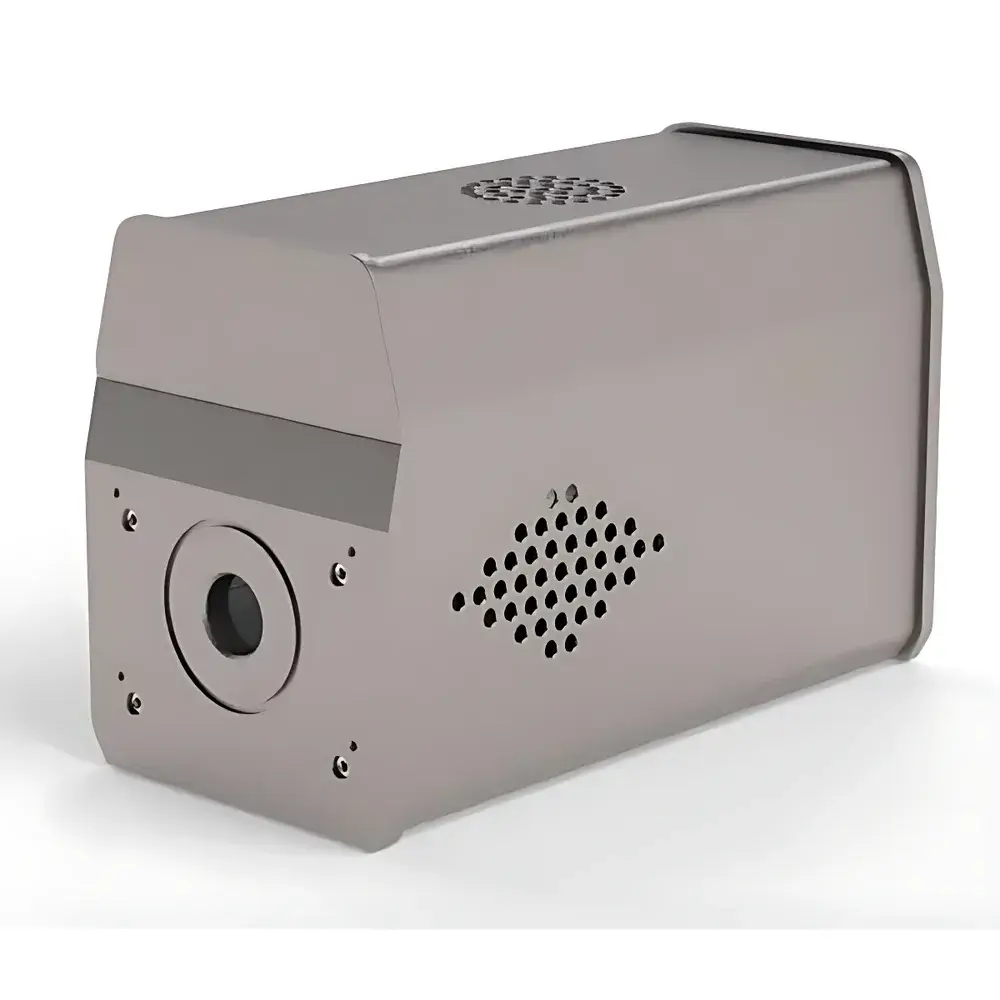
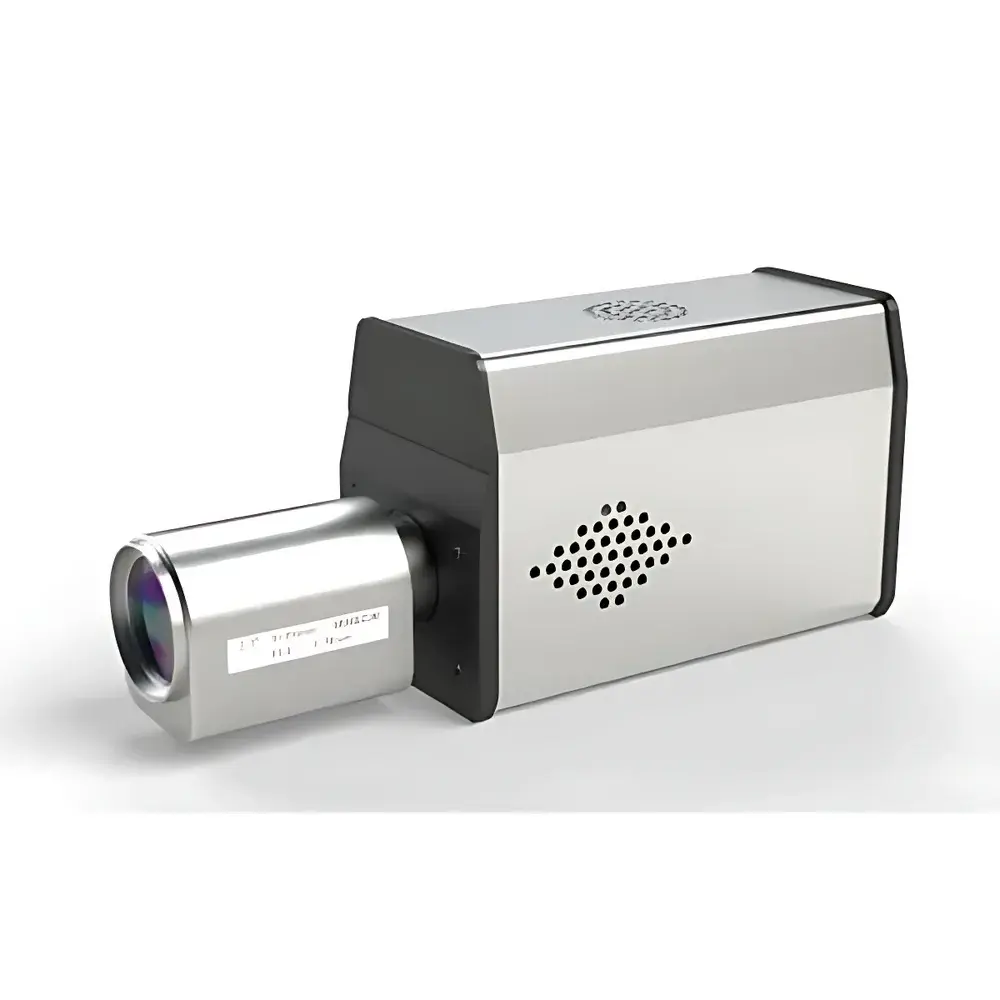
Auniontech PhoScu-ICMOS High-Speed Intensified CMOS Camera
| Brand | Auniontech |
|---|---|
| Origin | Shanghai, China |
| Manufacturer Type | Authorized Distributor |
| Product Category | Domestic |
| Model | PhoScu-ICMOS |
| Pricing | Upon Request |
| Image Resolution | 1920 × 1200 pixels |
| Pixel Size | 5.86 µm |
| Readout Noise | 6.8 e⁻ |
| Maximum Frame Rate (Full Resolution) | 164 fps |
| Dynamic Range | 72 dB |
| Digitization | 10-bit or 12-bit |
| Minimum Gate Width | 5 ns |
| Gate Width Increment | 500 ps |
| Maximum Gating Repetition Frequency | 300 kHz |
| Sensor Interface | USB 3.0 |
| Lens Mount | F-mount |
| Intensifier Types | Single-MCP (1MCP) or Dual-MCP (2MCP) |
| Input Diameter | 18 mm |
| Spectral Response Range | 175–950 nm |
| Photocathode Materials | S20, S25, GaAs |
| Phosphor Screen | P43 (standard) |
| Photon Gain (max) | 30,000 (1MCP), 100,000 (2MCP) |
| Equivalent Background Illumination | 0.25 µlx (typ.) |
| Spatial Resolution (Intensifier) | 60 lp/mm (1MCP) |
| Output Trigger Signals | Two independently adjustable TTL outputs (OUTA, OUTB) with delay and pulse width control |
| Coupling Method | Tapered fiber-optic coupling |
Overview
The Auniontech PhoScu-ICMOS is a high-performance, intensifier-coupled CMOS camera engineered for ultrafast, low-light scientific imaging applications requiring nanosecond temporal resolution and single-photon sensitivity. Unlike conventional CMOS cameras, the PhoScu-ICMOS integrates a Gen-II+ image intensifier—comprising a photocathode, microchannel plate (MCP), phosphor screen, and electron-optical focusing system—with a high-speed, low-noise CMOS sensor via tapered fiber-optic coupling. This architecture enables true gated imaging with sub-5 ns shutter control, making it suitable for time-resolved diagnostics where precise synchronization with pulsed lasers, LEDs, or plasma events is essential. The system operates on the principle of photoelectron amplification: incident photons strike the photocathode to emit electrons; these are multiplied within the MCP (1× or 2× stack), accelerated toward the phosphor screen to generate visible light, and finally imaged onto the CMOS sensor. This cascade delivers high gain (>30,000×), excellent signal-to-noise ratio, and intrinsic immunity to ambient light during gated acquisition.
Key Features
- Nanosecond-gated imaging with programmable gate widths down to 5 ns and 500 ps resolution
- Dual independent TTL output channels (OUTA & OUTB) for synchronized external device triggering—fully configurable in delay and pulse width
- Integrated high-precision timing controller enabling deterministic, jitter-free gating with <100 ps RMS jitter
- Two intensifier options: single-MCP (1MCP) for balanced gain/resolution or dual-MCP (2MCP) for maximum photon multiplication (up to 100,000×)
- High-resolution 1920 × 1200 CMOS sensor with 5.86 µm pixel pitch and ≤6.8 e⁻ readout noise
- Flexible digitization: selectable 10-bit (164 fps full resolution) or 12-bit (128 fps full resolution) modes
- F-mount lens interface with mechanical compatibility for standard C-mount adapters
- Compact, portable housing designed for integration into vacuum chambers, optical tables, and field-deployable LIDAR or LIBS systems
- Customizable configuration—including photocathode type (S20, S25, GaAs), spectral response (175–950 nm), phosphor (P43 standard), and fiber-optic taper ratio
Sample Compatibility & Compliance
The PhoScu-ICMOS supports broad spectral detection across UV-VIS-NIR (175–950 nm), accommodating diverse emission sources—from nitrogen-vacancy center fluorescence at 637 nm to vacuum UV plasma lines at 175 nm. Its 18 mm input diameter and tapered fiber coupling ensure optimal light throughput and spatial fidelity, preserving the intensifier’s native resolution of ≥60 line pairs per millimeter (lp/mm). The system complies with standard laboratory electromagnetic compatibility (EMC) requirements per IEC 61326-1 and meets RoHS Directive 2011/65/EU for hazardous substance restriction. While not certified for medical or aerospace use out-of-the-box, its firmware architecture supports audit-ready logging and timestamped metadata embedding—enabling alignment with GLP-compliant experimental workflows. For regulated environments (e.g., pharmaceutical process analytical technology), optional firmware upgrades provide FDA 21 CFR Part 11–compliant user access control and electronic signature functionality.
Software & Data Management
Auniontech provides the cross-platform PhoScu Control Suite, a native C++ application supporting Windows, Linux, and macOS. The software enables real-time parameter adjustment—including gate width, delay, bit depth, ROI selection, and trigger mode (internal/external/software)—with live histogram, frame averaging, and background subtraction. All acquired images embed EXIF-compatible metadata: absolute UTC timestamps (synchronized via internal oscillator), gate parameters, sensor temperature, and intensifier bias voltages. Data export supports HDF5 (for MATLAB/Python analysis), TIFF (16-bit linear), and AVI (lossless MJPEG compression). An SDK (C/C++, Python bindings) allows integration into custom LabVIEW, Python (NumPy/SciPy), or MATLAB-based acquisition pipelines. Raw frame buffers are accessible via memory-mapped I/O for low-latency streaming into FPGA-accelerated processing architectures.
Applications
- Plasma physics: Time-resolved imaging of laser-induced plasma dynamics, spark gap discharges, and fusion pellet implosions
- LIDAR & distance-gated imaging: Sub-meter range resolution in fog, smoke, or underwater environments using time-of-flight discrimination
- PLIF (Planar Laser-Induced Fluorescence): Quantitative 2D species concentration mapping in turbulent combustion with <10 ns temporal slicing
- LIBS (Laser-Induced Breakdown Spectroscopy): Gated spectral acquisition to suppress continuum background and enhance atomic line contrast
- Transient absorption spectroscopy: Pump-probe imaging with variable inter-pulse delays and femtosecond-laser-synchronized gating
- Time-resolved fluorescence & FLIM: Lifetime mapping of quantum dots, organic emitters, or biological fluorophores with TCSPC-compatible timing precision
- Quantum imaging: Coincidence detection in entangled photon experiments, ghost imaging, and intensity correlation measurements
- Pulsed Raman spectroscopy: Suppression of fluorescence interference through nanosecond spectral gating
FAQ
What is the minimum achievable gate width, and how is timing stability ensured?
Minimum gate width is 5 ns, adjustable in 500 ps increments. Timing stability is maintained by an onboard oven-controlled crystal oscillator (OCXO) with <100 ps RMS jitter and hardware-level trigger propagation path isolation.
Can the PhoScu-ICMOS be used in vacuum environments?
The standard unit is rated for ambient operation only. Vacuum-compatible variants (with hermetic feedthroughs and non-outgassing materials) are available under custom engineering order (lead time: 12–16 weeks).
Is the intensifier replaceable or upgradable post-purchase?
Yes—intensifier modules are field-swappable. Users may upgrade from 1MCP to 2MCP, or change photocathodes (e.g., S20 → GaAs) via authorized service centers with recalibration.
Does the camera support external synchronization with femtosecond laser systems?
Yes. The TTL input accepts 3.3 V / 5 V logic levels with <5 ns rise time. Optional NIM or LVDS input modules are available for direct integration with ultrafast laser timing controllers.
How is calibration traceability handled for quantitative intensity measurements?
Each unit ships with NIST-traceable responsivity calibration data (photons per ADU) measured at key wavelengths (254, 405, 532, 785, and 850 nm) using calibrated photodiodes and monochromators. Calibration files are loaded automatically by the control software.





