
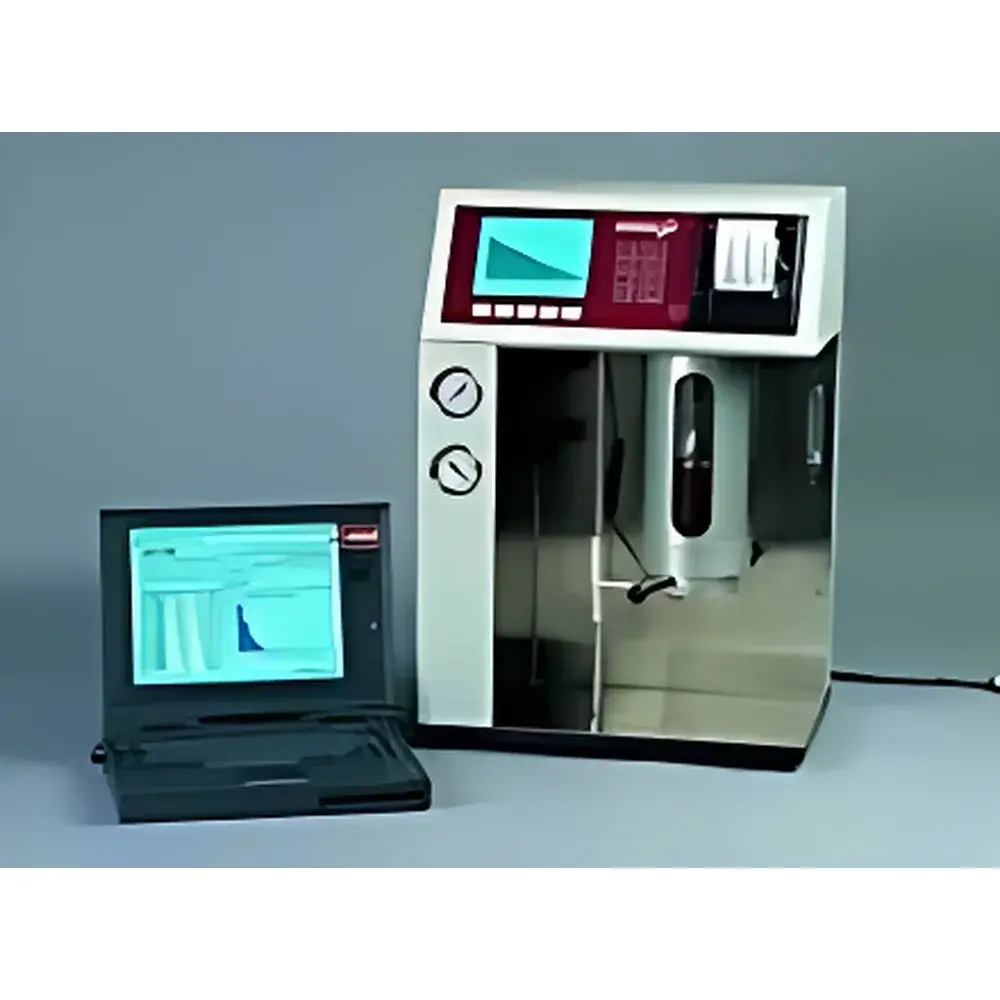
PAMAS SBSS Desktop Laboratory Particle Counter
| Brand | PAMAS |
|---|---|
| Origin | Germany |
| Model | SBSS |
| Instrument Type | Optical Particle Counter |
| Principle | Light Obscuration (LO) |
| Calibration Standards | ISO 4402 & ISO 11171 |
| Particle Size Range | 0.5–800 µm (sensor-dependent) |
| Adjustable Size Channels | Up to 32 |
| Sample Volume | 50–1000 mL |
| Max. Sampling Pressure | 30 bar |
| Max. Viscosity | 20,000 cSt |
| Display | 320×240 backlit LCD |
| Interface | RS-232C |
| Power Supply | 110/115/220/230 V, 50–60 Hz |
Overview
The PAMAS SBSS Desktop Laboratory Particle Counter is a precision-engineered optical particle counter designed for quantitative analysis of solid particulate contamination in liquid media. It operates on the well-established light obscuration (LO) principle—also known as the light blockage or extinction method—in which individual particles passing through a focused laser beam cause transient reductions in transmitted light intensity. These pulse signals are converted into electrical impulses proportional to particle cross-sectional area, enabling deterministic sizing and counting. The SBSS integrates a dedicated flow cell with high-stability optics and a programmable microprocessor-controlled fluidics system, ensuring repeatable volumetric sampling and high-resolution discrimination across a broad dynamic size range (0.5 µm to 800 µm, depending on sensor configuration). Its modular sensor architecture—including HCB-LD-100, HCB-LD-50/50, HCB-LD-25/25, and HCB-LD-15/25 variants—allows users to select optimal sensitivity and concentration tolerance for specific application requirements, from low-viscosity hydraulic oils to highly viscous polymer solutions and colloidal suspensions.
Key Features
- True dual-standard calibration compliant with both ISO 4402 (for mineral oil-based fluids) and ISO 11171 (for synthetic calibration standards), enabling traceable reporting per ISO 4406:2017, NAS 1638, SAE AS4059, and ASTM D6786.
- Up to 32 user-definable particle size channels, configurable via digital-to-analog threshold adjustment for granular distribution profiling.
- Automated vacuum-assisted sampling (up to 10 bar) and optional high-pressure sampling (up to 30 bar) with piston-driven positive displacement flow control for precise volume delivery (1–1000 mL).
- Integrated thermal printer (32-column) and RS-232C serial interface supporting ASCII data export for LIMS integration and audit-ready recordkeeping.
- Backlit graphical LCD (320 × 240 pixels) with real-time histogram display, cumulative count curves, and on-screen statistical summaries (e.g., particles/mL per size bin).
- Comprehensive sensor suite with documented sensitivity thresholds: 1 µm (ISO 4402), 3–4 µm (ISO 11171), and extended upper limits up to 850 µm (HCB-LD-100).
Sample Compatibility & Compliance
The SBSS accommodates a wide spectrum of industrial and pharmaceutical liquids under controlled pressure and viscosity constraints. Standard operation covers hydraulic oils, turbine oils, insulating oils, gear oils, engine oils, water-glycol fluids, and organic solvents—up to 400 cSt viscosity and 10 bar inlet pressure. For demanding applications—including polymer melts, gels, and high-viscosity lubricants—the high-pressure module supports viscosities up to 20,000 cSt at 30 bar. All sensor calibrations are performed using NIST-traceable latex sphere suspensions, validated per ISO 11171 Annex A and ISO 4402 Annex B. Optional USP and compliance mode enables pharmaceutical-grade particulate testing in parenteral solutions and ophthalmic preparations. System-level validation documentation supports GLP/GMP environments, including full audit trails, electronic signature readiness, and 21 CFR Part 11–compatible data handling when paired with certified laboratory software.
Software & Data Management
While the SBSS operates as a stand-alone instrument with embedded firmware, its ASCII-formatted output (8-bit, RS-232C) is fully compatible with third-party laboratory data management systems (LIMS), statistical process control (SPC) platforms, and custom Python/Matlab analysis scripts. Each measurement includes timestamped metadata: sample ID, volume aspirated, sensor ID, calibration standard used, and environmental parameters (if externally logged). Built-in memory retains the last 100 test records locally. For regulated environments, PAMAS provides optional validation packages—including IQ/OQ documentation templates, calibration logs, and traceability matrices—to support internal quality audits and regulatory inspections under ISO/IEC 17025 or FDA guidelines.
Applications
- Condition monitoring of hydraulic and lubrication systems in aerospace, power generation, and heavy machinery OEMs.
- Quality assurance of new and in-service oils per ISO 4406 classification codes and OEM-specific cleanliness specifications (e.g., Boeing D6-17487, GEK 32568).
- Validation of filtration efficiency and filter integrity testing in critical fluid circuits.
- Research and development of functional fluids, including nanofluids, bio-lubricants, and electric vehicle coolant formulations.
- Pharmaceutical manufacturing support for USP particulate matter testing in injectables and sterile preparations (when configured with HCB-LD-15/25 sensor and filtered sampling path).
- Academic and metrology lab use for inter-laboratory comparison studies and reference material characterization.
FAQ
What calibration standards does the SBSS support?
The SBSS is factory-calibrated to both ISO 4402 (using ACFTD-based standards) and ISO 11171 (using NIST-traceable PSL spheres), allowing direct conversion between ISO 4406 code formats and cross-standard reporting.
Can the SBSS analyze samples with viscosity above 400 cSt?
Yes—when equipped with the high-pressure sampling module and appropriate sensor (e.g., HCB-LD-25/25 or HCB-LD-15/25), it handles viscosities up to 20,000 cSt at pressures up to 30 bar.
How many size channels can be defined during a single analysis?
Users may configure up to 32 independent size thresholds, enabling full distribution histograms or targeted binning per industry-specific cleanliness codes.
Is the SBSS compliant with 21 CFR Part 11 requirements?
The instrument itself is not inherently Part 11–compliant, but its ASCII data stream and time-stamped output support integration into validated software platforms that provide electronic signatures, audit trails, and secure data archiving.
What is the minimum detectable particle size for different sensors?
Sensitivity depends on sensor selection: HCB-LD-15/25 detects ≥1 µm (ISO 4402) or ≥3 µm (ISO 11171); HCB-LD-50/50 detects ≥1 µm (ISO 4402) or ≥4 µm (ISO 11171); HCB-LD-100 detects ≥2.5 µm with extended upper range to 850 µm.



