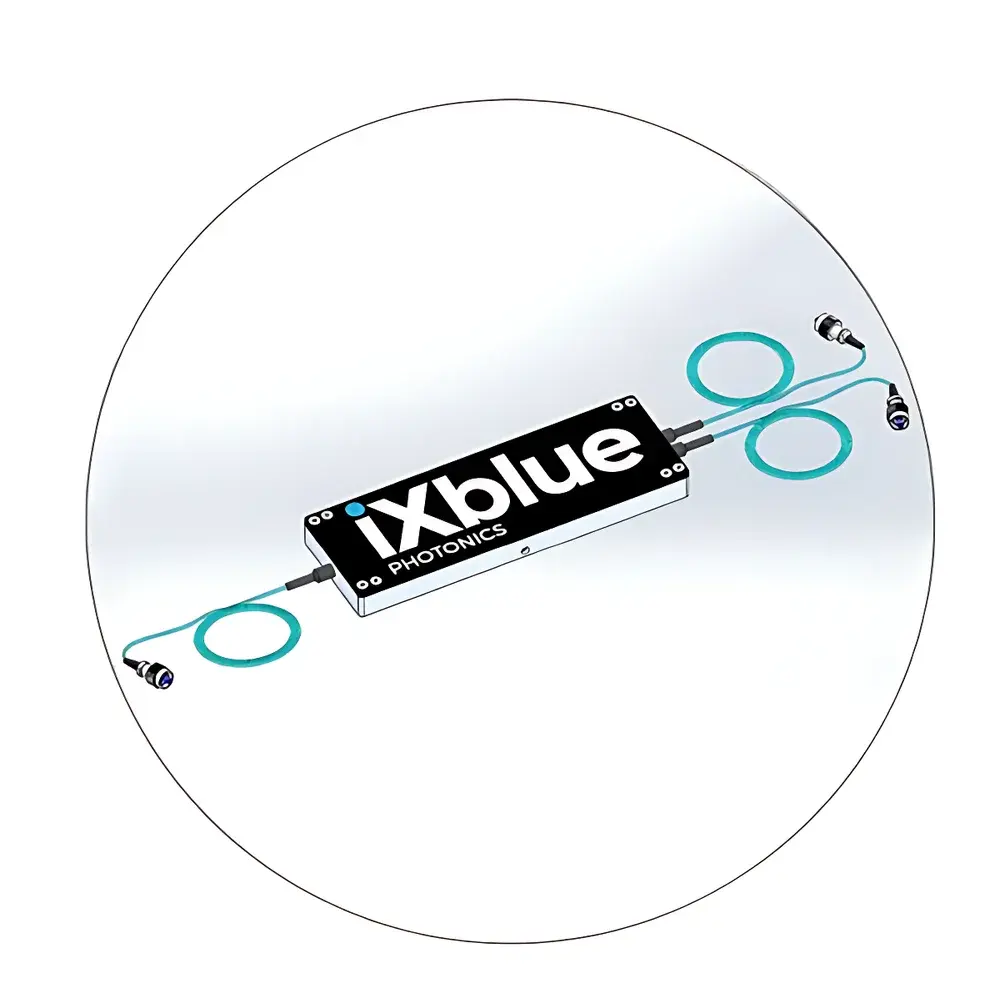
Ultra-Narrowband All-Fiber Tunable Bandpass Filter Module (1–4 GHz)
| Brand | IXFiber |
|---|---|
| Origin | France |
| Model | 1–4 GHz |
| FWHM Tuning Range | 1–4 GHz |
| Insertion Loss | < 4 dB |
| Optical Rejection Ratio @ ±10 GHz | > 25 dB |
| Fine Wavelength Tuning Range | ±100 pm |
| Fiber Type | PM or SMF |
| Compliance | RoHS, CE |
Overview
The Ultra-Narrowband All-Fiber Tunable Bandpass Filter Module (1–4 GHz) is a precision photonic component engineered for high-fidelity spectral selection in microwave photonics, quantum optical systems, and coherent sensing applications. Unlike conventional free-space or hybrid fiber–bulk-optic filters, this module employs monolithic fiber Bragg grating (FBG) technology integrated within a fully passive all-fiber architecture—eliminating air gaps, alignment-sensitive optics, and mechanical actuators. Its operational principle relies on thermally stabilized, chirped, and apodized FBGs written into polarization-maintaining (PM) or standard single-mode fiber (SMF), enabling wavelength-selective transmission with flat-top spectral response and steep roll-off characteristics. The filter operates in the C- and L-bands (1530–1625 nm), corresponding to RF passbands tunable from 1 to 4 GHz in the microwave domain via optical carrier modulation. This mapping between optical wavelength shift and RF frequency selectivity is calibrated per ITU-T G.694.2 and supports precise heterodyne detection, optical frequency discrimination, and narrow-linewidth laser stabilization.
Key Features
- All-fiber, monolithic design with no moving parts—ensures long-term stability, shock resistance, and immunity to misalignment
- Thermally encapsulated FBG structure maintains center wavelength drift < ±1 pm/°C over –5 to +70 °C operating range, compliant with Telcordia GR-1221-CORE reliability standards
- Flat-top passband profile with symmetrical edges (roll-off > 80 dB/nm) minimizes group delay distortion and preserves pulse integrity in time-domain applications
- Adjustable FWHM bandwidth from 1 GHz (≈8 pm at 1550 nm) to 4 GHz (≈32 pm), optimized for trade-offs between resolution and insertion loss
- Manual fine-tuning via external micrometer-driven thermal actuator enables ±100 pm center wavelength adjustment with sub-pm repeatability
- Low insertion loss ( 25 dB at ±10 GHz offset) meet requirements for ASE suppression and multi-wavelength laser mode control
- RoHS-compliant and CE-marked; compatible with standard FC/APC or SC/APC connectors; optional OEM housing with thermal anchoring flanges
Sample Compatibility & Compliance
This filter module is designed for integration into laboratory-grade and field-deployable photonic systems operating under GLP-aligned test environments. It supports both polarization-maintaining (PANDA or Bowtie-type) and standard single-mode fiber (ITU-T G.652.D) interfacing without additional coupling optics. The device complies with IEC 61300-2-4 (vibration), IEC 61300-2-1 (mechanical shock), and IEC 61300-2-17 (temperature cycling) test protocols. For regulated industries—including defense radar signal processing and quantum key distribution (QKD) infrastructure—the module’s traceable calibration certificate (NIST-traceable wavelength reference) and documented aging behavior (< 0.5 pm/year drift) support ISO/IEC 17025-compliant metrology workflows. No firmware or active electronics are present, eliminating concerns related to FDA 21 CFR Part 11 electronic record integrity.
Software & Data Management
As a passive, analog photonic component, this filter does not require driver software, firmware updates, or digital configuration interfaces. Wavelength tuning is purely mechanical–thermal and requires no host controller. However, for system-level integration, users may log tuning position (via encoder-equipped micrometer option), ambient temperature, and measured transmission spectra using third-party optical spectrum analyzers (e.g., Yokogawa AQ6370D or Keysight N77xx series). Raw spectral data can be exported in CSV or SDF format for post-processing in MATLAB, Python (using SciPy or PyOptica libraries), or LabVIEW-based automated test benches. Audit trails for calibration history and environmental exposure are maintained manually per laboratory SOPs—no embedded memory or timestamping functionality is implemented, consistent with passive component classification under ISO 9001:2015 Clause 7.1.5.
Applications
- Microwave photonics: RF photonic filtering, channelized receivers, and photonic-assisted ADC front-ends
- Quantum communication: Spectral purification of entangled photon pairs, heralding filter banks in time-bin QKD systems
- Coherent LiDAR and space communications: Narrowband interference rejection in free-space optical links
- Laser linewidth narrowing: Intracavity or external-cavity filtering for ultra-stable diode lasers and fiber lasers
- ASE noise suppression in EDFA and Raman amplifier chains
- Optical frequency discriminators for cavity ring-down spectroscopy and Doppler velocimetry
- Sensor interrogation: Demodulation of multiplexed FBG sensor arrays requiring GHz-level channel isolation
FAQ
Is this filter suitable for polarization-sensitive applications?
Yes—optional PM-fiber versions preserve state-of-polarization with extinction ratio > 20 dB across the full tuning range.
Can the center wavelength be locked electronically?
No—this is a manually tuned, thermally actuated device. For active locking, external PID-controlled thermal stages or piezoelectric stretchers must be integrated upstream.
What is the maximum input optical power rating?
Rated for continuous-wave operation up to +23 dBm (200 mW); higher peak powers require pulse-width and duty-cycle validation per IEC 60825-1.
Does the module include calibration documentation?
Each unit ships with a factory-measured spectral transmission report, including FWHM, IL, rejection band depth, and thermal drift coefficient—traceable to NPL/NIST wavelength standards.
Is custom bandwidth or center wavelength available?
Yes—IXFiber offers OEM customization for fixed or wider-tuning-range variants (e.g., 0.5–6 GHz FWHM, or C-band–extended L-band coverage) subject to minimum order quantities.