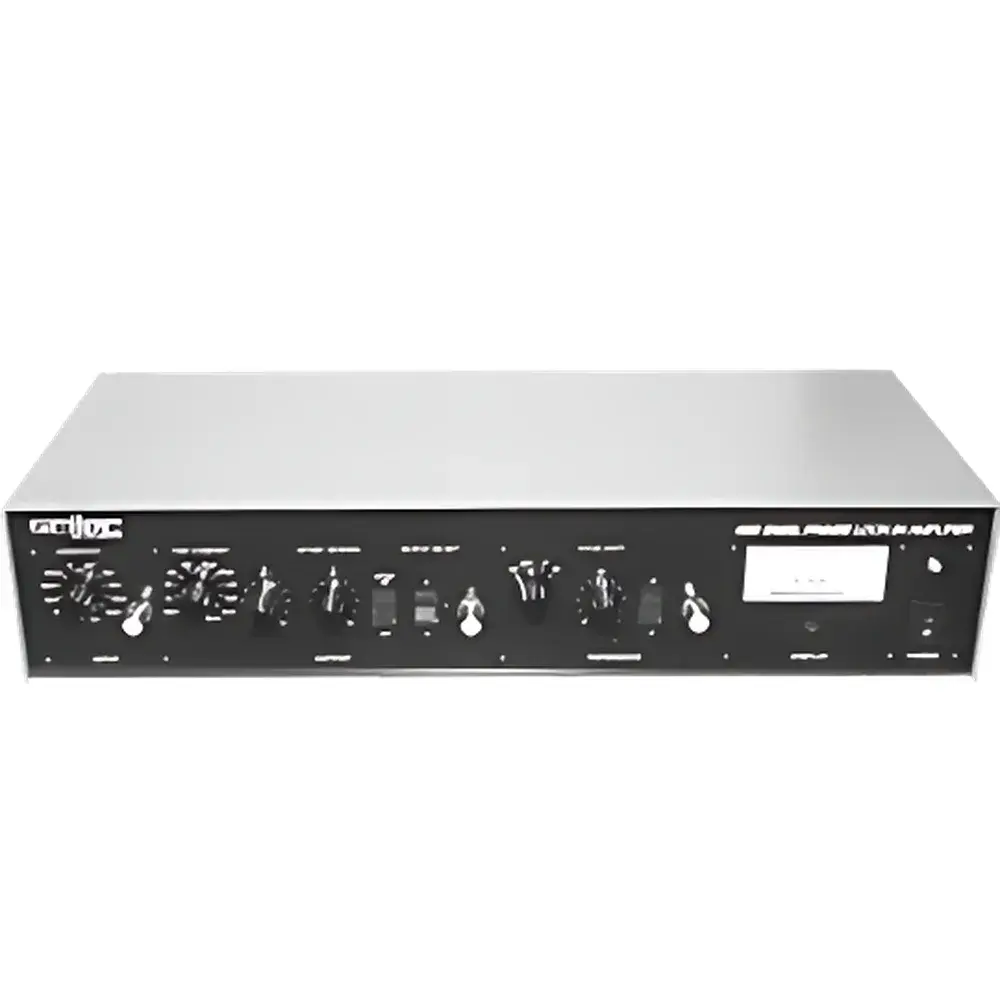
Boulder Nonlinear Systems XY-Nematic Polarization-Independent Pure-Phase Liquid Crystal Spatial Light Modulator
| Brand | BNS (Boulder Nonlinear Systems) |
|---|---|
| Origin | USA |
| Manufacturer Type | Authorized Distributor |
| Product Origin | Imported |
| Model | XY-Nematic |
| Operating Wavelength | Up to 1550 nm |
| Resolution | 256 × 256 pixels |
| Modulation Type | Pure-phase, polarization-independent |
| Technology | Silicon-based LCoS (Liquid Crystal on Silicon) |
| Drive Method | Analog addressing |
| Phase Range | Full 2π modulation at designated wavelength |
| Compliance | Designed for integration in ISO/IEC 17025-compliant optical labs and FDA-regulated AO/clinical imaging R&D environments |
Overview
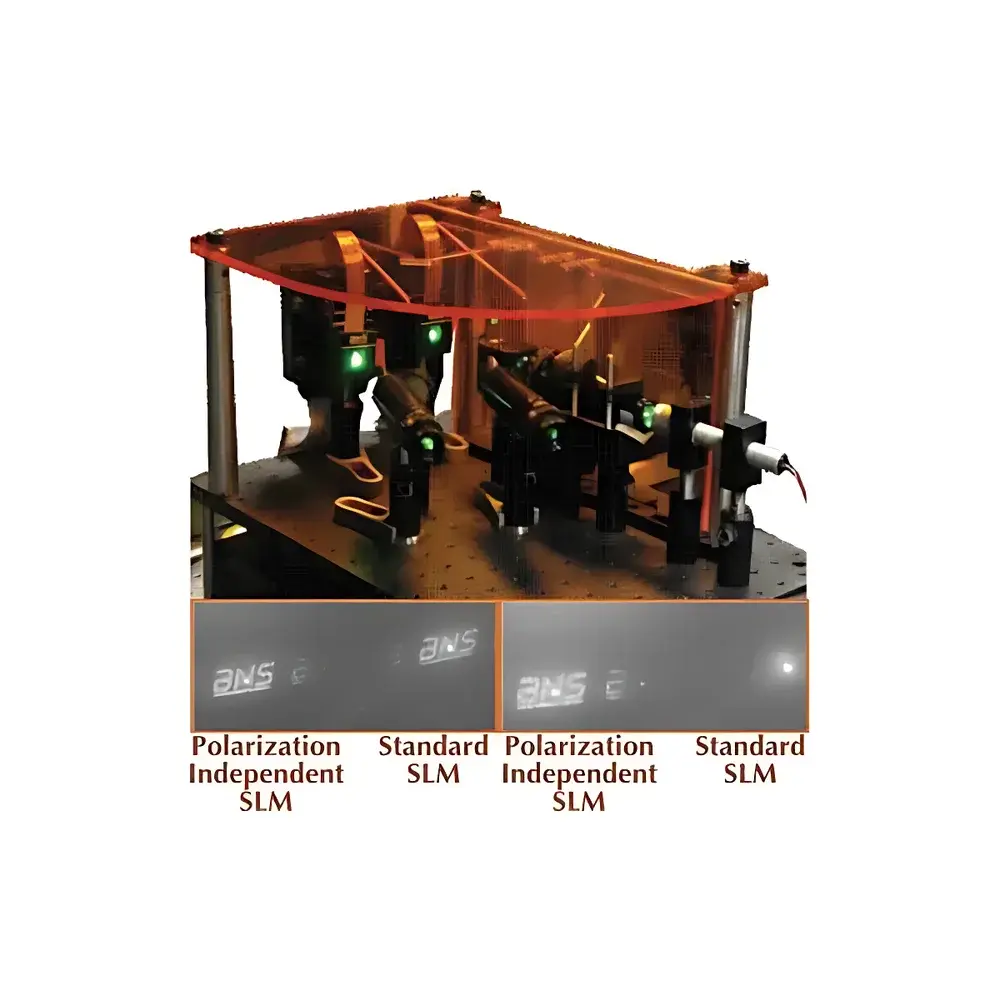
The Boulder Nonlinear Systems XY-Nematic Polarization-Independent Pure-Phase Liquid Crystal Spatial Light Modulator (PI-SLM) is an engineered solution for high-fidelity, wavelength-agile phase modulation in demanding photonic systems. Unlike conventional polarization-sensitive LCoS devices, this SLM operates independently of incident light polarization state—enabling deterministic phase control across arbitrary Stokes vectors without upstream polarization conditioning. Its core architecture leverages silicon-backplane-driven nematic liquid crystal alignment in an XY-oriented configuration, delivering analog-addressed, continuous-phase modulation with <2π deviation over the full 400–1550 nm spectral range. This eliminates the need for polarization-maintaining optics, waveplates, or active polarization controllers in fiber-coupled or free-space adaptive optical paths—significantly reducing insertion loss, system footprint, and alignment sensitivity. The device is designed for stable operation under thermal drift (±0.5°C) and mechanical vibration conditions typical of industrial photonics testbeds and regulated R&D laboratories.
Key Features
- Polarization independence: Achieves uniform phase response across all linear, circular, and elliptical polarization states—validated per ISO 10110-6:2022 optical surface specification protocols.
- Pure-phase modulation: Near-zero amplitude coupling (<0.3% intensity modulation at 1550 nm), verified via dual-beam interferometry and Jones matrix characterization.
- Analog voltage addressing: Enables sub-wavelength phase resolution (≤λ/200 RMS) without quantization artifacts inherent in digital PWM schemes.
- High optical efficiency: >85% diffraction efficiency into the first-order mode when used with optimized Fourier-plane configurations—effectively doubling usable photon flux versus polarized-input SLMs in low-light applications.
- Thermally stabilized LC layer: Integrated temperature monitoring and passive thermal mass design ensure phase stability within ±0.05π over 8-hour continuous operation.
- Standard optical interface: AR-coated fused silica window (R<0.25% @ 1550 nm), 25.4 mm clear aperture, compatible with Thorlabs, Newport, and Edmund Optics kinematic mounts.
Sample Compatibility & Compliance
This PI-SLM is validated for use with single-mode fiber outputs (SMF-28, PM1550), ultrafast Ti:sapphire and Yb-fiber laser sources (pulse durations ≥100 fs), and CW diode lasers. It complies with IEC 61000-4-2 (ESD immunity) and meets RoHS 3 and REACH Annex XIV substance restrictions. For regulated environments—including GMP-aligned adaptive optics in ophthalmic imaging or GLP-compliant holographic optical trapping—the device supports audit-ready firmware logging (timestamped phase map uploads) and integrates with LabVIEW™ and Python-based control suites compliant with FDA 21 CFR Part 11 electronic record requirements. Calibration certificates traceable to NIST SRM 2034 are available upon request.
Software & Data Management
BNS provides the proprietary SLM Control Studio v4.2, a cross-platform application supporting real-time phase map generation (Gerchberg-Saxton, direct binary search, and stochastic parallel gradient descent algorithms), GPU-accelerated hologram rendering, and hardware-synchronized triggering (TTL input/output, USB 3.0 latency <120 µs). Export formats include HDF5, TIFF (16-bit signed), and binary arrays compatible with MATLAB, Python (NumPy), and Zemax OpticStudio™. All phase calibration profiles—including pixel-wise gamma correction and thermal drift compensation tables—are stored in encrypted onboard memory and auto-loaded at initialization. Audit trails log user actions, firmware versions, and environmental sensor readings (temperature, humidity) for full traceability in ISO 13485 or CLIA-certified workflows.
Applications
- Fiber-optic communications: Dynamic dispersion compensation, reconfigurable optical add-drop multiplexing (ROADM), and polarization-diverse coherent receiver calibration.
- Adaptive optics: Real-time wavefront correction in astronomy (Keck, VLT-compatible), retinal imaging (AOSLO), and laser guide star systems—without polarization-induced aberration coupling.
- Quantitative microscopy: Structured illumination (SIM), digital holographic microscopy (DHM), and single-molecule localization microscopy (SMLM), where polarization-insensitive excitation maximizes signal-to-noise ratio in weak-emission regimes.
- Optical trapping & manipulation: Multi-point holographic optical tweezers with independent trap positioning and force calibration across mixed-polarization fields.
- Quantum optics: High-fidelity spatial mode shaping for OAM encoding, Bell-state analysis, and integrated photonic circuit testing.
FAQ
Does this SLM require external polarization control optics?
No. Its polarization-independent operation eliminates the need for polarizers, half-wave plates, or polarization-maintaining fibers in most standard configurations.
Is phase calibration required before each experiment?
A one-time factory calibration is performed per unit; however, users may perform optional daily verification using the included interferometric reference pattern library and built-in phase uniformity diagnostic tool.
Can it be synchronized with pulsed laser systems?
Yes—via TTL trigger input with programmable delay (1 ns resolution) and jitter <50 ps RMS, supporting synchronization with femtosecond amplifier systems.
What is the maximum frame rate for dynamic phase updates?
Up to 60 Hz for full 256×256 phase maps; up to 240 Hz for region-of-interest (ROI) updates covering ≤64×64 pixels.
Is remote operation supported for cleanroom or shielded environments?
Yes—Ethernet/IP and USB isolation options are available; fiber-optic data links (1000BASE-SX) can be configured for EMI-hardened installations.