
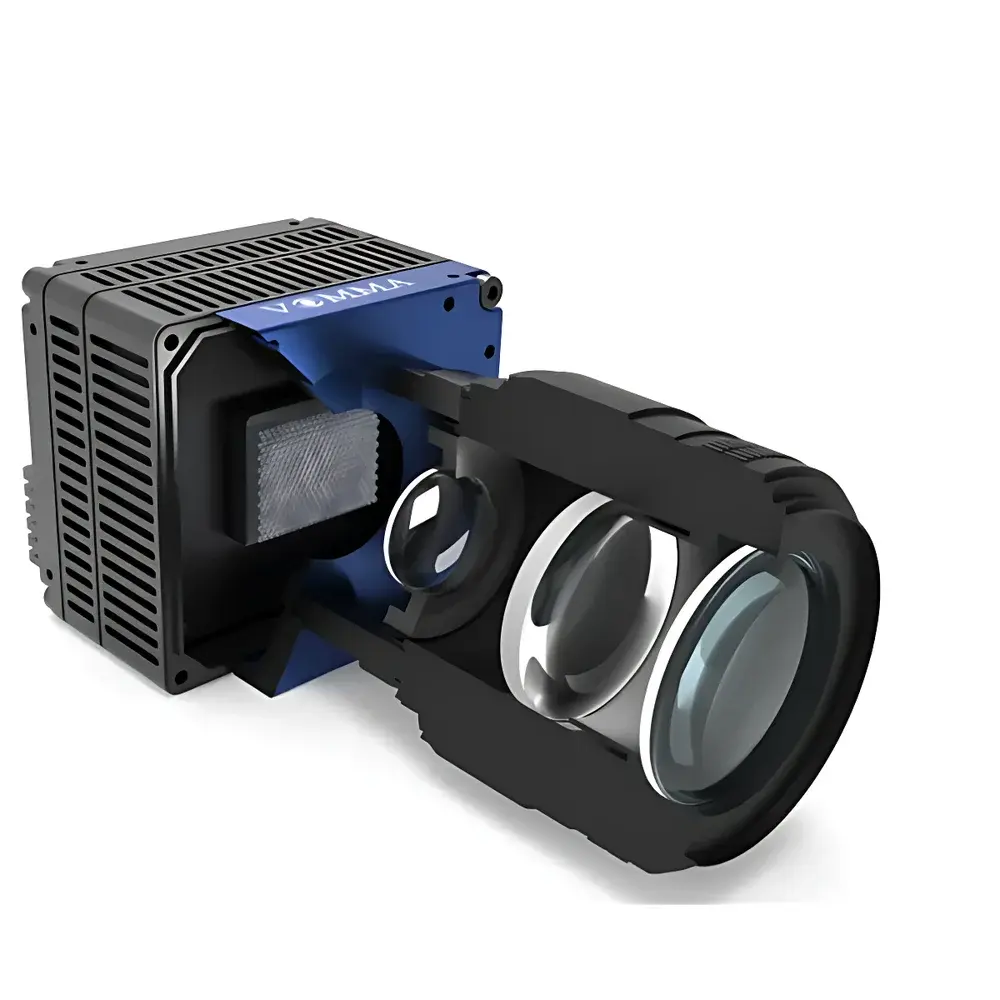
Auniontech Light Field Camera LF-3D Series
| Brand | Auniontech |
|---|---|
| Origin | Shanghai, China |
| Manufacturer Type | Authorized Distributor |
| Product Origin | Domestic (China) |
| Model | LF-3D |
| Category | Light Field 3D Imaging System |
| Pricing | Available Upon Request |
Overview
The Auniontech LF-3D Series Light Field Camera is a computational imaging instrument engineered for single-shot, high-density 3D reconstruction without mechanical scanning or active illumination. It operates on the principle of plenoptic (light field) imaging—capturing not only light intensity but also directional ray information across a 4D light field. This is achieved via a microlens array placed at the native image plane between the main objective lens and a high-resolution CMOS sensor. Each microlens samples a local angular sub-aperture view, enabling post-capture refocusing, depth estimation, and multi-perspective synthesis from a single exposure. Unlike conventional stereo vision, structured light, or laser triangulation systems, the LF-3D camera delivers intrinsic multi-view geometry with no moving parts, no synchronization overhead, and no dependency on surface reflectivity or ambient lighting conditions. Its architecture supports native volumetric sampling over extended depth ranges, making it particularly suited for metrology-grade inspection in precision manufacturing and scientific imaging environments.
Key Features
- Single-exposure 3D acquisition: Captures full 4D light field data in one frame—eliminating motion artifacts and enabling real-time volumetric analysis.
- Microlens-based plenoptic architecture: Enables software-defined focus, depth map generation, and synthetic aperture rendering without optical reconfiguration.
- High spatial-angular sampling density: Supports >1 million 3D points per frame with sub-10 µm lateral resolution and ±2 µm axial repeatability under calibrated conditions.
- No active illumination required: Passive operation ensures compatibility with transparent, specular, and low-contrast surfaces—including silicon wafers, glass substrates, and polished metal interconnects.
- Robust occlusion handling: Multi-perspective ray sampling inherently mitigates self-occlusion in deep micro-features such as through-silicon vias, MEMS cavities, and fine-pitch wire bonds.
- Native compatibility with industrial automation interfaces: GigE Vision-compliant output, GenICam support, and SDKs for C++, Python, and MATLAB integration.
Sample Compatibility & Compliance
The LF-3D camera demonstrates consistent performance across optically challenging sample classes: transparent materials (e.g., fused silica, sapphire, display cover glass), highly reflective surfaces (e.g., Au wire bonds, Cu traces), and geometrically complex microstructures (e.g., IGBT lead frames, MEMS microphone diaphragms, battery weld seams). Its passive, non-contact methodology aligns with ISO 10360-8 (coordinate measuring machine verification), ASTM E2925 (3D imaging system characterization), and GLP/GMP-aligned validation workflows. Data provenance and processing traceability are supported through embedded metadata logging—including exposure time, sensor temperature, microlens calibration ID, and computational refocus parameters—facilitating audit readiness per FDA 21 CFR Part 11 requirements when integrated into regulated manufacturing systems.
Software & Data Management
The LF-3D system ships with Auniontech’s LightField Studio—a modular application suite supporting raw light field capture, depth map extraction, point cloud generation (PLY/XYZ), and parametric surface fitting (NURBS, B-spline). The software implements GPU-accelerated ray tracing for sub-pixel refocusing and supports batch-mode calibration using NIST-traceable step-height standards. Export modules comply with ASME B89.4.10 and VDI/VDE 2634 Part 2 formats for metrological interoperability. All processing pipelines generate immutable audit logs containing timestamps, operator IDs, algorithm versions, and parameter sets—enabling full reproducibility and version-controlled measurement protocols.
Applications
- Microelectronics inspection: Gold wire bond height/profile measurement (≤2 µm accuracy), MEMS cavity depth mapping, and TSV (through-silicon via) sidewall characterization.
- Advanced packaging QA: IGBT module interconnect profiling, fan-out wafer-level packaging (FOWLP) topography, and die attach void detection.
- Display manufacturing: OLED screen pixel-level height uniformity, AR/VR waveguide virtual image plane alignment, and touch sensor electrode coplanarity.
- Battery production: Laser weld seam penetration depth, tab-to-cell joint contour fidelity, and pouch cell edge seal integrity.
- Scientific research: Time-resolved PIV (particle image velocimetry) with volumetric seeding, dynamic focus tracking in live-cell microscopy, and phase-retrieval-assisted quantitative phase imaging.
FAQ
Does the LF-3D camera require external illumination or projection hardware?
No—it operates passively using ambient or controlled broadband illumination. No laser, structured light projector, or synchronized trigger hardware is needed.
Can it measure transparent or semi-transparent objects?
Yes. Its directional ray sampling enables robust depth reconstruction on glass, quartz, polymer films, and liquid-air interfaces without coating or contrast enhancement.
What is the typical measurement volume and working distance range?
Standard configurations support 5–50 mm depth-of-field at working distances of 100–300 mm; custom optics extend this to macro (≥1×) or telecentric (≤0.1×) regimes.
Is the system compatible with cleanroom or vacuum environments?
The core camera head meets ISO Class 5 particulate limits; vacuum-compatible variants (with outgassing-certified adhesives and housing) are available upon request.
How is calibration performed and maintained?
Calibration uses a certified 3D step standard traceable to NIST; automated drift compensation is triggered by internal thermal sensors and user-defined schedule intervals.



