
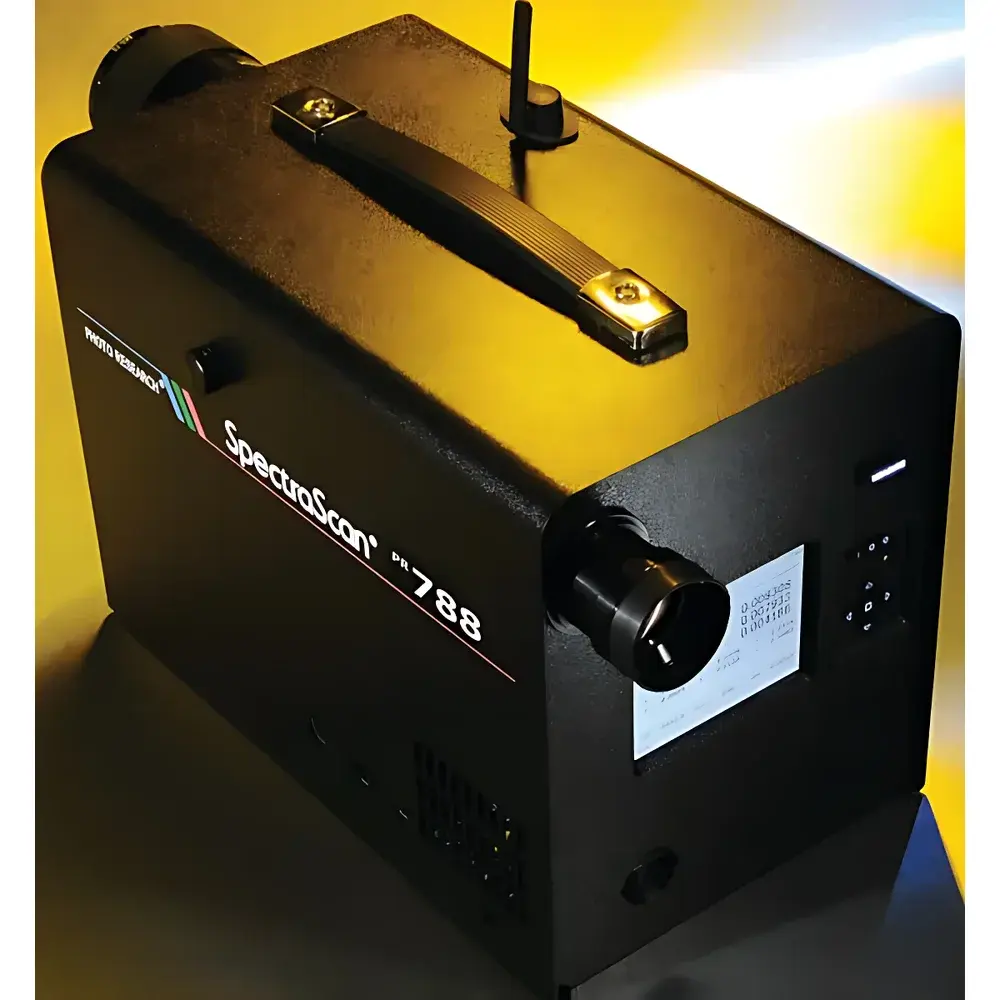
Photo Research PR-788 Wide Dynamic Range Spectroradiometer
| Brand | Photo Research |
|---|---|
| Model | PR-788 |
| Detector | 512-element cooled CCD array |
| Spectral Bandwidth | Standard 5 nm (optional 2/4/8 nm adjustable) |
| Wavelength Accuracy | < 0.4 nm |
| Spectral Resolution | 1 nm |
| Luminance Range | 1.71×10⁻⁵ to 6.85×10⁶ cd/m² (dependent on aperture and accessory) |
| Aperture Options | 2°, 1°, 0.5°, 0.25°, 0.125°, 0.1°, 0.1°×1° (horizontal slit), 0.5°×1.5° (vertical slit) |
| Colorimetric Accuracy | ±0.0015 CIE x,y |
| Colorimetric Repeatability | ±0.0005 CIE x,y |
| Polarization Error | < 0.2% |
| Stray Light | < 0.06% |
| Exposure Time | 7 ms – 120 s |
| Data Interface | USB, RS-232, Bluetooth |
| Storage | SD card |
| Power | Rechargeable Li-ion battery or 90–240 V AC adapter |
| Operating Temperature | 1–35 °C, ≤90% RH non-condensing |
| Weight | 6.01 kg |
| Dimensions | 28 × 17 × 20.3 cm |
| Digitization | 16-bit ADC |
| Synchronization Frequency | 20–2000 Hz |
Overview
The Photo Research PR-788 Wide Dynamic Range Spectroradiometer is a high-precision, field-deployable instrument engineered for absolute spectral radiance and luminance measurement across an industry-leading dynamic range of 1,000,000:1. Built upon the proven optical architecture of the PR-74X series, the PR-788 employs a thermoelectrically cooled 512-element linear CCD detector coupled with a high-fidelity Czerny-Turner monochromator to deliver traceable, NIST-compatible spectral data. Its core measurement principle relies on sequential wavelength scanning with calibrated photometric responsivity across the visible spectrum (380–780 nm), enabling direct calculation of CIE 1931 tristimulus values (X, Y, Z), chromaticity coordinates (x, y), correlated color temperature (CCT), and dominant wavelength — all without reliance on filter-based approximations. Designed explicitly for R&D validation, production-line quality control (QC), and regulatory-compliant QA workflows, the PR-788 eliminates the need for manual neutral density filtering or geometric reconfiguration when measuring from near-black (10⁶ cd/m²) emission sources — a critical capability for next-generation display technologies.
Key Features
- Unmatched 1,000,000:1 luminance dynamic range enables single-setup measurement from deep black to full-white output — no external ND filters or optical path modifications required.
- Configurable spectral bandwidth: standard 5 nm FWHM; optional fixed 2 nm or 8 nm; or motorized variable bandwidth (2/4/8 nm) for optimized resolution vs. signal-to-noise trade-offs.
- Thermoelectrically cooled 512-pixel CCD detector ensures low dark-current noise and high quantum efficiency across the visible spectrum.
- Seven discrete field-of-view apertures (2°, 1°, 0.5°, 0.25°, 0.125°, 0.1°, plus specialized slits) support precise spatial sampling for micro-displays, OLED pixels, and laser projection spots.
- Sub-300 ms measurement time at 3.42 cd/m² (2° FOV) enables high-throughput characterization in automated test environments (ATE).
- Triple communication interface (USB 2.0, RS-232, Bluetooth 4.2) facilitates seamless integration with LabVIEW, Python-based test scripts, or factory MES systems.
- Onboard SD card logging with timestamped metadata supports GLP/GMP audit trails and offline analysis.
Sample Compatibility & Compliance
The PR-788 is validated for use with emissive devices including OLED microdisplays, Mini/Micro-LED arrays, laser phosphor projectors (LCoS, DLP), automotive HUDs, and AR/VR waveguide emitters. Its spectral calibration is traceable to NIST SRM standards, and its photometric linearity conforms to CIE Publication 127:2007 and ISO/CIE 19476:2014 for LED measurement. Chromaticity accuracy (±0.0015 Δx,y) and repeatability (±0.0005 Δx,y) meet requirements for ISO 13406-2, IEC 62341-6-3 (OLED), and ANSI IT7.215 (projection). The instrument supports configurable synchronization (20–2000 Hz) for pulsed or PWM-driven sources, satisfying temporal measurement needs outlined in IEC 62777 and ENERGY STAR Program Requirements v8.0. All firmware and data handling comply with FDA 21 CFR Part 11 electronic record/electronic signature (ERES) principles when operated with validated software configurations.
Software & Data Management
The PR-788 operates with Photo Research’s SpectraWin™ v6.x software suite, which provides real-time spectral visualization, multi-parameter reporting (luminance, CCT, Duv, gamut coverage, ΔE₀₀), and customizable pass/fail thresholds. Raw spectral data is exported in ASCII (.dat) or CSV format with full metadata (aperture, integration time, calibration date, serial number). Audit-trail functionality logs all user actions, parameter changes, and calibration events with timestamps and operator IDs — essential for ISO 17025-accredited labs. Third-party integration is supported via COM/ActiveX APIs and SCPI command sets over USB/RS-232, enabling compatibility with Keysight PathWave, NI TestStand, and custom Python automation frameworks using PySerial or pyvisa.
Applications
- Backlight unit (BLU) uniformity and spectral stability testing across LCD and quantum-dot hybrid displays.
- OLED pixel-level luminance and chromaticity mapping for Mura defect detection and burn-in assessment.
- Laser projector primary channel calibration and white-point drift monitoring under thermal load.
- Automotive interior lighting compliance verification per SAE J1383 and UNECE Regulation 128.
- AR/VR near-eye display luminance uniformity, angular dependency, and flicker analysis (flicker index, percent modulation).
- Regulatory submission support for ENERGY STAR, TCO Certified, and DisplayPort Adaptive-Sync conformance testing.
FAQ
What is the lowest measurable luminance level with the PR-788?
The instrument achieves a minimum detectable luminance of 1.71×10⁻⁵ cd/m² using the 2° aperture and MS-75 telescope accessory under optimal integration conditions.
Can the PR-788 measure pulsed or modulated light sources?
Yes — internal hardware synchronization supports trigger frequencies from 20 Hz to 2000 Hz, allowing phase-locked spectral acquisition synchronized to source drive signals.
Is spectral calibration traceable to national standards?
All factory calibrations are performed against NIST-traceable reference lamps and reflectance standards; calibration certificates include uncertainty budgets per ISO/IEC 17025 guidelines.
How is data integrity ensured during long-duration measurements?
The embedded 16-bit ADC, temperature-stabilized detector housing, and real-time dark-spectrum subtraction minimize drift; onboard SD logging includes CRC-32 checksums for file integrity verification.
Does the PR-788 support automated report generation compliant with ISO 17025?
SpectraWin™ supports templated PDF/Excel export with embedded calibration certificates, operator credentials, environmental metadata, and statistical summaries — fully configurable for accredited lab workflows.




