
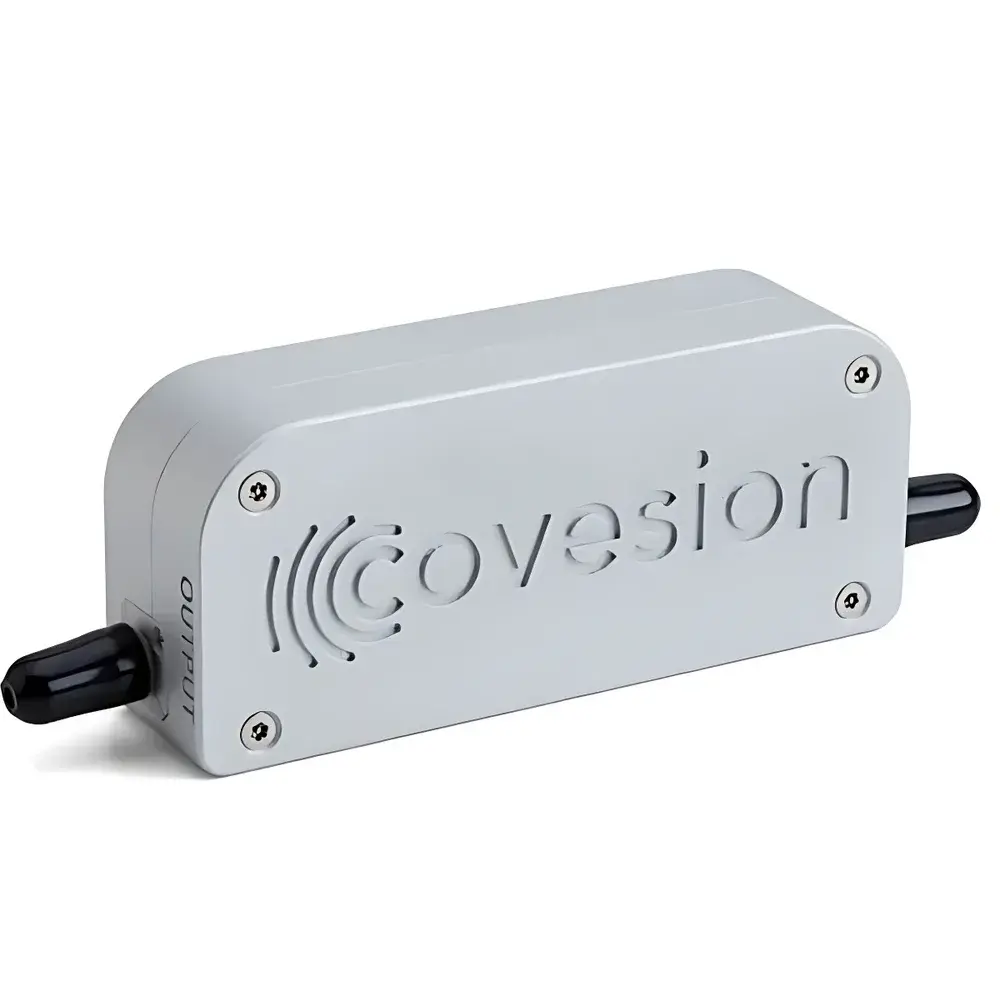
Covesion PPLN Waveguide Chip & Packaged Module
| Brand | Covesion |
|---|---|
| Origin | United Kingdom |
| Product Type | Periodically Poled Lithium Niobate (MgO-doped) Waveguide Device |
| Model | WG-1540 / WG-1550 / WG-1560 |
| Configuration Options | Bare Chip, Fiber-Pigtailed (APC), Thermally Tunable Package with Integrated Heater |
| Wavelength Support | 1540 nm, 1550 nm, 1560 nm (SHG-ready) |
| Operating Principle | Quasi-Phase-Matched Second Harmonic Generation (QPM-SHG) in MgO:PPLN Ridge Waveguide |
Overview
Covesion’s periodically poled lithium niobate (PPLN) waveguide devices are engineered for high-efficiency, narrowband nonlinear frequency conversion in the near-infrared (NIR) spectral region. Built on magnesium oxide–doped lithium niobate (MgO:PPLN) substrates and fabricated using precision ridge waveguide technology, these devices enable robust quasi-phase-matched (QPM) second harmonic generation (SHG) at telecom-relevant wavelengths—including 1540 nm, 1550 nm, and 1560 nm pump inputs—yielding visible output at ~770–780 nm. Unlike bulk crystals, the guided-wave architecture confines optical power over extended interaction lengths while maintaining diffraction-limited mode overlap, resulting in significantly enhanced conversion efficiency per unit pump power. The waveguides operate under low-power CW or pulsed laser excitation and are optimized for integration into compact, alignment-free photonic systems where stability, reproducibility, and long-term reliability are critical.
Key Features
- Ridge-type MgO:PPLN waveguide structure providing low propagation loss (<0.3 dB/cm) and high mode confinement
- Pre-engineered poling periods for phase-matching at 1540 nm, 1550 nm, and 1560 nm fundamental wavelengths (SHG)
- Multiple packaging options: bare die chips for OEM integration, ruggedized fiber-pigtailed modules with angled physical contact (APC) connectors, and thermally tunable packages with integrated micro-heaters
- Standard fiber input (SMF-28 or PM fiber); output configurable as fiber-coupled or free-space via integrated collimators
- Integrated thermal management: heater elements co-fabricated on the chip substrate, enabling precise temperature tuning of phase-matching condition (±0.1 °C resolution)
- Compatible with commercial temperature controllers supporting PID regulation and real-time monitoring (e.g., Thorlabs TED200C, ILX Lightwave LDT-5948)
Sample Compatibility & Compliance
Covesion PPLN waveguides are designed for use with polarization-maintaining (PM) or standard single-mode fiber-coupled lasers operating in the C-band (1530–1565 nm). They comply with industry-standard handling protocols for lithium niobate photonic components, including humidity-controlled storage (≤40% RH), ESD-safe mounting, and cleanroom-compatible packaging. While not certified to a specific ISO/IEC standard by default, all devices are manufactured under controlled cleanroom conditions (Class 1000 or better) and undergo rigorous optical inspection and functional verification per internal quality control procedures aligned with ISO 9001 principles. For regulated environments—such as quantum optics labs operating under GLP or photonics R&D facilities subject to FDA 21 CFR Part 11 data integrity requirements—the optional temperature controller units support audit-trail logging and user-access controls when paired with compliant software interfaces.
Software & Data Management
No proprietary firmware or embedded software resides on the waveguide itself; operation is fully hardware-driven and controller-agnostic. However, Covesion provides comprehensive technical documentation—including poling period tables, thermal tuning curves (ΔT vs. λSHG), coupling efficiency maps, and polarization-dependent loss (PDL) characterization reports—for each batch. These datasets are delivered in machine-readable formats (CSV, PDF) and may be imported into LabVIEW, MATLAB, or Python-based automation frameworks for closed-loop wavelength stabilization or calibration traceability. Optional third-party controller integration enables synchronization with DAQ systems for time-stamped thermal setpoint logging, essential for compliance with ISO/IEC 17025-accredited metrology workflows.
Applications
- Generation of visible light (770–780 nm) from telecom-band infrared lasers for quantum memory interfacing and atomic spectroscopy (e.g., Rb D1 line excitation)
- Compact, fiber-integrated sources for optical coherence tomography (OCT) and multiphoton microscopy requiring stable, narrow-linewidth visible output
- Wavelength-agile local oscillators in coherent LiDAR and free-space optical communications
- OEM subsystems in portable gas sensing platforms leveraging SHG-based absorption spectroscopy around 780 nm (e.g., O2, CH4)
- Frequency doubling stages in ultrafast laser systems where dispersion management and spatial mode fidelity are critical
FAQ
What is the typical conversion efficiency for WG-1550 under 100 mW CW pump power?
Conversion efficiency is highly dependent on polarization alignment, mode matching, and thermal setpoint. Under optimal conditions (TE-polarized, temperature-tuned, fiber-coupled), measured SHG power typically ranges from 1.5% to 3.5% (1.5–3.5 mW visible output).
Can the waveguide be used for sum-frequency generation (SFG) or optical parametric oscillation (OPO)?
Yes—while optimized for SHG, the same MgO:PPLN ridge platform supports other QPM processes. SFG and OPO configurations require custom poling design and appropriate cavity or pump architecture; consult Covesion’s technical team for feasibility assessment and phase-matching modeling.
Is anti-reflection coating included on the waveguide facets?
All packaged modules feature AR coatings optimized for 1550 nm ±20 nm (input) and 775 nm ±10 nm (output). Bare chips are supplied uncoated but can be coated per customer specification.
Do you provide test reports with individual device serial numbers?
Yes—each shipped unit includes a Certificate of Conformance (CoC) listing measured insertion loss, polarization extinction ratio (PER), and thermal tuning slope, traceable to NIST-calibrated instrumentation.
Related Products



