
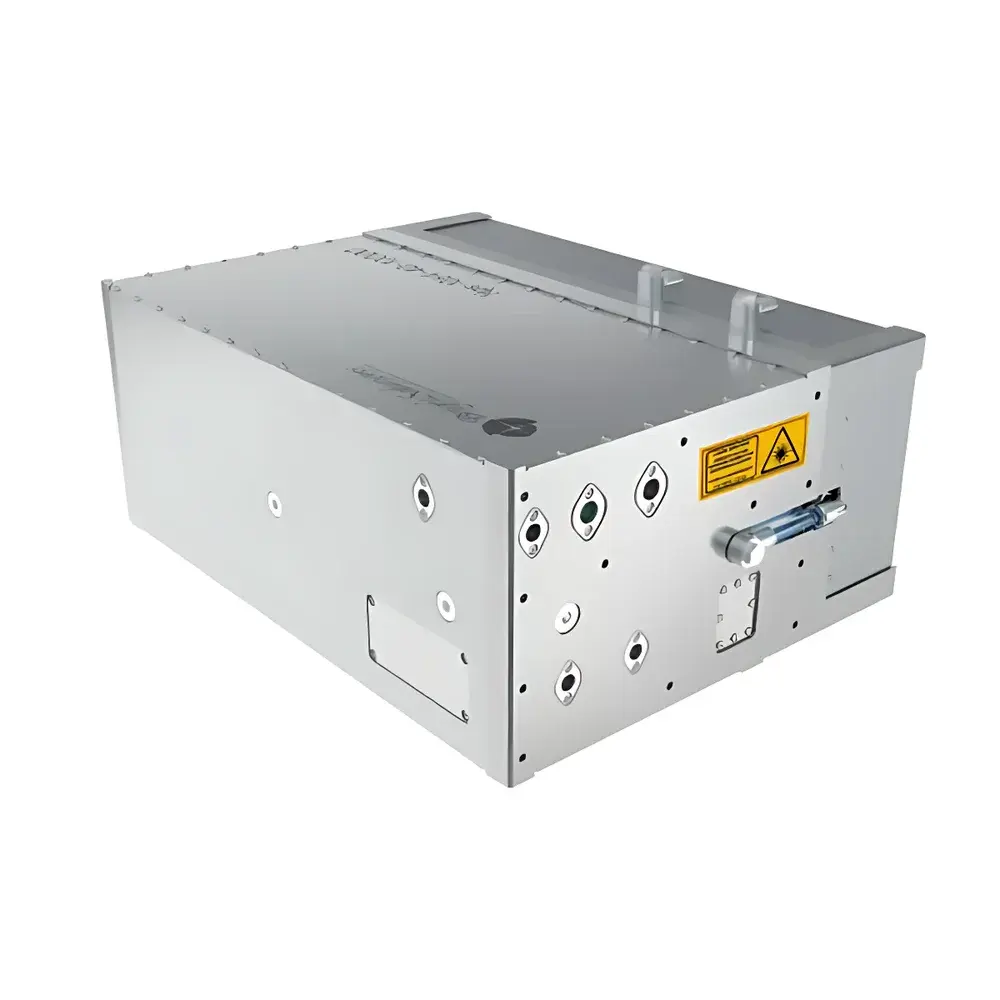
Bright Solutions NPS Narrowband Ultrafast Picosecond Laser System
| Brand | Bright Solutions |
|---|---|
| Origin | Italy |
| Model | NPS-1064-10 (Research-Grade Picosecond Laser) |
| Wavelength Options | 1064.3 nm, 532 nm, 355 nm, 266 nm |
| Pulse Width | 7 ps |
| Repetition Rate | 40 MHz (up to 80 MHz) |
| Average Output Power | 10 W @ 1064 nm, 5 W @ 532 nm, 1.5 W @ 355 nm |
| Spectral Linewidth | < 100 pm (< 0.1 nm) |
| Time-Bandwidth Product | < 0.5 |
| Beam Quality | M² < 1.5 |
| Polarization | Linear, >100:1 Extinction Ratio |
| RF Sideband Suppression | >50 dBc |
| Electrical Supply | 24 V DC |
| Operating Temperature | 15–35 °C |
| Cooling | Water-cooled (air-cooling optional) |
Overview
The Bright Solutions NPS Narrowband Ultrafast Picosecond Laser System is a research-grade, diode-pumped solid-state (DPSS) laser platform engineered for high-spectral-fidelity ultrafast applications. Built upon a hybrid architecture that integrates fiber-seeded amplification with bulk crystal gain media, the NPS series delivers transform-limited picosecond pulses with exceptional wavelength stability and narrow spectral bandwidth. Its fundamental emission at 1064.3 ± 0.1 nm—generated via mode-locked Yb-doped fiber oscillator followed by regenerative or multipass amplification—is intrinsically suited for seeding Nd:YAG or Nd:YVO₄-based amplifier chains and optical parametric oscillators (OPOs). The system operates at a fixed repetition rate of 40 MHz (scalable to 80 MHz), with pulse duration precisely maintained at 7 ps across all harmonic outputs. This combination of narrow linewidth (<100 pm), low time-bandwidth product (<0.5), and diffraction-limited beam quality (M² < 1.5) ensures minimal chirp and high temporal coherence—critical for coherent Raman spectroscopy, time-resolved pump-probe experiments, and nonlinear frequency conversion processes requiring high peak power and spectral selectivity.
Key Features
- Four-wavelength output capability: fundamental (1064.3 nm), second harmonic (532 nm), third harmonic (355 nm), and fourth harmonic (266 nm), each optimized for spectral purity and spatial mode integrity
- Transform-limited pulse generation with <100 pm spectral linewidth and <0.5 time-bandwidth product, enabling high-resolution spectral interrogation
- Stable linear polarization (>100:1 extinction ratio) and low RF sideband suppression (>50 dBc) for interferometric and heterodyne detection compatibility
- Integrated external trigger input (TTL/LVDS) supporting precise synchronization with delay generators, CCD/CMOS cameras, or lock-in amplifiers
- Modular thermal management architecture: standard water cooling with optional air-cooled configuration for space-constrained or mobile laboratory environments
- Robust mechanical design compliant with ISO 10110 optical mounting standards and RoHS directive requirements
Sample Compatibility & Compliance
The NPS laser system is designed for integration into regulated and academic research environments where traceability and reproducibility are essential. It meets CE marking requirements for electromagnetic compatibility (EN 61326-1) and safety (EN 60825-1:2014 Class 4 laser product). While not certified for IEC 61508 or FDA 21 CFR Part 11 out-of-the-box, its deterministic timing interface, stable power output (<0.5% RMS power fluctuation over 8 hours), and onboard temperature logging enable full compliance with GLP and GMP documentation workflows when deployed within validated instrument platforms. The laser is routinely used in laboratories adhering to ASTM E2912 (standard practice for Raman spectrometer calibration) and ISO/IEC 17025-accredited measurement procedures.
Software & Data Management
The NPS platform includes a USB 2.0–connected control interface compatible with Windows and Linux operating systems. Bright Solutions’ proprietary LaserControl GUI provides real-time monitoring of diode current, cavity temperature, output power, and internal photodiode feedback signals. All operational parameters—including pulse energy history, thermal drift logs, and synchronization status—are timestamped and exportable in CSV or HDF5 format. For automated experimentation, a documented SCPI command set supports integration with LabVIEW, Python (PyVISA), MATLAB, and EPICS-based control frameworks. Audit trails can be enabled to record user-initiated parameter changes—supporting alignment with ALCOA+ data integrity principles in regulated spectroscopy applications.
Applications
- Coherent anti-Stokes Raman scattering (CARS) and stimulated Raman scattering (SRS) microscopy, leveraging narrow linewidth for vibrational mode selectivity
- Pump-probe spectroscopy in condensed matter physics, including carrier dynamics in 2D materials and perovskite semiconductors
- Optical parametric oscillator (OPO) pumping for tunable mid-IR generation in trace gas sensing and molecular fingerprinting
- Precision ablation and surface structuring of transparent dielectrics and thin-film photovoltaics, enabled by high peak intensity and minimal thermal diffusion
- Time-of-flight LIDAR and atmospheric backscatter profiling, benefiting from high repetition rate and beam quality for long-range signal-to-noise optimization
- Quantum optics experiments involving photon pair generation via spontaneous parametric down-conversion (SPDC), where spectral purity directly impacts entanglement fidelity
FAQ
Is the NPS laser suitable for integration into OEM instrumentation?
Yes—the NPS platform features standardized mechanical interfaces (ISO 30 mm kinematic mounts), TTL-triggered Q-switch control, and RS-232/USB digital communication for embedded system integration.
What is the typical warm-up time to achieve spectral and power stability?
Less than 15 minutes under ambient conditions (20–25 °C); full thermal equilibrium and sub-picometer wavelength stability achieved within 30 minutes.
Can the repetition rate be adjusted externally?
The base model operates at fixed 40 MHz; variable repetition rates (1–80 MHz) require custom cavity length tuning and are available as factory-configured options.
Does the system include harmonic generation modules internally?
Yes—SHG (532 nm), THG (355 nm), and FHG (266 nm) modules are integrated into the same sealed optical bench and thermally stabilized for long-term phase-matching retention.
What maintenance is required during routine operation?
No consumables or periodic alignment needed; annual verification of output power calibration and thermal sensor accuracy is recommended per ISO/IEC 17025 guidelines.





