
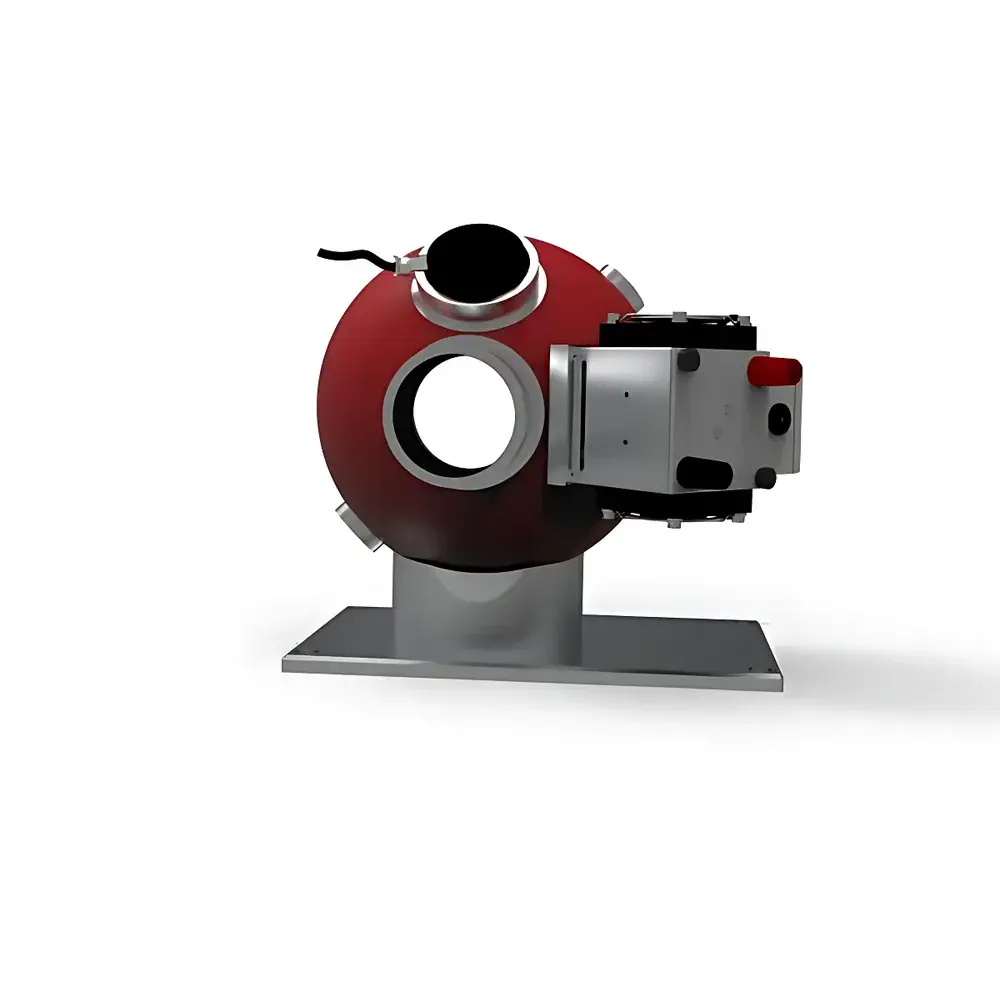
Gigahertz-Optik ISS-5P Integrating Sphere Uniform Source with Continuous Emission Spectrum
| Brand | Gigahertz-Optik |
|---|---|
| Origin | Germany |
| Model | ISS-5P |
| Sphere Diameter | 170 mm |
| Port Diameter | 50.8 mm |
| Coating | Spectralon® (BaSO₄-equivalent) |
| Light Source | 100 W Tungsten-Halogen Lamp |
| CCT Options | 2856 K & 3100 K |
| Spectral Range | 300–2500 nm |
| Calibration Traceability | ISO/IEC 17025-accredited |
| Detector Integration | Real-time CCT, Luminance, and Spectral Radiance Monitoring |
| Aperture Control | Manual (ISS-5P) or Motorized Remote (ISS-17-VAM variant) |
| Optional Diffuser Window | Yes |
Overview
The Gigahertz-Optik ISS-5P is a precision-engineered integrating sphere uniform source designed for high-dynamic-range radiometric and photometric calibration of imaging sensors, camera systems, spectroradiometers, and non-imaging optical detectors. Operating on the fundamental principle of multiple diffuse reflections within a highly reflective, spectrally neutral cavity, the ISS-5P delivers spatially uniform, Lambertian illumination across its 50.8 mm output port—enabling repeatable, geometry-independent measurement conditions essential for ISO 12233, ISO 15739, EMVA 1288, and ASTM E308-compliant testing. Its continuous tungsten-halogen emission spectrum (300–2500 nm) provides broad spectral coverage suitable for both visible/NIR characterization and extended IR validation workflows. The system integrates a calibrated 100 W halogen lamp with selectable correlated color temperatures (2856 K and 3100 K), allowing users to emulate standard illuminants while maintaining stable spectral shape over extended operational lifetimes (up to 2000 hours per lamp).
Key Features
- 170 mm diameter integrating sphere with high-reflectance (>97% @ 400–1500 nm), thermally stable BaSO₄-based Spectralon® coating ensuring minimal spectral distortion and long-term reflectance consistency.
- Manually adjustable aperture between lamp and sphere enables precise, continuous control of spectral radiance and luminance while preserving constant CCT—critical for dynamic range mapping and linearity verification.
- Integrated real-time monitoring via factory-calibrated detectors: simultaneous measurement of luminance (cd/m²), correlated color temperature (CCT), and relative spectral radiance (300–2500 nm) referenced to NIST-traceable standards.
- Optional motorized variable aperture (ISS-17-VAM configuration) supports automated intensity ramping, shutter synchronization, and integration into programmable test sequences via USB/Ethernet interface.
- Interchangeable diffuser window mount permits insertion of calibrated ground-glass or polymer diffusers to further homogenize angular distribution—particularly beneficial for wide-FOV sensor calibration and stray-light analysis.
Sample Compatibility & Compliance
The ISS-5P accommodates a wide range of optical devices, including CMOS/CCD image sensors, scientific cameras, radiometric imagers, photodiodes, and fiber-coupled spectrometers. Its 50.8 mm port enables direct coupling to lens mounts, integrating spheres, or collimation optics without vignetting. All radiometric calibrations—including spectral radiance, luminance, and CCT—are performed in accordance with ISO/IEC 17025 requirements by Gigahertz-Optik’s DAkkS-accredited calibration laboratory. Certificates include full uncertainty budgets (k = 2), traceability statements to PTB (Physikalisch-Technische Bundesanstalt), and spectral responsivity corrections applied to detector readings. The system complies with relevant sections of IEC 62471 (photobiological safety), ISO 9241-307 (display uniformity), and supports GLP/GMP audit readiness through documented calibration history and environmental condition logging.
Software & Data Management
The ISS-5P operates via Gigahertz-Optik’s proprietary luxsoft® control software, which provides intuitive GUI-based lamp power regulation, aperture positioning (for VAM variants), real-time detector readouts, and automated data logging in CSV and HDF5 formats. Software supports scripting via Python API (pyGigahertz), enabling integration into custom test benches compliant with IEEE 1622 or SCPI command sets. All calibration data—including spectral irradiance tables, CCT deviation curves, and spatial uniformity maps—is embedded in instrument metadata and exportable for traceability reporting. Audit trails record operator ID, timestamp, ambient temperature/humidity, and calibration certificate expiration dates—fully satisfying FDA 21 CFR Part 11 requirements for electronic records and signatures when deployed in regulated environments.
Applications
- Radiometric and photometric calibration of industrial and scientific imaging systems, including automotive ADAS cameras, satellite Earth observation payloads, and medical endoscopes.
- Dynamic range characterization and photoresponse non-uniformity (PRNU) analysis per EMVA 1288 methodology.
- Spectral sensitivity mapping of multispectral and hyperspectral sensors operating from UV to SWIR.
- Validation of display metrology tools (e.g., imaging colorimeters) against CIE standard illuminants A and C.
- Reference source for inter-laboratory comparison studies under ISO/IEC 17043 proficiency testing schemes.
FAQ
What spectral range does the ISS-5P cover, and how is it validated?
The ISS-5P delivers continuous spectral output from 300 nm to 2500 nm. Spectral radiance calibration is performed using a PTB-traceable reference spectroradiometer, with uncertainties reported per ISO/IEC 17025 Annex A.3.
Can the ISS-5P be used for absolute quantum efficiency measurements?
Yes—when paired with a calibrated reference detector and appropriate monochromator or tunable filter, the ISS-5P serves as a stable broadband source for QE determination of photodetectors and sensors.
Is the 2856 K / 3100 K CCT switching achieved electronically or mechanically?
CCT selection is implemented via interchangeable lamp assemblies pre-aligned for optimal thermal and spectral stability; no in-situ filament adjustment is required.
Does the system support automated calibration routines?
The ISS-17-VAM motorized version enables script-driven intensity sweeps and scheduled recalibration intervals, fully compatible with LabVIEW, MATLAB, and Python-based test automation frameworks.
How often is recalibration recommended?
Gigahertz-Optik recommends annual recalibration for routine metrology applications; biannual verification is advised for GMP-regulated use or after lamp replacement.



