
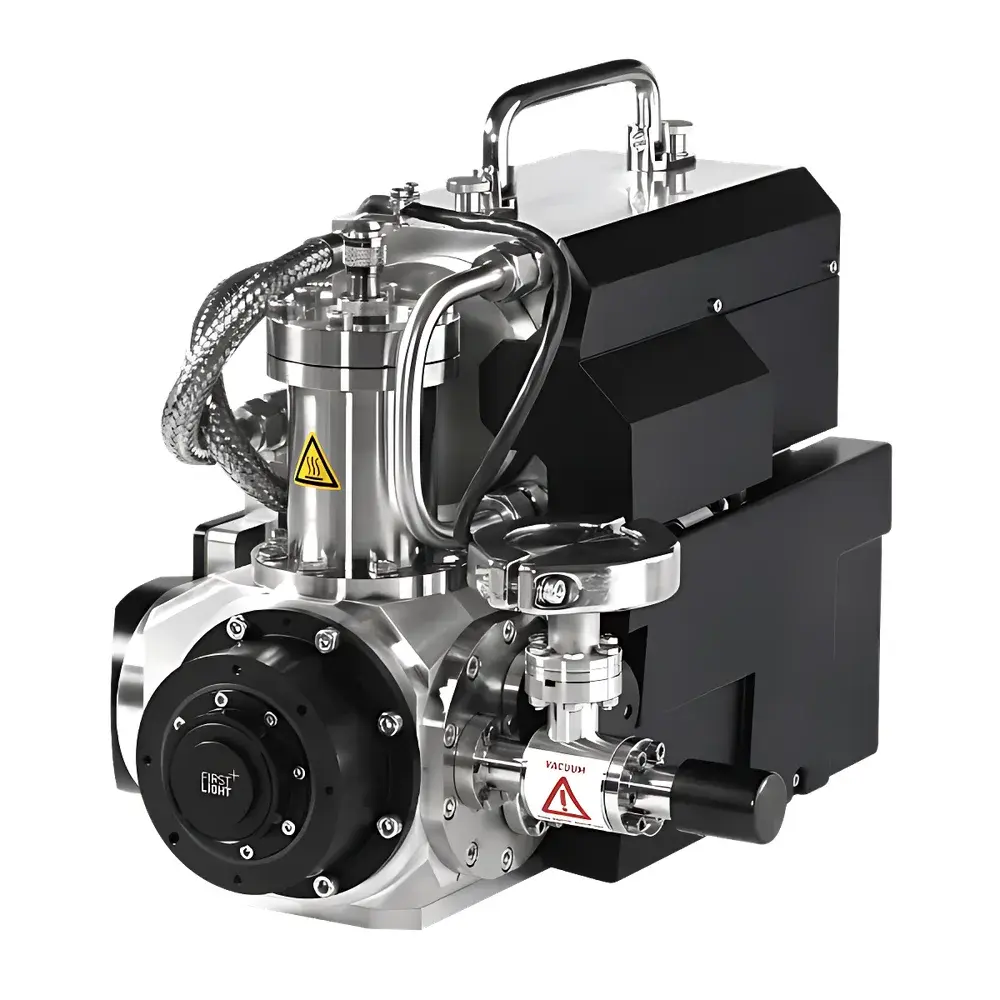
Oxford Instruments C-RED One SWIR Camera
| Brand | Oxford Instruments |
|---|---|
| Origin | France |
| Model | C-RED One |
| Sensor Format | 320 × 256 |
| Pixel Size | 24 µm |
| Spectral Range | J/H/K bands (0.9–2.5 µm) |
| Readout Noise | Sub-electron |
| Max Frame Rate | 3500 fps (full frame) / 10 kHz (ROI) |
| Cooling | Integrated pulse-tube cryocooler to 90 K |
| Vacuum System | Sealed, autonomous regeneration |
| Vibration Reduction | 10× active suppression |
| Readout Modes | Global reset, rolling reset, single readout, CDS, multiple non-destructive reads (MDR) |
Overview
The Oxford Instruments C-RED One is a high-performance short-wave infrared (SWIR) scientific camera engineered for ultra-low-noise, high-speed imaging in demanding photon-starved applications. Built upon First Light Imaging’s proprietary mercury cadmium telluride (HgCdTe) electron-triggered avalanche photodiode (e-APD) technology, the C-RED One leverages intrinsic gain at the pixel level—without added readout noise—to achieve sub-electron readout noise performance. Unlike conventional CMOS or InGaAs detectors, the e-APD architecture enables true photon-counting capability in the 0.9–2.5 µm spectral range, covering the astronomical J, H, and K bands with high quantum efficiency (>70% typical). Its 320 × 256 sensor array features 24 µm square pixels, optimized for diffraction-limited performance when coupled with standard f/2–f/4 optics. The camera operates as a fully autonomous imaging system: the detector is housed in a hermetically sealed vacuum chamber and cooled passively to 90 K using an integrated, high-reliability pulse-tube cryocooler. Vacuum regeneration is managed internally without user intervention, ensuring long-term operational stability in laboratory and observatory environments.
Key Features
- Sub-electron readout noise enabled by HgCdTe e-APD technology—no external amplification required
- Full-frame acquisition at up to 3500 fps while maintaining <0.7 e⁻ RMS read noise and negligible dark current
- Region-of-interest (ROI) readout supporting >10 kHz frame rates with preserved sub-electron noise floor
- Multiple configurable readout modes: global reset, rolling reset, correlated double sampling (CDS), and multiple non-destructive reads (MDR) for optimal signal-to-noise ratio in low-flux regimes
- Integrated pulse-tube cryocooler delivering stable 90 K sensor temperature with <±0.1 K thermal drift over 24 h
- Active vibration suppression system reducing mechanical perturbations by up to 10×—critical for adaptive optics, interferometry, and space-qualified instrumentation integration
- Fully autonomous vacuum management: no external pumps or consumables; mean time between vacuum regenerations exceeds 2 years under continuous operation
Sample Compatibility & Compliance
The C-RED One is designed for integration into optical systems requiring high-fidelity SWIR detection—including astronomical adaptive optics wavefront sensors, laser beam profiling (e.g., ultrafast Ti:sapphire or OPO sources), quantum optics experiments, and industrial process monitoring of semiconductor wafers or thermally emissive materials. Its compact, rigid mechanical design (120 mm × 120 mm × 180 mm) and standardized C-mount interface ensure compatibility with commercial and custom optical benches. The system complies with CE marking requirements for electromagnetic compatibility (EMC Directive 2014/30/EU) and low-voltage safety (LVD Directive 2014/35/EU). While not certified for medical or aerospace flight use out-of-the-box, its vacuum integrity, thermal stability, and radiation-hardened electronics make it suitable for qualification per MIL-STD-810G (vibration/shock) and ESA ECSS-E-ST-20-07C (space-grade vacuum testing protocols) when integrated into qualified subsystems.
Software & Data Management
The C-RED One is controlled via the vendor’s native C-RED Software Suite (Windows/Linux), which provides real-time visualization, ROI configuration, exposure sequencing, and hardware-synchronized triggering. All acquired data are saved in standard FITS (Flexible Image Transport System) format—fully compliant with astronomical data reduction pipelines (e.g., IRAF, AstroPy, ESO Reflex). Time-stamping is traceable to internal GPS-disciplined oscillator (optional), enabling precise temporal alignment across multi-instrument campaigns. The SDK (C/C++ and Python APIs) supports integration into LabVIEW, MATLAB, and custom Python-based control frameworks. Audit-trail logging—recording all acquisition parameters, cooling status, vacuum pressure, and user actions—is available for GLP/GMP-aligned environments, though full 21 CFR Part 11 compliance requires third-party validation of the host acquisition software stack.
Applications
- Astronomy: High-order wavefront sensing in extreme adaptive optics systems (e.g., ELT/METIS), exoplanet direct imaging, and speckle interferometry
- Quantum Technology: Single-photon-level detection in entanglement verification, quantum key distribution (QKD) receiver modules, and time-resolved SPAD array emulation
- Laser Diagnostics: Real-time monitoring of ultrafast laser pulses (fs–ps), beam quality analysis (M²), and nonlinear crystal characterization
- Industrial Metrology: Non-contact thermal mapping of microelectronics, inspection of silicon wafers through backside illumination, and polymer crystallinity assessment via SWIR reflectance
- Defense & Security: Covert active illumination imaging, laser warning receiver calibration, and counter-UAS optical signature analysis
FAQ
What is the primary advantage of e-APD technology over conventional InGaAs detectors?
The HgCdTe e-APD delivers internal, noiseless gain at the pixel level—eliminating the need for post-detection amplification and its associated electronic noise. This enables true sub-electron read noise performance even at kilohertz frame rates.
Does the C-RED One require liquid nitrogen or external vacuum pumps?
No. It uses an integrated pulse-tube cryocooler and sealed vacuum enclosure with autonomous regeneration—no consumables or external infrastructure are needed.
Can the camera be synchronized with external lasers or timing systems?
Yes. It supports TTL-compatible trigger input/output, programmable delay generators, and hardware-level synchronization with jitter <10 ns.
Is the sensor sensitive to cosmic rays or background radiation?
At 90 K, dark current is suppressed to <0.01 e⁻/pixel/s. Cosmic ray events appear as isolated hot pixels and are readily removed via median filtering or MDR-based frame differencing.
What optical interfaces are supported?
Standard C-mount is provided; optional adapters for F-mount, T-mount, and custom flanges are available upon request.




