
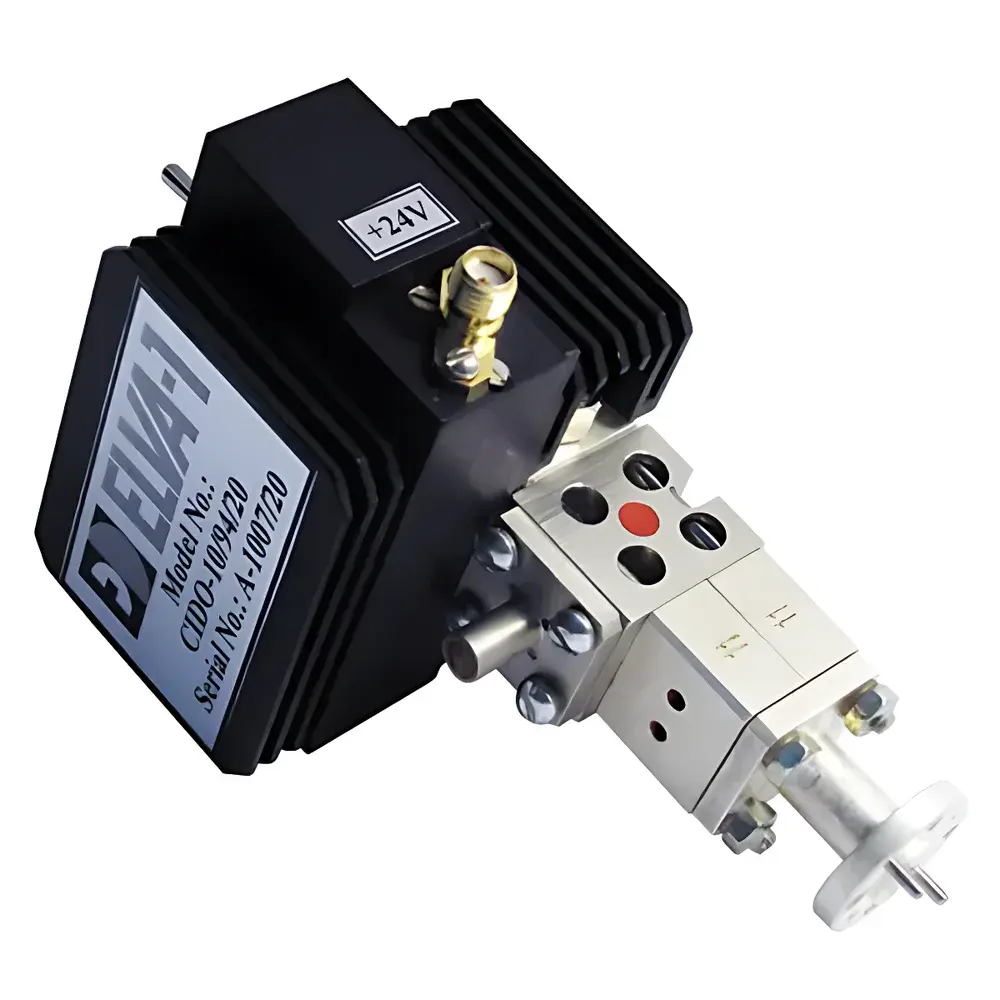
Auniontech ELVA-1 CIDO-XX Series IMPATT Millimeter-Wave Source
| Brand | Auniontech |
|---|---|
| Origin | Shanghai, China |
| Manufacturer Type | Authorized Distributor |
| Country of Origin | China |
| Model | CIDO-XX Terahertz/Millimeter-Wave Source |
| Output Power | Up to 50 mW |
| Frequency Range | 26–150 GHz (8 waveguide bands) |
| Frequency Stability | 5 × 10⁻⁶ /°C |
| Phase Noise | Low (typ. −90 dBc/Hz @ 10 kHz offset) |
| Frequency Accuracy | ±10 MHz (factory-set, fine-tuning ~few MHz) |
| Operating Temperature | −50 °C to +80 °C |
| Cavity Material | Invar alloy cylindrical high-Q resonant cavity |
| Integrated Components | EMI low-pass filter, current stabilizer, built-in isolator |
| Compliance | RoHS-compliant design, CE-marked for industrial lab use |
Overview
The Auniontech ELVA-1 CIDO-XX Series IMPATT Millimeter-Wave Source is a precision-engineered solid-state oscillator designed for stable, continuous-wave (CW) signal generation in the millimeter-wave band (26–150 GHz). Unlike broadband synthesizers or frequency-multiplied sources, the CIDO-XX employs cavity-stabilized IMPATT (Impact Ionization Avalanche Transit-Time) diode technology—leveraging controlled avalanche breakdown and carrier transit-time delay to achieve high output power and intrinsic frequency coherence. Its hybrid architecture integrates an IMPATT diode into a high-Q, high-order-mode cylindrical resonant cavity machined from Invar alloy, which minimizes thermal drift and ensures long-term frequency stability across demanding environmental conditions (−50 °C to +80 °C). This design bridges the performance gap between conventional Gunn oscillators (noted for stability but limited power) and raw IMPATT devices (high power but poor phase noise), delivering both >30 mW typical CW output and phase noise performance suitable for local oscillator (LO) applications in heterodyne detection, plasma diagnostics, and high-resolution spectroscopy.
Key Features
- High-output CW millimeter-wave generation: Up to 50 mW across eight discrete waveguide bands (WR-42 to WR-06), covering 26–150 GHz
- Cavity stabilization using Invar-alloy cylindrical resonator: Achieves frequency stability of 5 × 10⁻⁶ /°C, enabling operation in uncontrolled laboratory or field-deployable environments
- Low phase noise architecture: Optimized biasing, thermal management, and integrated isolator suppress amplitude-to-phase conversion and external load pulling
- Factory-calibrated frequency accuracy: ±10 MHz absolute tolerance; fine frequency adjustment (±few MHz) supported via cavity tuning screws prior to shipment
- Robust front-end integration: Built-in EMI low-pass filtering, precision current stabilization circuitry, and ferrite-based isolator ensure electromagnetic compatibility and impedance mismatch resilience
- Compact, waveguide-integrated mechanical design: Standard UG-flanged output interfaces (e.g., UG-387/U, UG-385/U) facilitate direct coupling to mixers, detectors, or quasi-optical systems without additional adapters
Sample Compatibility & Compliance
The CIDO-XX source is intended for use with standard millimeter-wave test benches compliant with IEEE Std 1394 and IEC 61000-4 series EMC requirements. It operates as a fixed-frequency CW source and does not require sample interaction—thus no material compatibility constraints apply. The device meets RoHS Directive 2011/65/EU for hazardous substance restrictions and carries CE marking per EU Directive 2014/30/EU (EMC) and 2014/35/EU (LVD). While not certified for medical or aerospace safety-critical use, its design adheres to GLP-aligned documentation practices—including traceable factory calibration records and component-level thermal derating data—for audit-ready laboratory deployment. All units are supplied with ISO/IEC 17025–traceable calibration certificates upon request.
Software & Data Management
The CIDO-XX is a hardware-only analog source with no embedded microcontroller, firmware, or digital interface. It requires external DC bias (typically +60 to +100 V, current-limited to 300 mA) and operates without software dependency. For system-level integration, users commonly pair it with programmable power supplies (e.g., Keysight B2900 series) and data acquisition platforms (NI PXIe, Keysight PathWave) to log bias voltage, ambient temperature, and downstream detector output. While no proprietary software is provided, Auniontech supplies comprehensive technical documentation—including cavity resonance mode charts, thermal expansion coefficients of Invar, and waveguide cutoff/frequency maps—in English PDF format. All calibration reports include uncertainty budgets conforming to GUM (JCGM 100:2008) guidelines.
Applications
- Local oscillator (LO) excitation in millimeter-wave heterodyne receivers, especially for atmospheric remote sensing (e.g., O₂/ClO line detection at 115 GHz) and fusion plasma interferometry
- Stimulus source for vector network analyzer (VNA) receiver calibration and mixer conversion loss characterization
- Benchtop reference source in metrology labs performing THz time-domain spectroscopy (THz-TDS) pump-probe alignment and lock-in amplifier referencing
- Fixed-frequency illumination in non-destructive testing (NDT) setups evaluating dielectric anomalies in polymer composites or ceramic coatings
- Plasma electron density diagnostics via microwave interferometry, where phase stability directly determines fringe resolution
- Material property extraction (permittivity, conductivity) using free-space quasi-optical transmission/reflection methods
FAQ
Is the CIDO-XX frequency tunable in real time during operation?
No. Frequency tuning is mechanical and static—performed via cavity screw adjustment prior to final calibration. In-service frequency drift is limited to thermal effects, compensated by Invar’s low CTE.
What waveguide flange types are available for different bands?
Standard configurations include UG-387/U (WR-28, 26–40 GHz), UG-385/U (WR-15, 50–75 GHz), and UG-383/U (WR-10, 75–110 GHz); custom flanges (e.g., CPR-10, PBR-6) are available on request.
Does the source support pulse modulation?
Not natively. The IMPATT diode operates in CW mode only. External gating requires fast high-voltage MOSFET switches synchronized to the bias supply—design guidance is available in Application Note AN-CIDO-03.
Can multiple CIDO-XX units be phase-locked?
Yes—via injection locking using a master oscillator and directional coupler network. Lock range depends on cavity Q and injection level; typical capture bandwidth is ±1–3 MHz.
What is the expected lifetime under continuous operation?
Rated for ≥20,000 hours MTBF when operated within specified voltage/current/temperature limits and with adequate heatsinking (≥0.15 K/W thermal resistance to ambient).



