
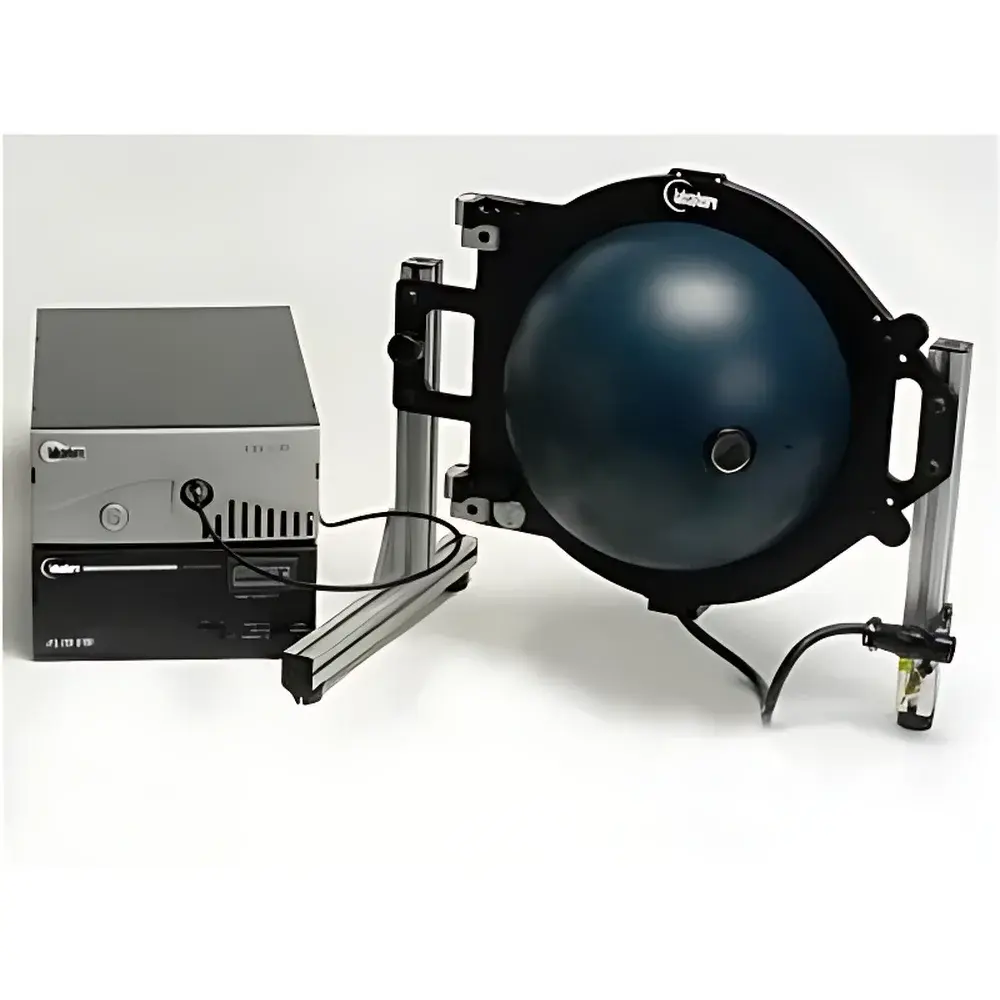
LED Light Source Photometric, Radiometric, and Electrometric Testing System – Labsphere Illumia
| Brand | Labsphere |
|---|---|
| Origin | USA |
| Model | Illumia |
| Calibration Traceability | NIST |
| Sphere Options | 2π and 4π configurations |
| Spectrometer Options | TE-cooled CCD |
| Software | Illumia Control & Analysis Suite |
| Compliance | ASTM E308, CIE S 025, IES LM-79, ISO/CIE 13370, USP <857> (photometric validation) |
| Sample Mounting | Central (4π) or Wall-mounted (2π) with auxiliary correction lamp |
Overview
The Labsphere Illumia LED Light Source Photometric, Radiometric, and Electrometric Testing System is a metrologically rigorous, modular platform engineered for absolute spectral flux measurement and comprehensive photobiological, colorimetric, and electrical characterization of solid-state lighting (SSL) devices. Built upon the fundamental principle of integrating sphere photometry—where incident light undergoes multiple diffuse reflections within a highly uniform Spectraflect®-coated cavity—the Illumia system achieves high spatial and angular response uniformity essential for compliant measurements under IES LM-79-19, CIE S 025/E:2015, and ISO/CIE 13370. Its architecture supports both 2π (hemispherical) and 4π (full-sphere) geometries, enabling accurate total luminous flux determination for discrete emitters (e.g., chip-on-board LEDs) as well as extended sources (e.g., street luminaires), with traceability to NIST-certified standard lamps calibrated per NIST SRM 2020 and SRM 2030 series.
Key Features
- Modular integrating sphere platform with interchangeable diameters (0.3 m to 2.0 m) optimized for source size scalability—from single-die LEDs to large-area luminaires.
- Dual-mode optical geometry: 4π configuration with sample centrally mounted for total flux; 2π configuration with wall-mounting and proprietary auxiliary correction lamp to compensate for self-absorption and directional bias in asymmetric emitters.
- NIST-traceable radiometric calibration using certified tungsten-halogen standard lamps, with documented uncertainty budgets aligned with ISO/IEC 17025 requirements.
- Optional TE-cooled back-thinned CCD spectroradiometer (200–1100 nm) offering thermal stability ≤ ±0.02 nm/°C and signal-to-noise ratio >1000:1 (at 1 s integration), ensuring reproducible spectral power distribution (SPD) acquisition.
- In-situ system verification capability: Users perform routine performance checks using built-in diagnostic routines and reference spectra—no return-to-factory recalibration required.
- Real-time spectral visualization and parameter computation: Simultaneous display of SPD, CIE 1931 chromaticity coordinates (x,y), CCT (correlated color temperature), CRI (Ra and R1–R15), Duv, dominant wavelength, peak wavelength, spectral purity, FWHM, luminous efficacy (lm/W), radiant flux (W), and forward voltage/current characteristics.
Sample Compatibility & Compliance
The Illumia system accommodates diverse SSL form factors—including bare dies, packaged LEDs, COB arrays, OLED panels, fluorescent tubes, induction lamps, and high-bay fixtures—via configurable mechanical fixtures and thermal management interfaces (e.g., heatsink mounting plates with thermocouple ports). All measurement protocols adhere to industry-standard test methods: photometric data comply with IES LM-79-19 (Electrical and Photometric Measurements of Solid-State Lighting Products); colorimetric outputs conform to CIE Publication 15:2018 and ISO/CIE 13370:2020; radiometric accuracy satisfies ASTM E308-22 (Computing the Colors of Objects Using CIE Tristimulus Values); and software audit trails meet FDA 21 CFR Part 11 requirements for electronic records and signatures when configured with optional GLP/GMP mode.
Software & Data Management
Illumia Control & Analysis Suite is a Windows-based application providing instrument control, automated sequence execution, and standards-compliant reporting. It features multi-user role-based access control, full electronic audit trail (including operator ID, timestamp, parameter changes, and raw spectrum export), and CSV/PDF report generation with embedded metadata (calibration date, sphere ID, spectrometer serial number, ambient conditions). Data exports include CIE XYZ tristimulus values, spectral irradiance (W/m²/nm), spectral radiant intensity (W/sr/nm), and electrical waveforms synchronized to optical acquisition. The software supports custom pass/fail limits per parameter and integrates with LIMS via OPC UA or direct database connectors (SQL Server, PostgreSQL).
Applications
- LED package qualification and binning in manufacturing QA/QC environments.
- R&D-level spectral analysis for phosphor-converted white LEDs, micro-LEDs, and UV-C disinfection sources.
- Third-party testing lab accreditation per ISO/IEC 17025 for LM-79 and LM-80 reports.
- Luminaire photometric certification for DLC, ENERGY STAR®, and DesignLights Consortium submissions.
- Color consistency validation across production batches under varying drive currents and junction temperatures.
- Photobiological safety assessment (IEC 62471) via spectral radiant exposure calculation.
FAQ
What calibration standards are used for NIST traceability?
NIST-traceable calibration is performed using Labsphere’s suite of standard lamps (e.g., FEL-type tungsten-halogen lamps certified to NIST SRM 2020), with full uncertainty budgets provided in accordance with ISO/IEC 17025.
Can the system measure pulsed or modulated LED signals?
Yes—when paired with a gated spectrometer option and synchronized trigger input, the Illumia supports time-resolved spectral acquisition at frequencies up to 10 kHz.
Is thermal management integrated into the test fixture?
Standard fixtures include thermally conductive mounting plates with embedded Type-T thermocouple ports; optional active cooling (TEC or liquid heat sink) is available for high-power device testing.
Does the software support automated compliance reporting for ENERGY STAR?
Yes—preconfigured report templates generate ENERGY STAR V2.1–compliant documentation, including mandatory SPD plots, CCT bins, CRI tables, and efficacy summaries.
How often does the system require recalibration?
Annual verification against the included reference lamp is recommended; full recalibration is only required if verification fails or after major hardware modification.



