
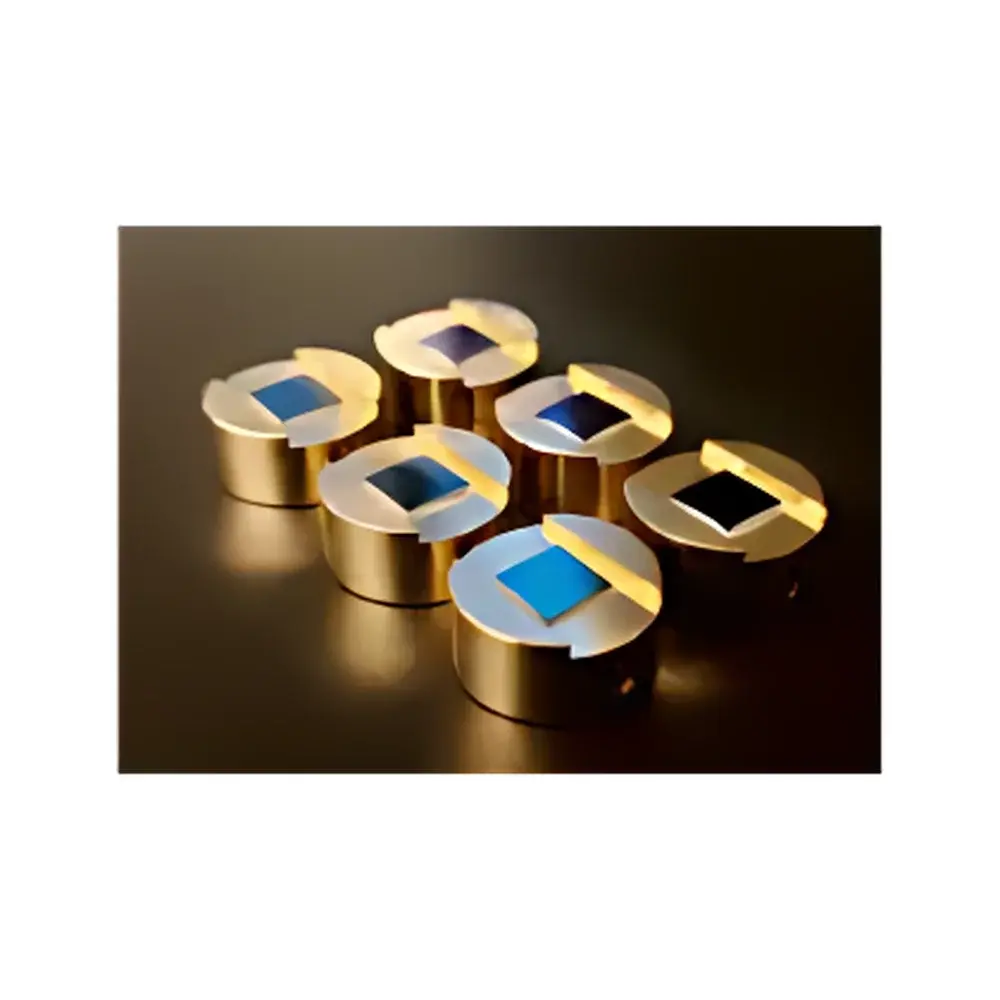
Auniontech Semiconductor Saturable Absorber Mirror (SAM) and Transmission-Mode Saturable Absorbers
| Brand | Auniontech |
|---|---|
| Origin | Shanghai, China |
| Product Type | Optical Instrument Component |
| Wavelength Range | 620 nm – 3.5 µm |
| Device Categories | SAM, RSAM, SA, RSA, SANOS, SOC |
| Mounting Options | Free-space and fiber-coupled configurations |
| Compliance | Designed for integration into laser cavities compliant with ISO 11146 (laser beam parameters), IEC 60825-1 (laser safety), and GLP-aligned optical test environments |
Overview
Semiconductor saturable absorbers are passive, ultrafast nonlinear optical components essential for initiating and stabilizing mode-locked and Q-switched laser operation. Engineered using epitaxial growth on GaAs substrates, Auniontech’s semiconductor saturable absorber mirrors (SAMs) integrate a distributed Bragg reflector (DBR) mirror with an integrated low-dimensional absorbing layer—typically quantum wells or quantum dots—designed to exhibit intensity-dependent reflectivity. This nonlinearity arises from ground-state depletion under high-intensity irradiation, enabling pulse shortening, self-starting passive mode-locking, and amplitude noise suppression. The core operating principle relies on carrier relaxation dynamics governed by sub-picosecond recovery times, making these devices suitable for femtosecond-to-nanosecond pulse regimes across solid-state, diode-pumped, and fiber laser architectures.
Key Features
- Wide spectral coverage: 620 nm to 3.5 µm—enabling compatibility with Ti:sapphire, Cr:forsterite, Yb-, Er-, Tm-, and Ho-doped gain media
- Multiple device architectures: SAM (saturable absorber mirror), RSAM (resonant SAM), SA (transmission-mode saturable absorber), RSA (resonant saturable absorber in transmission), SANOS (saturable noise suppressor), and SOC (saturable output coupler)
- GaAs-based monolithic fabrication ensures high thermal stability, reproducible saturation fluence, and minimal group delay dispersion
- Free-space and fiber-pigtailed variants available for flexible cavity integration in bulk and waveguide lasers
- Low saturation fluence (e.g., <100 µJ/cm² for RSA; ~50–200 µJ/cm² for SAM depending on wavelength and design)
- High damage threshold (>500 MW/cm² for pulsed operation at 1064 nm, typical)
Sample Compatibility & Compliance
Auniontech saturable absorbers are qualified for use in Class 4 laser systems per IEC 60825-1 and meet mechanical and optical interface standards required for OEM integration into commercial and research-grade ultrafast oscillators. RSAMs and RSA devices incorporate Gires–Tournois interferometric resonance structures, ensuring narrowband spectral selectivity (FWHM <5 nm typical) and high contrast between low-intensity loss and high-intensity reflectivity/transmission. All components are fabricated under cleanroom-controlled processes and undergo spectral responsivity mapping, surface flatness verification (λ/10 PV), and long-term aging tests. Devices support compliance workflows for GLP and GMP environments when embedded in validated laser sources used in metrology, spectroscopy, or biomedical instrumentation.
Software & Data Management
While semiconductor saturable absorbers are inherently passive components, their performance characterization is supported by Auniontech’s standardized test reports—including measured saturation fluence (Fsat), nonsaturable loss (δ), modulation depth (ΔR or ΔT), and recovery time (τr)—delivered in machine-readable CSV and PDF formats. These datasets align with traceable calibration protocols referenced to NIST-traceable photodiode standards and calibrated autocorrelators. For system integrators, spectral response files (S-parameters or transfer functions) can be provided for modeling in Zemax OpticStudio, LASCAD, or MATLAB-based cavity simulations. No proprietary software or drivers are required for operation, ensuring full interoperability with third-party control systems and data acquisition platforms compliant with IEEE 1278.1 (HLA) or SCPI command sets.
Applications
- Self-starting passive mode-locking in diode-pumped solid-state lasers (DPSSL), including microchip and thin-disk configurations
- Ultrafast fiber laser oscillators (Er-, Yb-, and Tm-doped) requiring low-threshold, polarization-insensitive pulse initiation
- Q-switching of compact Nd:YAG and Nd:YVO₄ lasers for micromachining and LIBS applications
- Optical noise suppression in EDFA-amplified systems and post-pulse-picker ASE filtering via SANOS elements
- Wavelength-selective pulse generation using RSA elements in ring-cavity fiber lasers
- Nonlinear pulse shaping and temporal gating in pump-probe and THz generation setups
FAQ
What is the difference between SAM and RSAM?
SAM provides broadband saturable absorption with moderate modulation depth and fixed resonance behavior, while RSAM incorporates a Gires–Tournois resonator to enhance spectral selectivity and increase effective modulation depth at a specific wavelength.
Can these absorbers be used in femtosecond oscillators?
Yes—especially SAM and RSAM variants optimized for 800 nm and 1040 nm exhibit sub-500 fs recovery times and are routinely deployed in Ti:sapphire and Yb:KGW oscillators.
Do you provide custom coating or substrate options?
Custom designs—including InP-based absorbers for 1.55 µm, AlGaAs DBRs for extended UV-VIS range, or ion-beam-sputtered AR/HR coatings—are available upon technical specification and minimum order quantity agreement.
How is saturation fluence determined and verified?
Saturation fluence is measured using balanced optical autocorrelation combined with variable attenuator calibration against a NIST-traceable energy meter, following ISO 13697 guidelines for laser-induced damage testing.
Are fiber-coupled versions compatible with standard FC/APC or SMA connectors?
Yes—standard offerings include FC/APC for single-mode fiber integration; custom connectorization (e.g., angled physical contact for polarization-maintaining fiber) is supported.





