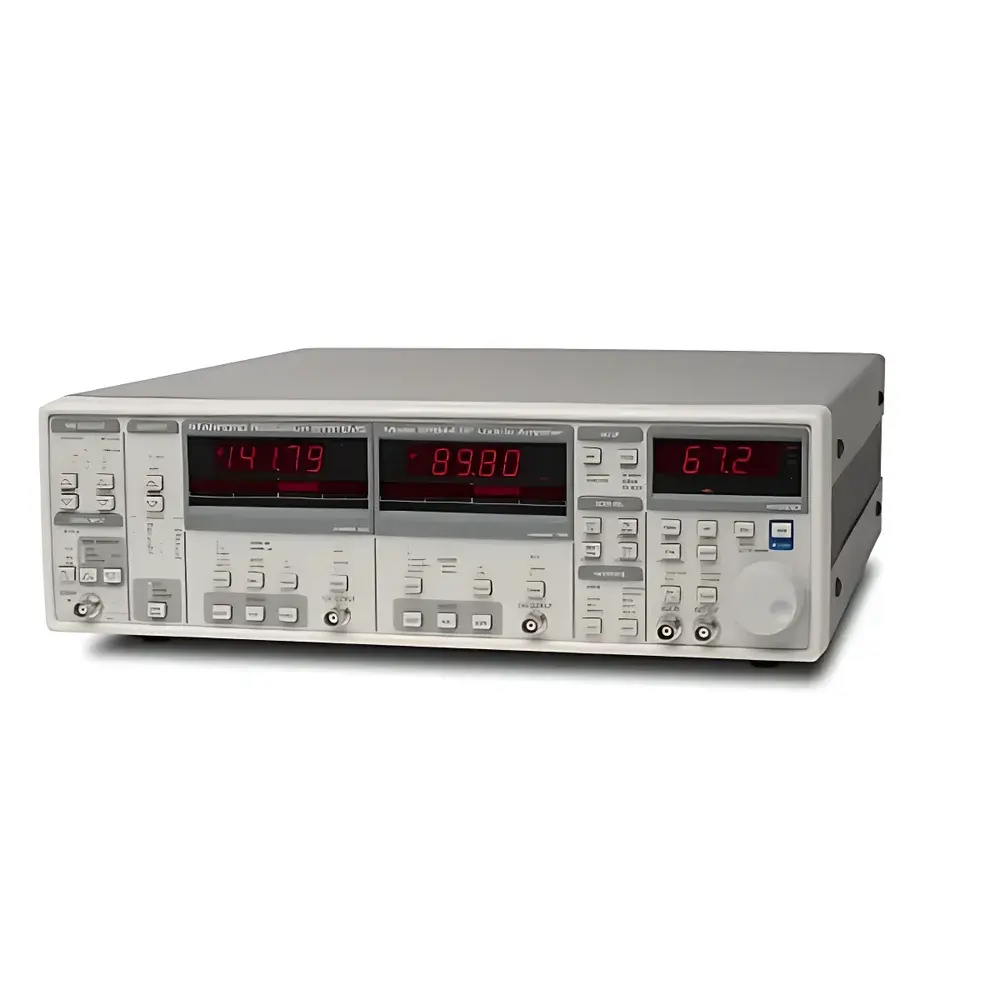
Stanford Research Systems SR844 RF Lock-in Amplifier
| Brand | Stanford Research Systems |
|---|---|
| Origin | USA |
| Model | SR844 |
| Frequency Range | 25 kHz to 200 MHz |
| Dynamic Reserve | 80 dB |
| Input Impedance | 50 Ω or 1 MΩ + 30 pF |
| Voltage Input Sensitivity | 100 nVrms–1 Vrms (≤1 MHz), 1 µVrms–1 Vrms (<50 MHz), 10 µVrms–1 Vrms (<200 MHz) |
| Gain Accuracy | ±0.25 dB (<50 MHz), ±0.50 dB (<200 MHz) |
| Input Noise | 2 nV/√Hz (typ., 50 Ω), 5 nV/√Hz (typ., 1 MΩ) |
| Time Constants | 100 µs to 30 ks (6/12/18/24 dB/oct roll-off) |
| Output Channels | Dual ±10 V analog outputs (X, Y, CH1, CH2) |
Overview
The Stanford Research Systems SR844 RF Lock-in Amplifier is a high-performance, digitally synthesized lock-in amplifier engineered for precision measurement of weak AC signals buried in high-noise environments at radio frequencies. Unlike traditional baseband lock-ins, the SR844 employs direct digital synthesis (DDS) and dual-phase demodulation architecture to achieve stable, low-drift detection across a continuous frequency range from 25 kHz to 200 MHz — enabling applications in RF impedance spectroscopy, cavity ring-down measurements, microwave reflectometry, and quantum device characterization. Its core operation relies on synchronous demodulation: an internal or external reference signal drives a pair of quadrature mixers, producing in-phase (X) and quadrature (Y) components that are low-pass filtered with user-selectable time constants and roll-off slopes. This architecture ensures high signal-to-noise ratio (SNR) recovery even when the signal amplitude is below the thermal noise floor of conventional amplifiers.
Key Features
- Wide RF operating bandwidth: 25 kHz to 200 MHz — fully programmable via front panel or GPIB/Ethernet interface
- 80 dB dynamic reserve — maintains linearity and accuracy in presence of large interfering signals
- Dual independent analog outputs (±10 V): configurable to X, Y, R, θ, or channel-specific demodulated signals (CH1/CH2)
- Four selectable low-pass filter slopes: 6, 12, 18, or 24 dB/octave, with time constants ranging from 100 µs to 30 ks
- Input stage with switchable 50 Ω or 1 MΩ + 30 pF impedance — optimized for both RF transmission-line and high-impedance sensor interfaces
- Low input voltage noise: 2 nV/√Hz (typ.) at 50 Ω termination; <8 nV/√Hz maximum across full band
- High gain accuracy: ±0.25 dB up to 50 MHz, degrading gracefully to ±0.50 dB at 200 MHz — traceable to NIST-calibrated standards
- Integrated harmonic detection: measure up to 9th harmonic of reference frequency with independent phase and amplitude readout
Sample Compatibility & Compliance
The SR844 supports direct connection to a broad spectrum of RF-sensitive transducers and resonant structures without external preamplification or downconversion. It is routinely deployed with cryogenic RF reflectometers, superconducting quantum interference devices (SQUIDs), scanning microwave impedance microscopes (sMIM), and plasma diagnostics probes. Input protection circuits comply with IEC 61000-4-2 (ESD) and IEC 61000-4-4 (EFT) standards. While not certified for medical or industrial safety (e.g., UL/CE), the instrument meets FCC Part 15 Class A emission limits and is designed for laboratory use under GLP-compliant environments. Data integrity features — including timestamped output logging and non-volatile configuration storage — support audit-ready workflows aligned with ISO/IEC 17025 documentation requirements.
Software & Data Management
The SR844 is fully controllable via SCPI commands over IEEE-488 (GPIB), RS-232, or 10/100 Ethernet. Stanford Research Systems provides the free, cross-platform LabVIEW VI library and Python API (sr844.py), enabling seamless integration into automated test systems. All front-panel settings — including filter parameters, reference source selection, harmonic order, and output scaling — are scriptable and recallable. Internal data buffers store up to 16,384 points per channel with 16-bit resolution, accessible via streaming or block read modes. Export formats include CSV and binary (IEEE 754); no proprietary file locking or vendor-specific viewers are required. For regulated environments, optional firmware upgrades support enhanced audit trail logging (user actions, timestamps, parameter changes) compatible with FDA 21 CFR Part 11 compliance frameworks when paired with validated host software.
Applications
- RF impedance spectroscopy of battery electrodes and fuel cell membranes
- Resonant frequency tracking in MEMS/NEMS sensors under vacuum or cryogenic conditions
- Phase-sensitive detection in electron spin resonance (ESR) and nuclear magnetic resonance (NMR) probe development
- Low-noise characterization of high-electron-mobility transistors (HEMTs) and GaN HEMT amplifiers
- Real-time feedback control in laser cavity stabilization and optical parametric oscillator (OPO) tuning
- Quantum computing readout: dispersive qubit state discrimination using superconducting coplanar waveguide resonators
FAQ
What reference sources does the SR844 support?
It accepts internal DDS-generated references or external TTL, CMOS, or sine-wave inputs (100 mVpp to 5 Vpp). Reference frequency and phase are fully programmable.
Can the SR844 measure both amplitude and phase simultaneously?
Yes — X (in-phase) and Y (quadrature) outputs are generated concurrently; R = √(X²+Y²) and θ = arctan(Y/X) are derived in real time and available as analog or digital outputs.
Is harmonic rejection adjustable?
Harmonic detection is selectable up to the 9th order, with independent gain and phase adjustment per harmonic — critical for distortion analysis and nonlinear material studies.
Does the SR844 require external calibration?
No — factory calibration is stored in non-volatile memory and covers sensitivity, gain flatness, and phase response across the full 25 kHz–200 MHz range. Annual recalibration is recommended for metrology-grade applications.
How is noise performance verified?
Input-referred voltage noise is measured per IEEE Std 1005–2015 using a calibrated thermal noise source and spectrum analyzer; typ./max values reflect statistical distribution across production lots at 25°C ambient.
Related Products