
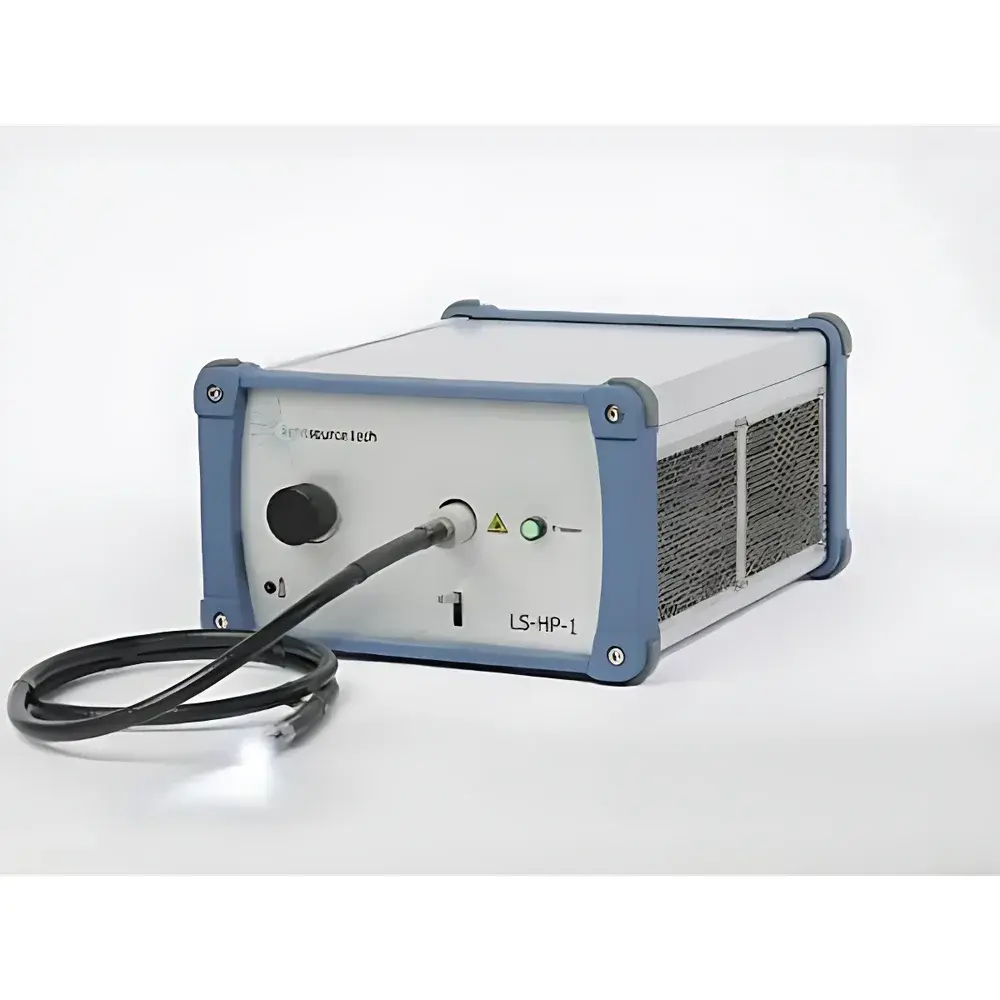
Auniontech LS-HP1 High-Power Fiber-Coupled LED White & Monochromatic Light Source
| Brand | Auniontech |
|---|---|
| Origin | Shanghai, China |
| Model | LS-HP1 |
| Light Source Type | High-Power Solid-State LED |
| Output Coupling | Liquid Light Guide (LLG), 3 mm or 5 mm core diameter |
| Spectral Range | 365–850 nm |
| CRI (White Models) | Up to 92 |
| Typical Output Power | 2.5–9.6 W (wavelength-dependent) |
| Operating Modes | CW, Pulsed, Strobed, Triggered (TTL/SMA), Direct Drive |
| Control Interface | USB, RS232, Analog Voltage, Digital I/O |
| Compliance | CE-marked for laboratory use |
| Regulatory Context | Designed for alignment with ISO/IEC 17025-compliant optical calibration workflows and GLP-aligned photometric characterization |
Overview
The Auniontech LS-HP1 is a high-radiance, fiber-coupled solid-state light source engineered for demanding optical laboratory applications requiring stable, spectrally defined, and spatially uniform illumination. Unlike traditional arc lamps or halogen sources, the LS-HP1 leverages next-generation high-flux LED emitters integrated with liquid light guide (LLG) coupling technology—enabling efficient, low-thermal-load delivery of collimated broadband or narrowband radiation into 3 mm or 5 mm core-diameter optical fibers. Its measurement principle is based on direct electroluminescent emission from semiconductor die arrays, eliminating spectral contamination from plasma arcs or blackbody tails. This architecture delivers exceptional radiometric stability (<0.5% RMS intensity drift over 8 h), near-instant on/off response (<1 µs rise time in pulsed mode), and absence of UV ozone generation or IR thermal load at the sample plane—critical for photobiological assays, fluorescence excitation, reflectance standardization, and optical system alignment.
Key Features
- High-power LED array delivering up to 9.6 W optical output (e.g., 365 nm, 385 nm models) with full spectral confinement—no out-of-band leakage beyond ±2 nm of specified FWHM
- Liquid light guide (LLG) coupling ensures uniform spatial irradiance profile (top-hat distribution) and minimal étendue growth—ideal for homogenized illumination in spectroscopic calibration and imaging optics testing
- Two white-light variants: Daylight-simulating (5700 K, CRI 92) and Cool White (6500–7500 K, CRI 70), both calibrated to CIE 1931 chromaticity coordinates within ±0.003 Δu’v’
- Monochromatic options spanning 365 nm (UVA) to 850 nm (NIR), including biologically relevant bands (e.g., 405 nm for microbial inactivation, 735 nm for chlorophyll-a excitation)
- Multi-mode operation: continuous wave (CW), externally triggered (TTL/SMA), internally gated pulse (10 ns–10 s width), and analog-modulated intensity control (0–10 V input, 5–100% linear scaling)
- Integrated thermal management with PID-controlled heatsink and real-time junction temperature monitoring—ensuring wavelength stability ≤ ±0.1 nm/°C and lifetime > 20,000 h at rated power
Sample Compatibility & Compliance
The LS-HP1 is compatible with standard SMA905 and FC/PC fiber interfaces and supports integration into ISO 13694-compliant optical power measurement chains. Its spectral irradiance profiles are traceable to NIST-calibrated reference detectors (e.g., Hamamatsu S1337 series) and conform to ASTM E308-22 for colorimetric computation. For regulatory environments, the system supports audit-ready logging of operational parameters (intensity setpoint, mode, timestamp, thermal status) via optional firmware-enabled data capture—aligning with GLP documentation requirements for method validation. While not FDA 21 CFR Part 11-certified out-of-box, its deterministic digital control architecture permits integration into validated software platforms meeting electronic record integrity standards.
Software & Data Management
Auniontech provides the LS-Control Suite (Windows/Linux/macOS), a native application supporting real-time intensity profiling, spectral library import (CIE illuminant spectra, custom LED SPDs), and automated sequence scripting (e.g., multi-wavelength kinetic scans). Communication protocols include SCPI over USB-VCOM, Modbus RTU over RS232, and analog voltage feedback for closed-loop intensity stabilization. All device registers—including LED drive current, heatsink temperature, and pulse timing registers—are memory-mapped for third-party integration via Python (PySerial, PyVISA) or LabVIEW drivers. Firmware updates retain user calibration coefficients and support field-upgradable spectral correction matrices.
Applications
- Photometric calibration of CCD/CMOS sensors and radiometers against CIE standard illuminants
- Excitation source for steady-state and time-resolved fluorescence microscopy (e.g., FRET, FLIM) using discrete monochromatic channels
- Accelerated aging tests per ISO 4892-3, leveraging controlled UVA (365 nm) and visible irradiance without mercury-lamp spectral artifacts
- Optical coherence tomography (OCT) system development requiring broadband low-coherence illumination with high brightness density
- Machine vision lighting validation under standardized D65 and TL84 illuminants for color rendering assessment
- Photosynthetic photon flux density (PPFD) quantification in plant physiology studies using 400–700 nm spectral weighting
FAQ
What is the maximum permissible fiber NA for optimal coupling efficiency?
The LS-HP1 is optimized for NA ≤ 0.5 fibers; coupling efficiency drops >15% above NA 0.55 due to LLG numerical aperture constraints.
Can multiple LS-HP1 units be synchronized for multi-spectral illumination?
Yes—via external TTL master clock input with <10 ns jitter; firmware supports phase-aligned triggering across up to 8 independent units.
Is spectral recalibration required after long-term operation?
No routine recalibration is needed; wavelength drift remains <±0.05 nm over 10,000 h at 70% drive current, verified by onboard spectral reference diode monitoring.
Does the system support OEM integration into automated test equipment (ATE)?
Yes—full register-level documentation, SDK, and hardware trigger I/O pinout are provided under NDA for embedded integration.
Are there restrictions on ambient operating temperature?
Rated performance is guaranteed from 15°C to 35°C; derating applies above 35°C—output power reduces 0.8%/°C to maintain junction temperature <85°C.



