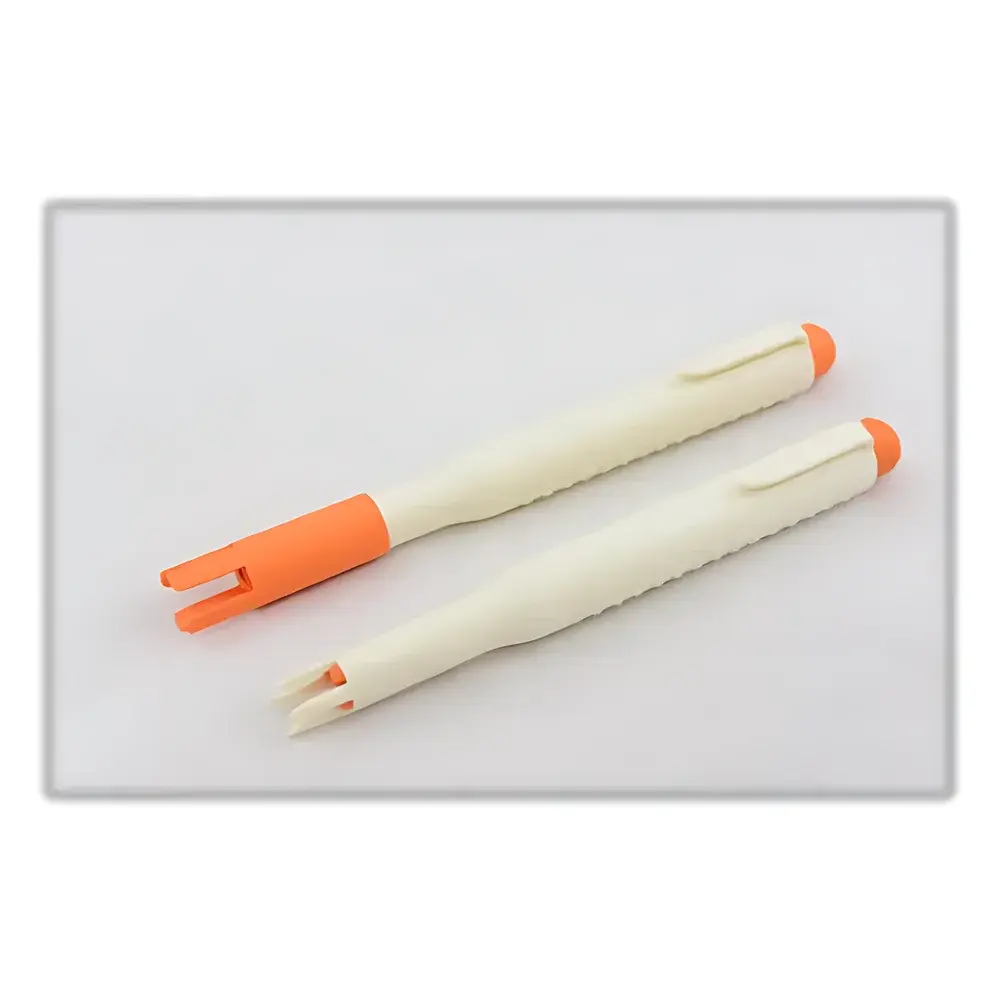
Vitl Life Science Solutions TubePen Pipetting Aid
| Brand | Vitl Life Science Solutions (distributed by Auniontech) |
|---|---|
| Origin | United Kingdom |
| Product Type | Laboratory Sample Handling Tool |
| Intended Use | Cryotube and Microtube Manipulation |
| Weight | 20 g (Microtube version), 23 g (Cryotube version) |
| Length | 150 mm (Microtube), 165 mm (Cryotube) |
| Height (incl. pocket clip) | 17 mm |
| Tube Compatibility | 8.5 mm diameter tubes (e.g., 0.5 mL, 1.5 mL, 2.0 mL microcentrifuge tubes and standard 2 mL cryovials) |
Overview
The Vitl TubePen Pipetting Aid is an ergonomically engineered, hand-held laboratory tool designed for precise, low-contact manipulation of standard 8.5 mm diameter microcentrifuge tubes and cryovials. Unlike conventional forceps or tweezers, the TubePen operates on a spring-loaded push-button actuation mechanism that engages a compliant silicone-tipped jaw to grip tubes without lateral compression or torque—minimizing mechanical stress on tube caps and preserving sample integrity. Its design principle centers on thermal isolation: by limiting surface contact area and eliminating metal-to-tube conduction paths, the TubePen significantly reduces heat transfer during handling of temperature-sensitive samples stored at –20 °C or –80 °C. This makes it particularly suitable for workflows involving thermal modules (e.g., heating blocks, dry baths, thermocyclers) where repeated insertion/removal of tubes must avoid unintended thawing or condensation-induced contamination.
Key Features
- Single-hand operation with tactile push-button release—enables rapid, repeatable tube engagement and ejection without repositioning the hand.
- Chemically inert, temperature-stable silicone tips rated for continuous use between –80 °C and +120 °C; resistant to common laboratory solvents including ethanol, isopropanol, and acetone.
- Low-mass construction (20–23 g) ensures minimal fatigue during extended use; integrated pocket clip allows secure attachment to lab coats or instrument panels.
- No moving parts beyond the actuation spring and jaw linkage—no lubricants, batteries, or calibration required; fully autoclavable at 121 °C for 20 minutes (validated per ISO 17664).
- Compatible with standard nitrile, latex, and powder-free vinyl gloves—maintains dexterity and grip even with double-gloving protocols.
Sample Compatibility & Compliance
The TubePen is validated for use with polypropylene and polyethylene microtubes (0.5–2.0 mL) and cryovials conforming to ANSI/SLAS dimensional standards (e.g., 8.5 mm outer diameter, 48 mm height). It is not intended for use with glass vials, PCR strips, or non-cylindrical containers. While classified as a Class I non-invasive laboratory aid under EU MDR 2017/745 Annex XVI, it carries no CE marking as a medical device; its application remains strictly within research and diagnostic support environments—not direct patient contact or in vitro diagnostic (IVD) assay execution. The device complies with ISO 13485:2016 quality management system requirements for distributors (Auniontech), and materials meet USP and biological reactivity testing criteria.
Software & Data Management
The TubePen is a fully mechanical, analog handling tool with no embedded electronics, firmware, or connectivity interfaces. As such, it requires no software installation, driver configuration, or data logging integration. Its operational consistency is verified through physical performance testing—not algorithmic validation—making it inherently compatible with GLP- and GMP-regulated environments where software qualification burdens are prohibitive. Documentation includes a traceable manufacturing batch number engraved on the body and a certificate of conformance available upon request for audit trail purposes.
Applications
- High-frequency transfer of samples between cryogenic storage and heated modules during enzymatic reactions (e.g., restriction digests, ligations, RT-PCR setup).
- Handling of pre-chilled reagents in cold-room workflows where minimizing ambient heat ingress is critical to enzyme stability.
- Immuno-precipitation and chromatin immunoprecipitation (ChIP) protocols requiring sequential tube transfers without cap loosening or vortex-induced shearing.
- Pre-analytical processing in clinical diagnostics labs—e.g., aliquoting serum/plasma into secondary tubes prior to immunoassay platforms.
- Quality control sampling in biomanufacturing environments where glove compatibility and rapid decontamination cycles are mandatory.
FAQ
Is the TubePen compatible with 0.2 mL PCR tubes or strip formats?
No. The jaw geometry and actuation force are optimized exclusively for single 8.5 mm diameter tubes. PCR strips or low-profile tubes fall outside its mechanical specification envelope.
Can the TubePen be sterilized using ethylene oxide (EtO)?
Yes—EtO sterilization is validated per ISO 11135:2014; however, residual gas desorption time must follow manufacturer-recommended aeration protocols (minimum 12 hours at ambient conditions).
Does the device require recalibration after repeated autoclaving?
No. Mechanical performance is verified across 500+ autoclave cycles (121 °C, 20 min); spring tension and jaw alignment remain within ±2% tolerance per ASTM F2503-21 test methodology.
What is the expected service life under routine lab use?
Minimum 20,000 actuation cycles when operated within specified temperature and load limits; wear indicators (e.g., reduced jaw closure force or tip deformation) signal end-of-life.
Is bulk customization available for OEM integration?
Yes—custom engraving, color-coded variants, and modified jaw geometries are available for orders ≥300 units; lead time and validation documentation provided upon formal RFQ submission.