
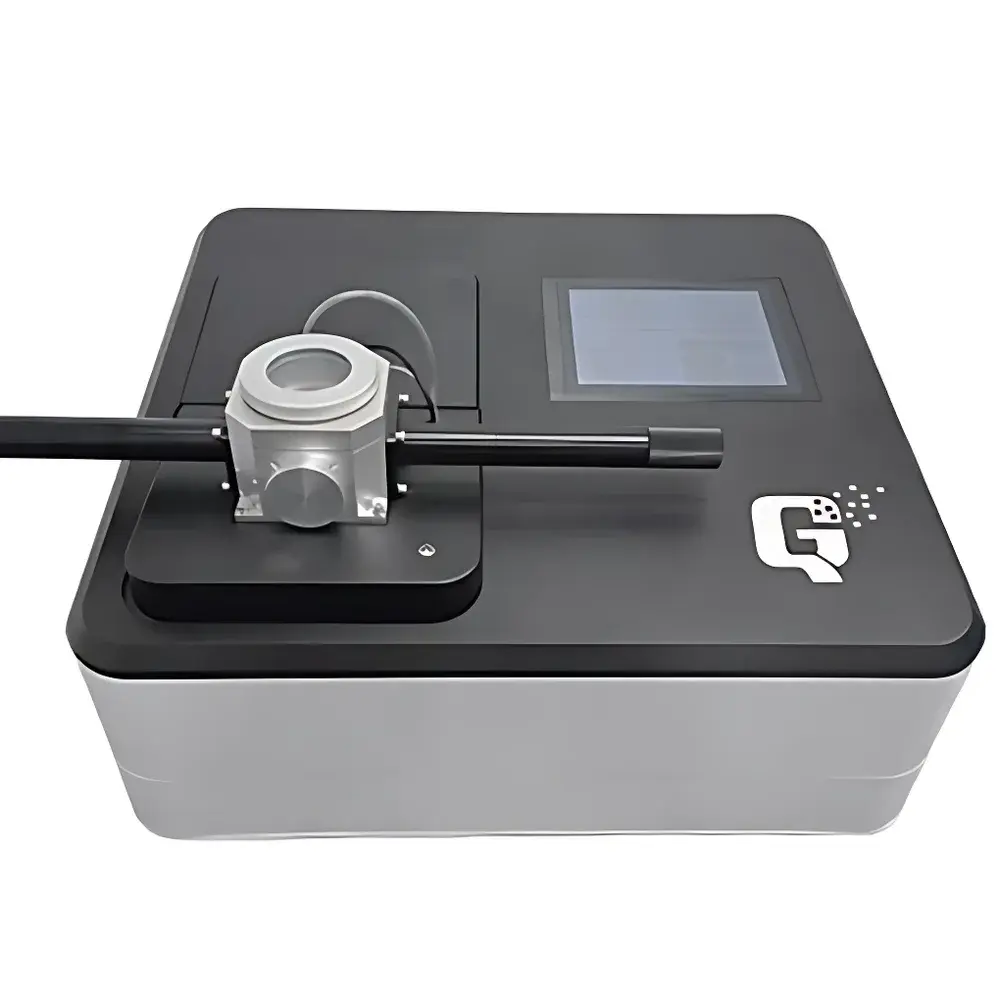
DingHong GU-IC6000 Ion Beam Cleaner
| Brand | DingHong |
|---|---|
| Origin | Jiangsu, China |
| Manufacturer Type | Authorized Distributor |
| Country of Origin | China |
| Model | GU-IC6000 |
| Instrument Type | Domestic Ion Beam Cleaner |
| Ultimate Vacuum | 6 Pa |
| Pumping Time to Operating Vacuum | ≤2 min (with standard mechanical pump) |
| Sample Holder Capacity | 2 standard holders (expandable to 7 with dual-layer configuration) |
| Optional Pump | Integrated diaphragm pump |
Overview
The DingHong GU-IC6000 Ion Beam Cleaner is a compact, high-reliability plasma-based surface preparation system engineered for ultra-clean sample conditioning prior to high-resolution electron microscopy analysis. Unlike conventional RF or microwave plasma cleaners that rely on reactive gas discharge, the GU-IC6000 employs a focused, low-energy ion beam generated via thermionic emission and electrostatic acceleration—enabling precise, non-thermal physical sputtering of surface contaminants without inducing thermal damage or subsurface modification. This principle ensures atomic-level removal of hydrocarbon residues, adsorbed water layers, and organic films from delicate TEM grids, SEM stubs, and electron-transparent specimens—critical for achieving artifact-free imaging, quantitative EDS mapping, and reproducible EELS acquisition. The system operates under controlled vacuum conditions (≤6 Pa), minimizing recontamination during processing and enabling seamless integration into cleanroom-limited lab environments.
Key Features
- Ultra-rapid vacuum establishment: Achieves stable operating pressure (<6 Pa) in ≤2 minutes using a standard two-stage rotary vane mechanical pump—optimized for workflow efficiency in high-throughput EM labs.
- Dual-mode surface functionalization: Supports both contaminant removal (via Ar⁺ or O₂⁺ ion sputtering) and surface hydrophilization (e.g., oxygen plasma treatment of Cu grids), enhancing specimen adhesion and reducing charging artifacts.
- Modular sample holder architecture: Accommodates up to 2 standard specimen holders as standard; expandable to 7 positions via optional dual-tier mounting plate—compatible with standard 3.05 mm TEM grid holders and custom-fabricated carriers.
- Hardware-integrated safety logic: Built-in interlock circuitry prevents ion beam activation unless vacuum threshold is met and holder positioning is verified—eliminating risk of uncontrolled bombardment or holder arcing.
- Space-optimized configuration: Optional integrated diaphragm pump reduces footprint by >40% versus external pump setups and lowers acoustic emissions to <45 dB(A), meeting ISO 14040 noise requirements for shared laboratory spaces.
Sample Compatibility & Compliance
The GU-IC6000 is validated for use with electron microscopy consumables including copper, nickel, and gold TEM grids; carbon-coated SEM stubs; silicon nitride membranes; and polymer-based substrates (e.g., PI, PET). It complies with IEC 61000-6-3 (EMC emission limits) and meets CE marking requirements for laboratory equipment. While not certified to GLP or GMP standards per se, its repeatable process parameters (beam energy, exposure time, gas composition) support audit-ready documentation when paired with optional PC-based logging. The system’s vacuum integrity and contamination control performance align with ASTM E1558–22 guidelines for electron microscope specimen preparation.
Software & Data Management
Operation is managed via a dedicated embedded controller with tactile membrane keypad and LED status display—no external PC required for routine cleaning cycles. All process parameters (ion source voltage, exposure duration, gas flow rate if equipped with mass flow controller option) are stored in non-volatile memory with timestamped logs. Optional RS-232/USB interface enables export of cycle records (CSV format) for traceability in regulated environments. Audit trail functionality—including operator ID input and parameter change history—is available via firmware upgrade, supporting compliance with FDA 21 CFR Part 11 requirements when deployed in pharmaceutical or medical device QA/QC labs.
Applications
- Prior to TEM imaging: Carbon-contaminant removal from ultrathin sections and cryo-EM grids to improve contrast and reduce beam-induced drift.
- SEM sample prep: Hydrophilization of insulating substrates (e.g., glass slides, ceramic filters) to suppress charging during low-kV imaging.
- EDS quantification readiness: Elimination of surface hydrocarbons that contribute to spurious carbon peaks and skew matrix corrections.
- AFM tip cleaning: Gentle ion etching of Si₃N₄ or diamond probes to restore apex geometry without altering spring constant.
- Vacuum storage mode: Maintains processed specimens and holders at ≤6 Pa for up to 72 hours—reducing chamber venting frequency in multi-user TEM facilities.
FAQ
What gases are compatible with the GU-IC6000 ion source?
Standard operation uses argon (Ar) for inert sputtering; optional O₂ or air admixture is supported for oxidative cleaning—gas selection must be configured during installation per local safety protocols.
Can the GU-IC6000 be used for metallographic sample polishing?
No—it is not designed for bulk material removal or topographic leveling; its ion energy profile is optimized for monolayer-scale surface cleaning, not mechanical polishing.
Is remote monitoring supported?
Basic status signals (vacuum OK, beam ON/OFF, fault code) are accessible via dry-contact outputs; full remote control requires third-party SCADA integration through the RS-232 interface.
What maintenance intervals are recommended?
Ion source filament replacement every 1,200 operational hours; mechanical pump oil change every 500 hours; vacuum chamber cleaning every 6 months or after 200 cycles involving halogenated organics.
Does the system meet ISO 14644-1 Class 5 cleanroom compatibility requirements?
While the unit itself is not classified, its sealed vacuum path and low outgassing materials (304 stainless steel chamber, Viton® seals) enable safe operation inside ISO Class 5 environments when installed with appropriate vibration isolation and HEPA-filtered exhaust routing.



