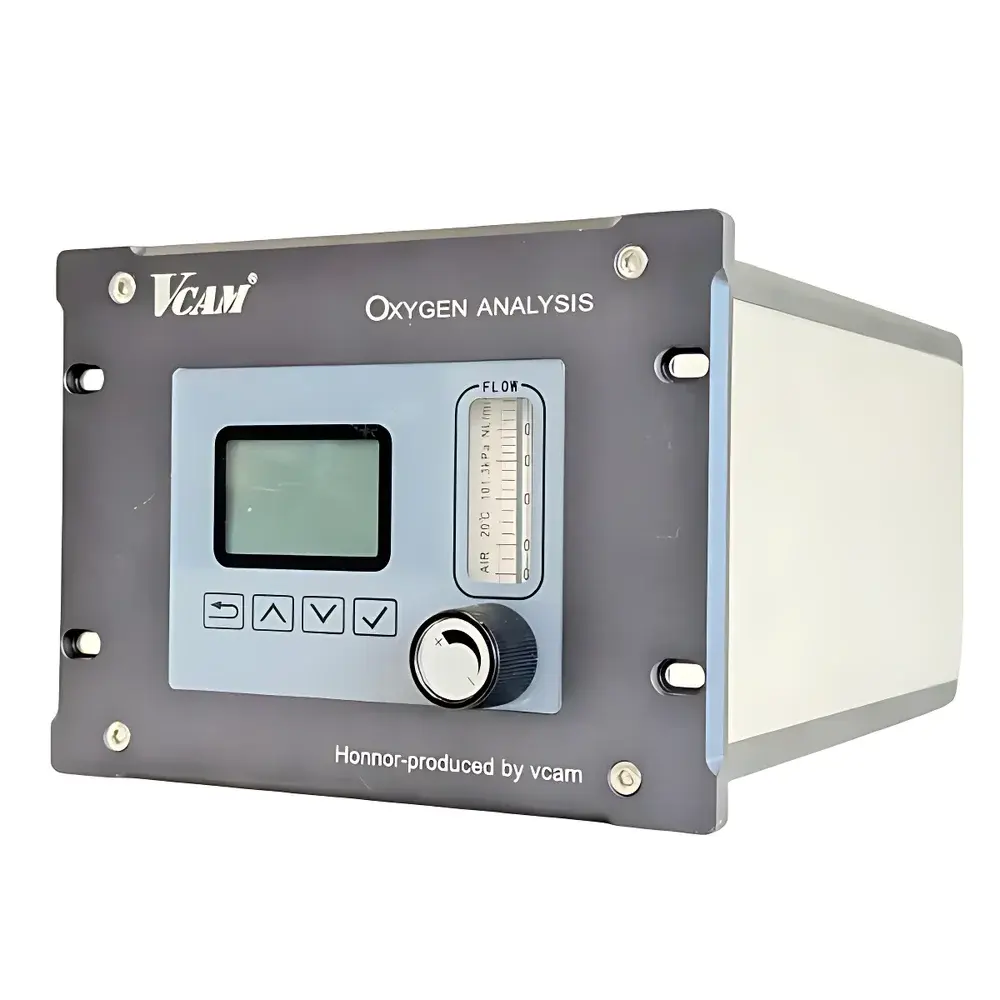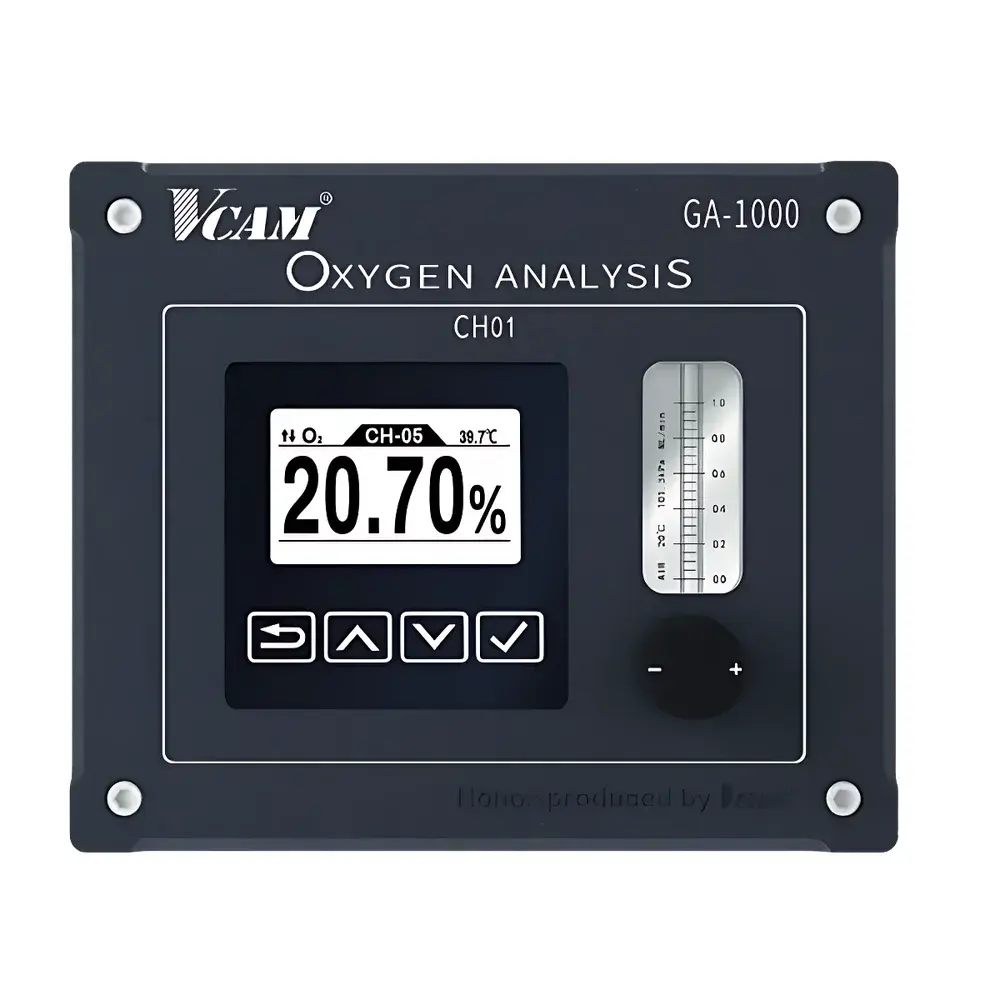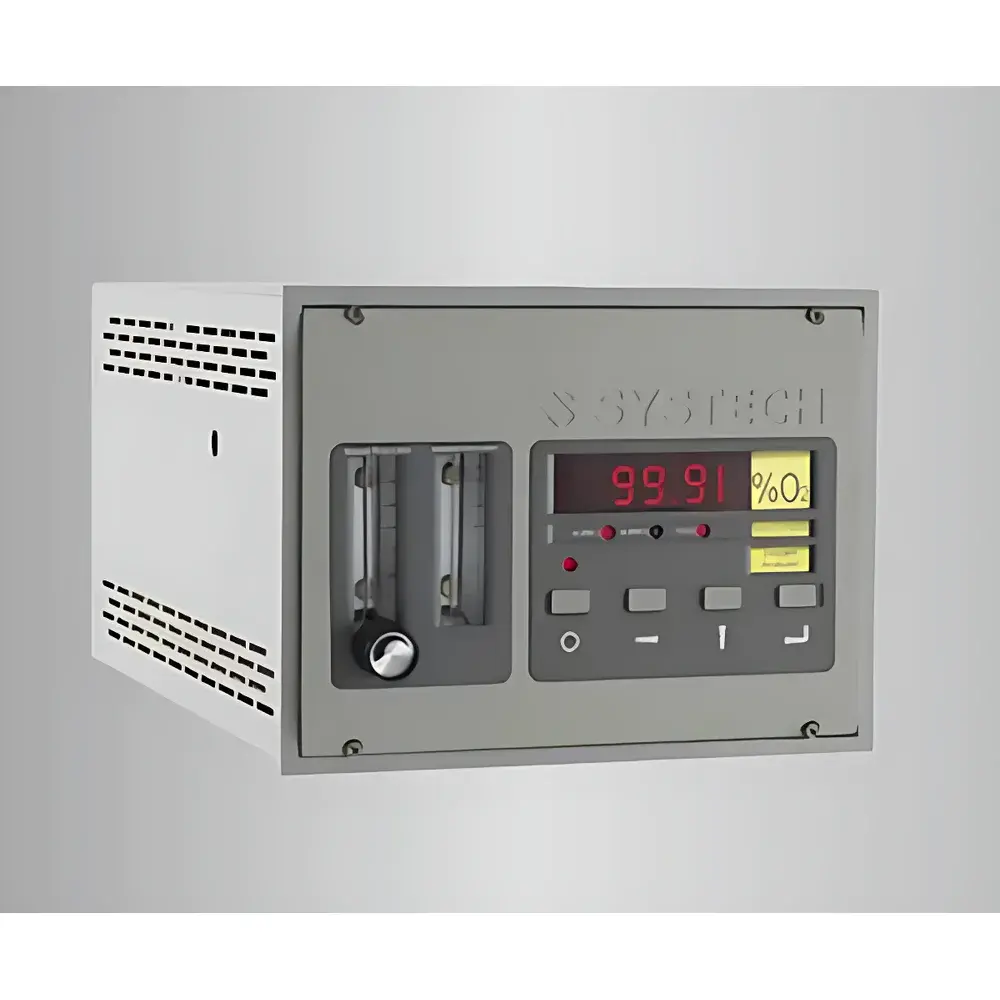
Systech Illinois PM700 Mechanical Paramagnetic Oxygen Analyzer
| Brand | Systech |
|---|---|
| Origin | United Kingdom |
| Model | PM700 |
| Measurement Principle | Mechanical Paramagnetic (Dumbbell) Detection |
| Range | 0.01–99% O₂ (auto-ranging) |
| Resolution | 0.01% O₂ (two decimal places) |
| Linearity | ±0.1% O₂ FS |
| Zero Drift | <0.05% O₂/week |
| Repeatability | ±0.02% O₂ |
| T₉₀ Response Time | ≤6 s |
| Operating Pressure | 0.1–5 barg |
| Ambient Temperature | −10 to +45 °C |
| Humidity | Non-condensing |
| Display | 5-digit high-brightness LED |
| Analog Output | Optional 4–20 mA (also configurable as 0–20 mA, 0–10 mA, or 0–100 mA) |
| Pressure Compensation | Integrated barometric compensation (800–1100 mbar) |
| Power Supply | 115/230 VAC, 50/60 Hz |
| Gas Inlet Port | 1/8" OD compression fitting |
| Compliance | Designed for ISO-compliant calibration traceability |
Overview
The Systech Illinois PM700 Mechanical Paramagnetic Oxygen Analyzer is a precision industrial-grade analyzer engineered for continuous, high-stability oxygen concentration measurement in process gas streams. It employs the classical mechanical paramagnetic (dumbbell) detection principle—based on the strong magnetic susceptibility of molecular oxygen—to deliver inherently selective, drift-resistant, and physically robust O₂ quantification. Unlike electrochemical or zirconia-based sensors, the PM700’s paramagnetic sensor exhibits no cross-sensitivity to CO₂, CO, hydrocarbons, or moisture, eliminating the need for frequent recalibration or complex gas conditioning in most dry or moderately humid applications. Its design prioritizes long-term stability over short-term sensitivity, making it especially suited for purity verification in nitrogen blanketing, inerting systems, pharmaceutical purge validation, and heat-treatment furnace atmospheres where O₂ levels range from trace percent (0.01%) up to full air saturation (99%). The instrument operates without consumables, catalysts, or electrolytes—ensuring low lifetime cost of ownership and compliance with maintenance-interval requirements under ISO 9001, ASTM D3176, and USP guidelines.
Key Features
- Mechanical paramagnetic dumbbell sensor with PID-controlled thermal stabilization for minimal thermal drift and optimal signal reproducibility
- Auto-ranging measurement capability across 0.01–99% O₂ with 0.01% resolution and two-decimal-place display accuracy
- Integrated barometric pressure compensation (800–1100 mbar), enabling stable readings across variable elevation or process-pressure conditions
- High-brightness 5-digit LED display with intuitive menu navigation and real-time status indicators (e.g., fault, calibration mode, pressure alert)
- Configurable analog output (4–20 mA standard; optional 0–20 mA, 0–10 mA, or 0–100 mA) with user-defined scaling and loop-powered capability
- Automatic zero calibration function using ambient air (20.95% O₂ reference), with optional traceable calibration gas support for ISO 17025-compliant QA/QC protocols
- Robust industrial enclosure rated for operation in ambient temperatures from −10 °C to +45 °C and non-condensing humidity environments
- Built-in diagnostic monitoring—including sensor health check, temperature deviation alerts, and power anomaly detection—for predictive maintenance and system uptime assurance
Sample Compatibility & Compliance
The PM700 is optimized for clean, dry, non-corrosive gas matrices including nitrogen, argon, helium, CO₂, and compressed air. While not intended for ppm-level O₂ detection (e.g., below 0.01%), it delivers exceptional linearity and repeatability within its specified range—validated per IEC 61298-2 for analog output accuracy and EN 61000-6-2/6-4 for electromagnetic compatibility. Calibration traceability is supported via certified reference gases traceable to NPL (UK) or NIST (USA), facilitating compliance with FDA 21 CFR Part 11 data integrity expectations when paired with validated SCADA or DCS logging systems. The analyzer meets CE marking requirements and conforms to ATEX/IECEx Zone 2 recommendations when installed with appropriate barrier configurations.
Software & Data Management
Although the PM700 operates as a standalone hardware analyzer without embedded firmware-based software, its analog output and discrete alarm relays are fully compatible with industry-standard process control architectures—including DeltaV, Siemens Desigo, Honeywell Experion, and Rockwell FactoryTalk. For enhanced data governance, users may integrate the 4–20 mA signal into historian platforms (e.g., OSIsoft PI System or AspenTech IP.21) with timestamped, audit-trail-enabled acquisition. When deployed in regulated environments, configuration changes—including range selection, pressure compensation enablement, and output scaling—are logged manually per site SOPs, supporting GLP and GMP documentation workflows. Optional external data loggers can record time-series O₂, temperature, and pressure data for batch release justification or root-cause analysis.
Applications
- Oxygen purity verification in bulk gas supply lines (N₂, Ar, He) for semiconductor manufacturing and food packaging
- Inert atmosphere monitoring during pharmaceutical lyophilization, solvent recovery, and reactor purging
- Combustion air optimization and flue gas O₂ trim control in thermal processing furnaces
- Leak detection and integrity testing of sealed enclosures (e.g., gloveboxes, vacuum chambers, medical device packaging)
- Quality assurance in metal heat treatment (annealing, brazing, sintering) where oxygen partial pressure directly impacts oxide formation
- Environmental chamber O₂ setpoint verification in accelerated aging and stability testing labs
FAQ
Can the PM700 measure oxygen at sub-ppm levels?
No—the PM700 is designed for percent-level O₂ measurement (0.01–99%). For sub-ppm detection, electrochemical or laser-based analyzers are recommended.
Is field calibration possible without external gas standards?
Yes—ambient air (20.95% O₂) serves as the default zero/span reference; however, for ISO-compliant validation, certified calibration gases are required.
Does the analyzer require routine sensor replacement?
No—the mechanical paramagnetic sensor has no consumable elements and is rated for >10 years of continuous operation under specified environmental conditions.
What gas conditioning is needed upstream?
A particulate filter (5 µm) and coalescing filter (for liquid aerosols) are recommended; chemical scrubbers are unnecessary unless H₂S or halogenated compounds are present.
How is pressure compensation implemented?
An internal absolute pressure transducer continuously measures ambient or sample line pressure and applies real-time correction to the O₂ reading within the 800–1100 mbar operating window.