
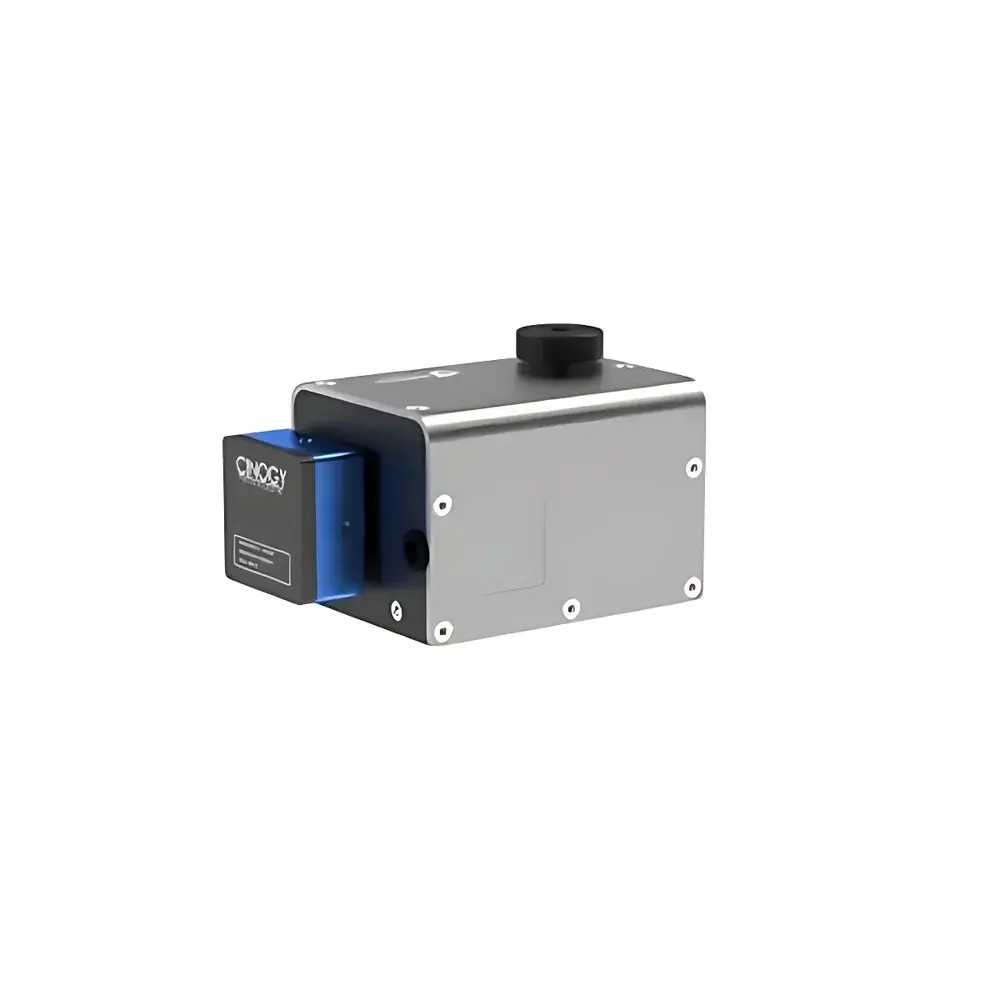
Cinogy AUT-BPPM-LP Series Laser Beam Profiler and Power Meter
| Brand | Cinogy |
|---|---|
| Origin | Germany |
| Model | AUT-BPPM-LP Series Laser Beam Profiler and Power Meter |
| Wavelength Range | 150–1700 nm |
| Max. Measurable Power | 1 W |
| Min. Resolvable Spot Diameter | 22 µm |
| Max. Measurable Spot Diameter | 11 mm |
| Detector Type | CinCam CMOS Camera |
| Spectral Response | 150–1700 nm |
| Spatial Resolution (min) | 2.2 µm |
| Interface Options | USB 2.0 / USB 3.0 / GigE |
| Cooling Method | Air-cooled |
| Software | RayCi Beam Analysis Suite |
Overview
The Cinogy AUT-BPPM-LP Series Laser Beam Profiler and Power Meter is an integrated, real-time optical metrology instrument engineered for simultaneous quantitative measurement of laser beam spatial parameters and absolute power. Based on the proven CinCam CMOS sensor platform and coupled with the RayCi beam analysis software suite, this system implements a dual-sensor architecture: a calibrated photodiode-based power detection channel co-aligned with a high-dynamic-range, spectrally broadband imaging sensor. Unlike conventional setups requiring separate beam profilers and power meters—introducing alignment drift, temporal desynchronization, and calibration mismatch—the AUT-BPPM-LP ensures traceable, correlated acquisition of beam centroid position, ellipticity, M²-relevant intensity distribution (e.g., D4σ, knife-edge, ISO 11146-compliant moments), and total power within a single acquisition cycle. Designed for low-power continuous-wave (CW) and quasi-CW lasers (≤1 W), it serves as a primary verification tool in laser development labs, optical component qualification, and QC workflows where beam quality and output stability must be monitored concurrently under identical environmental and alignment conditions.
Key Features
- Simultaneous, synchronized acquisition of beam profile (intensity distribution, centroid, width, ellipticity, kurtosis) and absolute power (±3% uncertainty, NIST-traceable calibration available)
- Broad spectral response from deep UV (150 nm) to near-IR (1700 nm), enabled by interchangeable, coated CinCam CMOS sensor modules with optimized quantum efficiency curves
- High spatial resolution down to 2.2 µm pixel pitch; measurable spot diameters spanning 22 µm to 11 mm without mechanical reconfiguration or attenuation stage switching
- Modular detector head design supporting USB 2.0, USB 3.0, and GigE Vision interfaces for flexible integration into automated test benches or cleanroom environments
- Air-cooled thermal management ensuring long-term measurement stability (<0.5% power drift over 8 h at 23 °C ambient)
- Fully compliant with ISO 11146-1:2005 and ISO 13694:2003 beam characterization standards; supports export of raw TIFF/CSV data for third-party validation
Sample Compatibility & Compliance
The AUT-BPPM-LP accommodates free-space collimated or focused beams across the full specified wavelength range, including excimer (193 nm, 248 nm), HeCd (325 nm), diode (405–1550 nm), and fiber-coupled sources. It meets the optical safety requirements of IEC 60825-1:2014 Class 1/Class 1M when used with appropriate attenuation (optional ND filters available). All factory calibrations are performed per DIN EN ISO/IEC 17025:2018-accredited procedures. The system supports audit-ready operation under GLP and GMP frameworks: RayCi software includes user access control, electronic signatures, and 21 CFR Part 11-compliant audit trails for critical measurements in regulated environments (e.g., medical laser device validation per IEC 60601-2-22).
Software & Data Management
RayCi v5.x provides a deterministic, scriptable analysis environment built on a modular C++ core with Python API (PyRayCi) for custom algorithm integration. Key capabilities include real-time beam parameter tracking (with configurable averaging windows), multi-frame statistical reporting (mean, std dev, min/max over time series), batch processing of thousands of profiles, and automated report generation in PDF/HTML formats compliant with internal SOPs. Raw image and power data are stored in HDF5 format with embedded metadata (timestamp, exposure, gain, wavelength, calibration ID), enabling full reproducibility and FAIR data principles compliance. Export options include CSV (for Excel/Origin), FITS (astronomy compatibility), and MATLAB .mat files.
Applications
- Laser diode and VCSEL array characterization during R&D and production screening
- Optical fiber output mode analysis (SMF/MMF coupling efficiency verification)
- Beam shaping optic (e.g., diffractive optical elements, micro-lens arrays) performance validation
- In-process monitoring of ultrafast oscillator-amplifier systems (pulse energy stability + spatial mode correlation)
- Calibration transfer between reference lasers and field-deployed systems in metrology institutes
- Teaching laboratory instrumentation for undergraduate photonics courses (beam propagation, diffraction theory, M² measurement)
FAQ
Can the AUT-BPPM-LP measure pulsed lasers?
Yes—when configured with appropriate triggering (TTL sync input) and exposure control, it supports pulse repetition rates up to 10 kHz for nanosecond pulses, provided average power remains ≤1 W.
Is vacuum-compatible operation possible?
Standard units are rated for ambient air operation only; custom vacuum-housing variants (up to 10⁻⁵ mbar) are available upon request with modified thermal management.
How is wavelength-dependent responsivity corrected?
Each CinCam module ships with a per-pixel spectral calibration map; RayCi applies pixel-wise correction using user-selected wavelength or auto-detects via optional integrated monochromator feedback.
Does the system support automated pass/fail testing against user-defined tolerances?
Yes—via RayCi’s Test Sequence Editor, users define multi-parameter limits (e.g., “Power: 950–1050 mW AND D4σ-X 0.9”) and generate binary verdict logs compatible with MES/SCADA systems.
What documentation is provided for regulatory submissions?
Factory calibration certificates (including uncertainty budgets), IQ/OQ protocols, software validation reports (per GAMP5), and 21 CFR Part 11 configuration files are included in the delivery package.




