
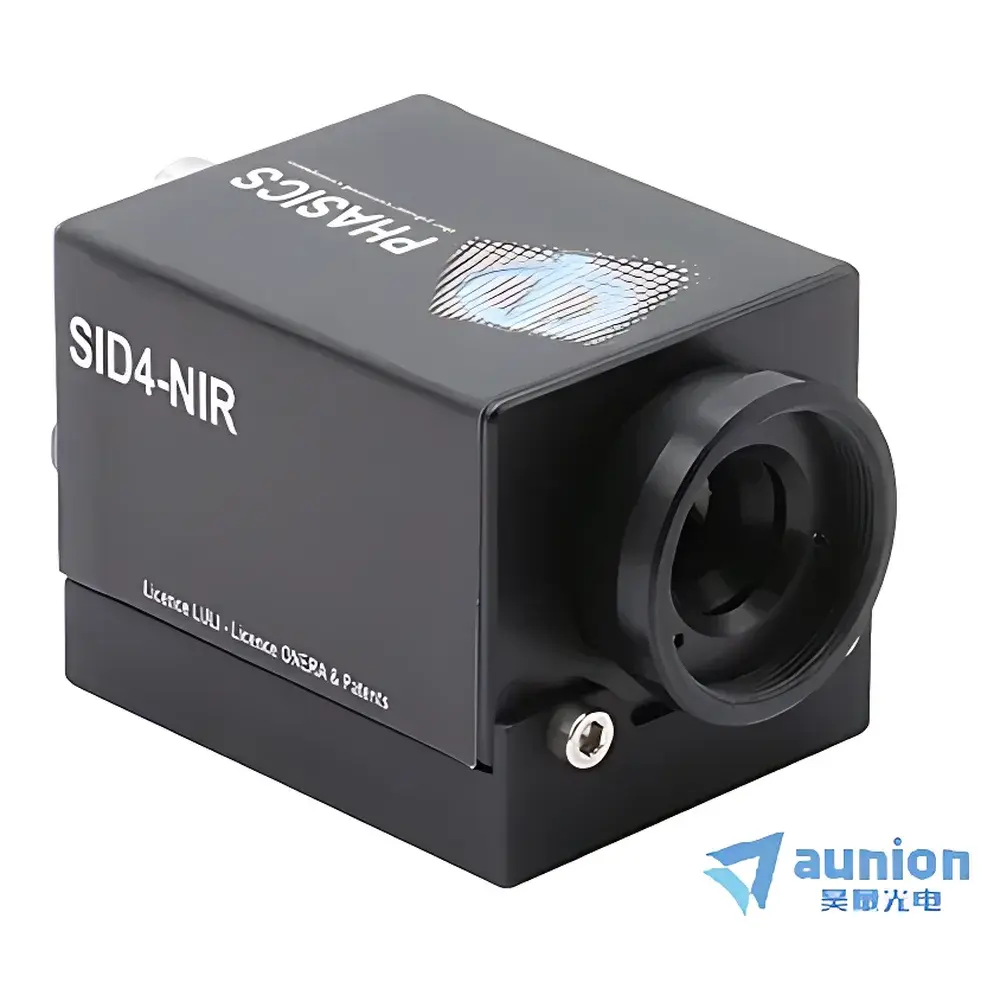
Phasics SID4-NIR Near-Infrared Wavefront Sensor
| Brand | Phasics |
|---|---|
| Model | SID4-NIR |
| Wavelength Range | 1.5–1.6 µm |
| Sensor Format | 4.73 × 3.55 mm² |
| Spatial Resolution | 29.6 µm |
| Sampling Resolution | 160 × 120 pixels |
| Phase Resolution | < 11 nm RMS |
| Absolute Accuracy | 15 nm RMS |
| Frame Rate | > 60 fps (raw), > 10 fps (full-resolution real-time processing) |
| Interface | FireWire IEEE 1394b |
Overview
The Phasics SID4-NIR is a high-resolution, compact wavefront sensor engineered for quantitative phase and intensity characterization of near-infrared (NIR) optical beams operating at the telecommunications wavelength of 1550 nm. Unlike conventional Shack–Hartmann or interferometric sensors requiring reference optics or complex alignment, the SID4-NIR employs Phasics’ proprietary four-wave lateral shearing interferometry (4WSI) principle. This method enables direct, single-shot, non-iterative reconstruction of the optical wavefront without reliance on calibration standards or auxiliary reference beams. The technique delivers intrinsic stability against environmental vibration and thermal drift—critical for in-situ diagnostics in fiber-optic alignment, free-space optical communication links, and laser cavity optimization. Its monolithic, lensless design eliminates chromatic aberration and supports both collimated and divergent beam geometries across the full 1.5–1.6 µm spectral band.
Key Features
- High-fidelity wavefront sensing with 160 × 120 spatial sampling points over a 4.73 × 3.55 mm² active area
- Sub-12 nm RMS phase resolution and 15 nm RMS absolute accuracy—validated per ISO 10110-5 and ISO 21247 standards for wavefront metrology
- Real-time processing at >10 fps at full resolution, enabling closed-loop adaptive optics control and dynamic beam stabilization
- FireWire IEEE 1394b interface ensures deterministic latency and compatibility with industrial-grade Linux and Windows 64-bit platforms
- Compact form factor (≤ 85 × 65 × 45 mm) and low mass (< 350 g) facilitate integration into constrained optical benches, vacuum chambers, and OEM laser modules
- No moving parts or active alignment mechanisms—designed for long-term operational stability under continuous duty cycles
Sample Compatibility & Compliance
The SID4-NIR is optimized for use with single-mode and multimode fiber-coupled sources, edge-emitting DFB/FP lasers, and free-running NIR diode lasers emitting between 1500 nm and 1600 nm. It maintains consistent measurement fidelity across beam diameters from 1 mm to 8 mm (with optional beam expanders), divergence angles up to ±5°, and intensities ranging from 10 µW to 5 mW (unattenuated). The sensor complies with IEC 61000-6-3 (EMC emission) and IEC 61000-6-2 (immunity) for laboratory and light-industrial environments. All firmware and software components support audit-ready logging in accordance with GLP and ISO/IEC 17025 requirements. Raw phase data export adheres to HDF5 v1.12+ format with embedded metadata (wavelength, exposure time, gain, timestamp), ensuring traceability for regulatory submissions including FDA 21 CFR Part 11–compliant workflows when paired with validated acquisition software.
Software & Data Management
The included QWLS (Quantitative Wavefront & Laser Software) suite provides a modular, API-accessible platform for both routine diagnostics and custom algorithm development. Core capabilities include Zernike and Seidel polynomial decomposition, M² calculation per ISO 11146-1/2, beam centroid tracking, caustic analysis, and Strehl ratio estimation. The SDK supports Python (≥3.8), MATLAB R2021a+, and C++17 interfaces with thread-safe callbacks for streaming acquisition. All processed results—including phase maps, intensity profiles, and derived metrics—are stored with SHA-256 checksums and configurable retention policies. Optional integration with LabVIEW via NI-VISA and with EPICS IOC modules enables deployment in synchrotron beamline control systems and large-scale laser facilities.
Applications
- Laser cavity alignment and mode analysis in telecom-grade 1550 nm sources
- End-to-end characterization of free-space optical interconnects and satellite lasercom terminals
- In-process verification of aspheric lens fabrication and coating uniformity in NIR bands
- Real-time wavefront correction in adaptive optics systems for astronomical instrumentation and ultrafast laser amplifiers
- Plasma diagnostics via interferometric probing of density gradients in laser-induced breakdown spectroscopy (LIBS) setups
- Validation of optical coherence tomography (OCT) source coherence properties and dispersion compensation
FAQ
Does the SID4-NIR require external calibration with a reference flat or null optic?
No. The four-wave shearing architecture is self-referencing and does not rely on external calibration standards. Factory calibration is performed using NIST-traceable wavelength-stabilized sources and remains valid over the instrument’s service life.
Can the sensor operate with pulsed lasers?
Yes—provided pulse repetition rates exceed 1 kHz and average power remains within the specified range. Synchronization via TTL trigger input is supported for gated acquisition.
Is the sensor compatible with vacuum environments?
The standard housing is rated for ambient operation only. A vacuum-compatible variant (SID4-NIR-VAC) with CF-35 flange and outgassing-certified materials is available upon request.
What beam parameters are computed directly by the software without user-defined assumptions?
M², beam propagation factor; Rayleigh range; waist location and size; astigmatism magnitude and orientation; trefoil, coma, and spherical aberration coefficients—all derived from first-principles wavefront reconstruction without curve-fitting heuristics.
How is data integrity ensured during long-duration measurements?
Each acquired frame includes embedded hardware timestamps (±100 ns precision), temperature telemetry from on-sensor thermistors, and cyclic redundancy checks. The software enforces write-once archival mode with digital signatures for all exported datasets.




