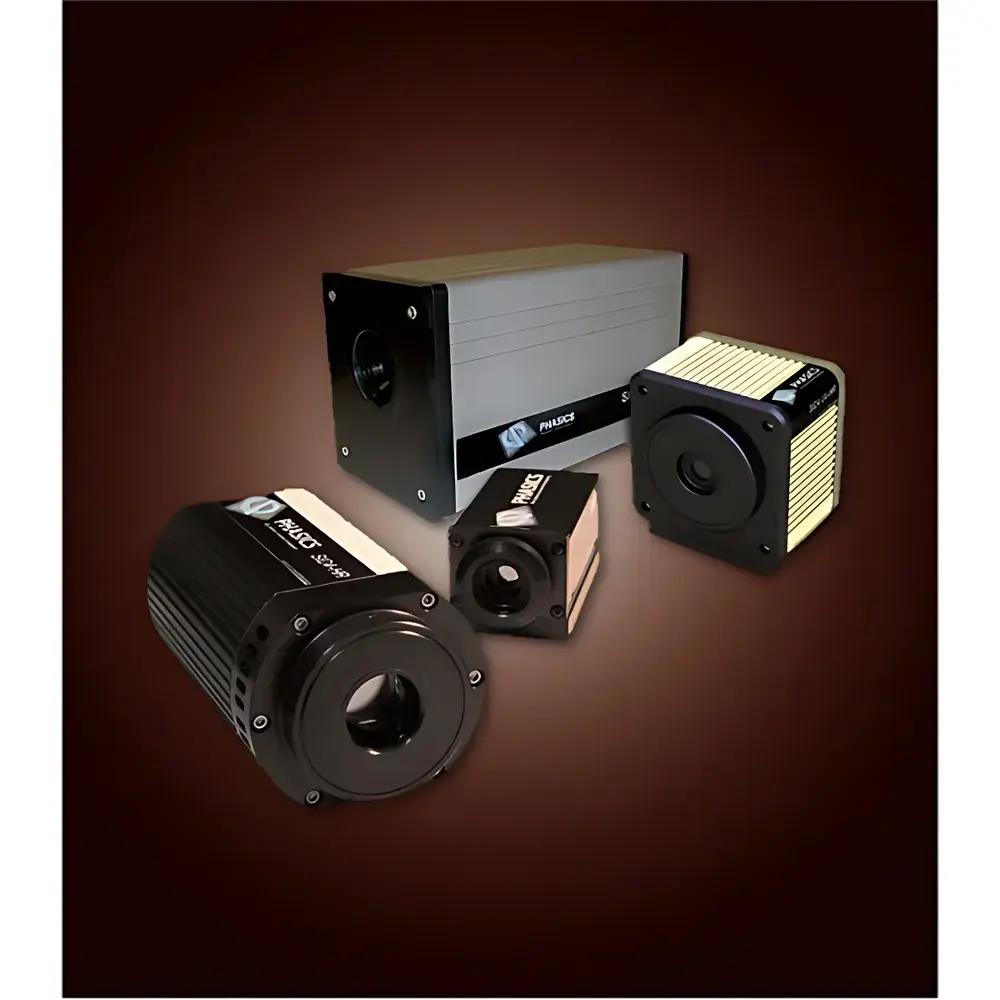

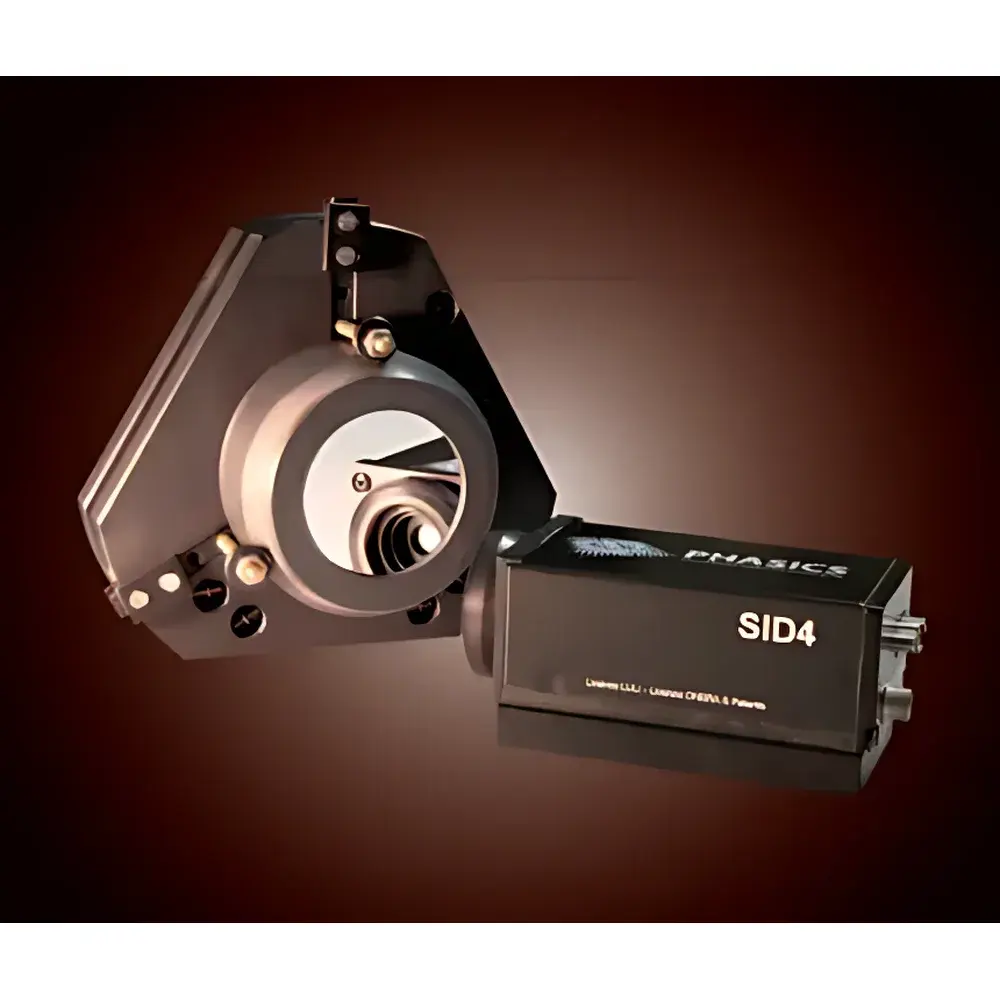
Phasics SID4 Wavefront Sensor – Lateral Shearing Interferometer
| [Brand | Phasics |
|---|---|
| Origin | France |
| Technology | 4-Wave Lateral Shearing Interferometry |
| Wavelength Ranges | UV (190–400 nm), VIS-NIR (350–1100 nm), SWIR (0.9–1.7 µm), NIR (1.5–1.6 µm), MWIR/LWIR (3–5 µm & 8–14 µm) |
| Spatial Resolution | up to 250 × 250 points |
| Dynamic Range | >500 µm |
| Accuracy | ≤10 nm RMS (UV/VIS/NIR/SWIR variants) |
| Frame Rate | up to 60 fps |
| Aperture Size | up to 13.44 × 10.08 mm² |
| Compliance | ISO 10110-5, ISO 21246, ASTM E2815, supports GLP/GMP audit trails via software export] |
Overview
The Phasics SID4 Wavefront Sensor is a high-precision, non-contact optical metrology instrument engineered for quantitative phase and intensity characterization of light fields. Unlike Shack-Hartmann sensors that rely on micro-lens array spot centroiding—introducing spatial averaging errors and wavelength-dependent calibration overhead—the SID4 implements patented 4-wave lateral shearing interferometry (LSI). This Fourier-domain interferometric technique directly measures local wavefront gradients across the full aperture without spatial undersampling, enabling sub-nanometer phase sensitivity, intrinsic achromaticity, and immunity to intensity fluctuations. The sensor operates across five spectral bands—UV (190–400 nm), visible–NIR (350–1100 nm), SWIR (0.9–1.7 µm), narrowband NIR (1.5–1.6 µm), and dual-band MWIR/LWIR (3–5 µm & 8–14 µm)—with model-specific apertures, resolutions, and dynamic ranges optimized for application-critical trade-offs between field-of-view, spatial sampling density, and thermal or quantum noise floor.
Key Features
- Patented 4-wave lateral shearing interferometry architecture eliminates reliance on spot detection algorithms and micro-lens calibration, delivering true wavefront slope measurement with no interpolation artifacts.
- Achromatic operation across designated spectral bands—no per-wavelength recalibration required—enabling rapid multi-wavelength characterization of broadband sources or tunable lasers.
- High spatial sampling density: up to 300 × 400 measurement points (SID4-HR), corresponding to ≤29.6 µm pixel pitch in VIS-NIR models; 250 × 250 in UV-HR; 96 × 72 in DWIR.
- Large dynamic range (>500 µm peak-to-valley in SID4-HR) accommodates strongly aberrated beams—including those from uncorrected telescopes, high-NA microscope objectives, or CO₂ laser systems—without fringe ambiguity or phase unwrapping.
- Vibration-insensitive monolithic optical design with integrated CMOS/InSb/MCT detectors; no moving parts, no alignment-sensitive relay optics.
- Real-time processing: frame rates up to 60 fps (SID4, SID4-NIR, SID4-DWIR); ≥10 Hz full-phase reconstruction rate with on-board FPGA acceleration.
- Compact form factor compatible with OEM integration: all models operate via USB 3.0 or Camera Link interface and support laptop-based control without external power supplies or cooling units.
Sample Compatibility & Compliance
The SID4 family supports direct measurement of collimated or converging beams (NA up to 0.5), enabling characterization of lenses, mirrors, laser cavities, fiber outputs, and free-space optical systems without auxiliary beam expanders or relay optics. UV-HR (190–400 nm) is qualified for semiconductor lithography mask inspection and excimer laser diagnostics per ISO 10110-5 surface irregularity standards. VIS-NIR and SWIR variants comply with ISO 21246 for MTF and PSF validation of imaging optics. DWIR models meet ASTM E2815 requirements for infrared lens quality assessment in thermal imaging and defense applications. All software exports include timestamped, metadata-rich HDF5 files containing raw interferograms, reconstructed wavefronts, Zernike coefficients, MTF curves, PSF cross-sections, and OTF magnitude/phase—fully traceable for GLP/GMP environments under FDA 21 CFR Part 11-compliant audit trail configuration.
Software & Data Management
Kaleo software—developed exclusively for Phasics sensors—provides real-time visualization of phase maps, intensity distributions, Zernike decomposition (up to 36 terms), PSF convolution, MTF/OTF computation, focal plane scanning, and radius-of-curvature estimation. It includes native LabVIEW and C++ SDKs for custom algorithm integration, automated test sequencing, and closed-loop adaptive optics control. The software supports batch analysis of time-series datasets, statistical reporting (e.g., RMS wavefront error vs. time), and export to MATLAB, Python (NumPy/HDF5), or CSV formats. For regulated environments, optional validation packages provide IQ/OQ documentation, electronic signature workflows, and full audit trail logging—including user actions, parameter changes, and data export events—in accordance with 21 CFR Part 11 Annex 11 requirements.
Applications
- Laser beam diagnostics: M² measurement, focus stability analysis, thermal lensing monitoring in high-power DPSS and fiber lasers.
- Astronomy: on-sky wavefront sensing for large segmented telescopes and laser guide star AO systems.
- Ophthalmology: pupil-resolved wavefront aberrometry for customized refractive surgery and adaptive optics retinal imaging.
- Industrial metrology: aspheric lens certification, mold surface inspection, EUV mirror testing, and wafer stepper projection optics verification.
- Infrared optics: CO₂ laser cavity alignment, thermal camera lens MTF mapping, and MWIR/LWIR objective characterization for surveillance and hyperspectral systems.
- Defense & aerospace: beam quality assurance for directed-energy systems, satellite payload alignment, and airborne lidar transmitter validation.
- Research: quantitative phase microscopy, holographic optical trapping feedback, and ultrafast pulse front tilt measurement via spectral shearing interferometry extensions.
FAQ
How does lateral shearing interferometry differ from Shack-Hartmann sensing?
Lateral shearing interferometry measures local wavefront gradients directly via interference of laterally displaced replicas of the input beam, avoiding the centroid-fitting errors inherent in micro-lens arrays. It provides higher spatial resolution, broader dynamic range, and intrinsic achromaticity without per-wavelength calibration.
Can the SID4 measure divergent or convergent beams without relay optics?
Yes—models with NA ≥ 0.5 (e.g., SID4-HR, SID4-DWIR) accept focused beams directly; no beam collimation or intermediate imaging optics are required for accurate wavefront reconstruction.
Is the system compliant with regulatory data integrity requirements?
When configured with Kaleo’s optional compliance module, all measurements include electronic signatures, immutable audit logs, and exportable metadata conforming to FDA 21 CFR Part 11 and EU Annex 11 guidelines.
What is the minimum measurable wavefront error?
Typical RMS repeatability is ≤2 nm for UV/VIS/NIR models under stable thermal conditions; system noise floor is dominated by photon shot noise and detector readout noise—not algorithmic interpolation limits.
Does Phasics offer OEM integration support?
Yes—Phasics provides mechanical drawings, electrical interface specifications (USB 3.0/Camera Link), firmware update protocols, and dedicated engineering support for embedded integration into custom optical platforms or automated test equipment.