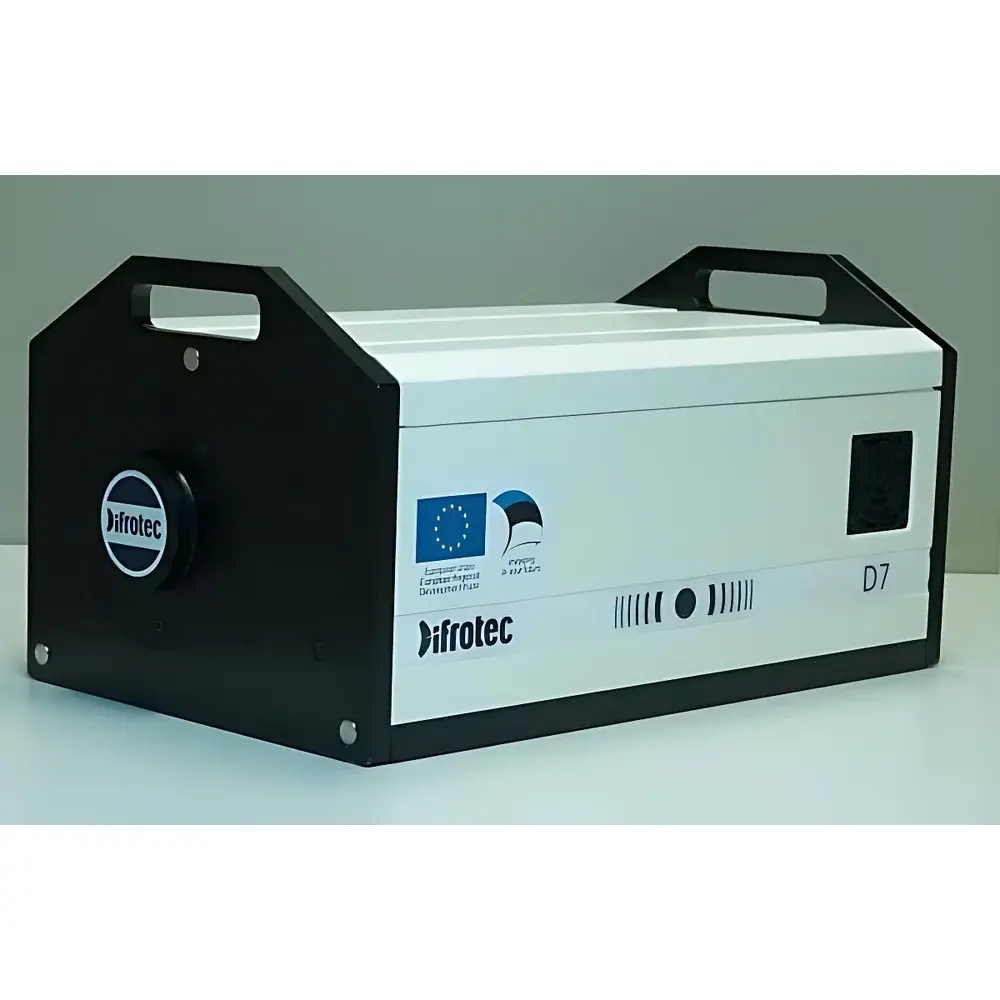
Difrotec PD-700 Point-Diffraction Laser Interferometer
| Brand | Difrotec |
|---|---|
| Origin | Estonia |
| Manufacturer Type | Original Equipment Manufacturer (OEM) |
| Product Category | Imported Precision Optical Interferometer |
| Model | PD-700 |
| Aperture | ≥ 700 mm |
| Accuracy (RMS Wavefront) | ≤ 0.6 nm |
| Resolution (PV) | 0.05 nm |
| Repeatability (RMS) | < 0.23 nm |
| Simple RMS Repeatability | < 0.06 nm |
| Numerical Aperture (NA) | 0.55 (f/# 0.91) |
| Interferometry Method | Phase-Shifting Interferometry (PSI) |
| Laser Source | Dual-Frequency He–Ne |
Overview
The Difrotec PD-700 Point-Diffraction Laser Interferometer is a high-precision, non-contact optical metrology system engineered for absolute wavefront measurement of large-aperture optical components. As the world’s first commercially deployed point-diffraction interferometer (PDI), it eliminates reliance on reference optics—replacing traditional null or transmission flat references with a spatially filtered, coherent point source generated via sub-wavelength pinhole diffraction. This architecture inherently suppresses system-induced errors and enables traceable, absolute measurement of surface figure (PV, RMS) and transmitted wavefront error (TWE) across flat, spherical, and aspheric optics up to 700 mm in diameter. Operating at a stabilized dual-frequency He–Ne laser wavelength (632.8 nm), the PD-700 delivers sub-nanometer resolution and metrological stability compliant with ISO 10110-5, ISO 14999-2, and VDI/VDE 2634 Part 3 standards for optical surface testing.
Key Features
- Reference-free absolute measurement: Utilizes a self-referencing point-diffraction source, eliminating calibration drift and environmental sensitivity associated with external reference optics.
- Large-aperture capability: Supports full-aperture testing of optics up to Ø700 mm without beam expansion or stitching—maintaining single-shot coherence and data integrity.
- Sub-nanometer metrological performance: Achieves ≤ 0.6 nm RMS wavefront accuracy (λ/1000), 0.05 nm PV resolution (λ/12,000), and < 0.23 nm RMS repeatability under controlled laboratory conditions (20 ± 0.5 °C, vibration-isolated optical table).
- High-NA optical design: NA = 0.55 (f/# 0.91) enables efficient light collection and robust phase retrieval even for steep aspheres and low-reflectivity coatings.
- Phase-shifting interferometry (PSI) engine: Integrates 4-step or 16-step PSI algorithms with real-time fringe analysis, carrier suppression, and advanced noise filtering for high-fidelity phase map reconstruction.
- Compact, modular architecture: Designed for integration into cleanroom environments or optical fabrication lines; no external vacuum or cryogenic requirements.
Sample Compatibility & Compliance
The PD-700 accommodates plano, spherical, parabolic, ellipsoidal, and rotationally symmetric aspheric surfaces—including fused silica, ULE®, CaF₂, Zerodur®, and coated optics (AR, HR, metallic). It supports both reflective (surface figure) and transmissive (wavefront transmission) configurations via interchangeable test arms and collimators. The system complies with ISO/IEC 17025 documentation requirements for calibration laboratories and supports audit-ready records per GLP and GMP frameworks. Export classification confirms EAR99 status—no export license required for global shipment.
Software & Data Management
Controlled via Difrotec’s proprietary WaveSight™ software suite (Windows 10/11 64-bit), the PD-700 provides intuitive workflow management—from alignment assistance and auto-focus to Zernike decomposition, PSD analysis, and ISO 10110-5 conformity reporting. All raw interferograms and processed maps are stored in HDF5 format with embedded metadata (timestamp, environmental sensor logs, operator ID, instrument configuration). Audit trails meet FDA 21 CFR Part 11 requirements, including electronic signatures, user access controls, and immutable revision history. Export options include CSV, TIFF, and STEP AP242 for integration with Zemax OpticStudio, Code V, and FRED optical design platforms.
Applications
- Final qualification of large astronomical mirrors (e.g., segmented primary segments, M1/M2 assemblies)
- In-process verification of diamond-turned aspheres and freeform optics
- Validation of EUV lithography mask substrates and multilayer coatings
- Calibration of coordinate measuring machines (CMMs) and autocollimators via artifact-based traceability
- R&D metrology for next-generation gravitational-wave detector optics (e.g., LIGO-style fused silica test masses)
- ISO-compliant certification of optical flats, wedges, and windows per MIL-PRF-13830B scratch-dig and surface figure specifications
FAQ
What makes point-diffraction interferometry fundamentally different from Twyman–Green or Fizeau architectures?
Point-diffraction eliminates the need for high-quality reference optics by generating a near-perfect spherical wavefront directly from a sub-wavelength pinhole—making it inherently insensitive to reference surface errors and thermal drift.
Can the PD-700 measure aspheric departure beyond λ/4?
Yes—the system supports extended-range PSI and Fourier-transform-based analysis for aspheric departures exceeding 100 waves PV without dynamic range limitation.
Is environmental stabilization (e.g., temperature, air pressure) required for RMS < 0.3 nm performance?
For guaranteed ≤ 0.23 nm RMS repeatability, operation within ISO Class 5 (Class 100) cleanroom conditions with active temperature control (±0.5 °C) and passive seismic isolation is recommended.
Does the system support automated alignment routines for untrained operators?
WaveSight™ includes guided alignment sequences with real-time centroid tracking, tilt compensation, and focus optimization—reducing setup time to under 15 minutes.
How is traceability to SI units maintained?
The dual-frequency He–Ne laser is referenced to iodine-stabilized standards (NIST-traceable); wavelength uncertainty is < 2 × 10⁻⁹, enabling direct traceability of all wavefront measurements to the meter definition.