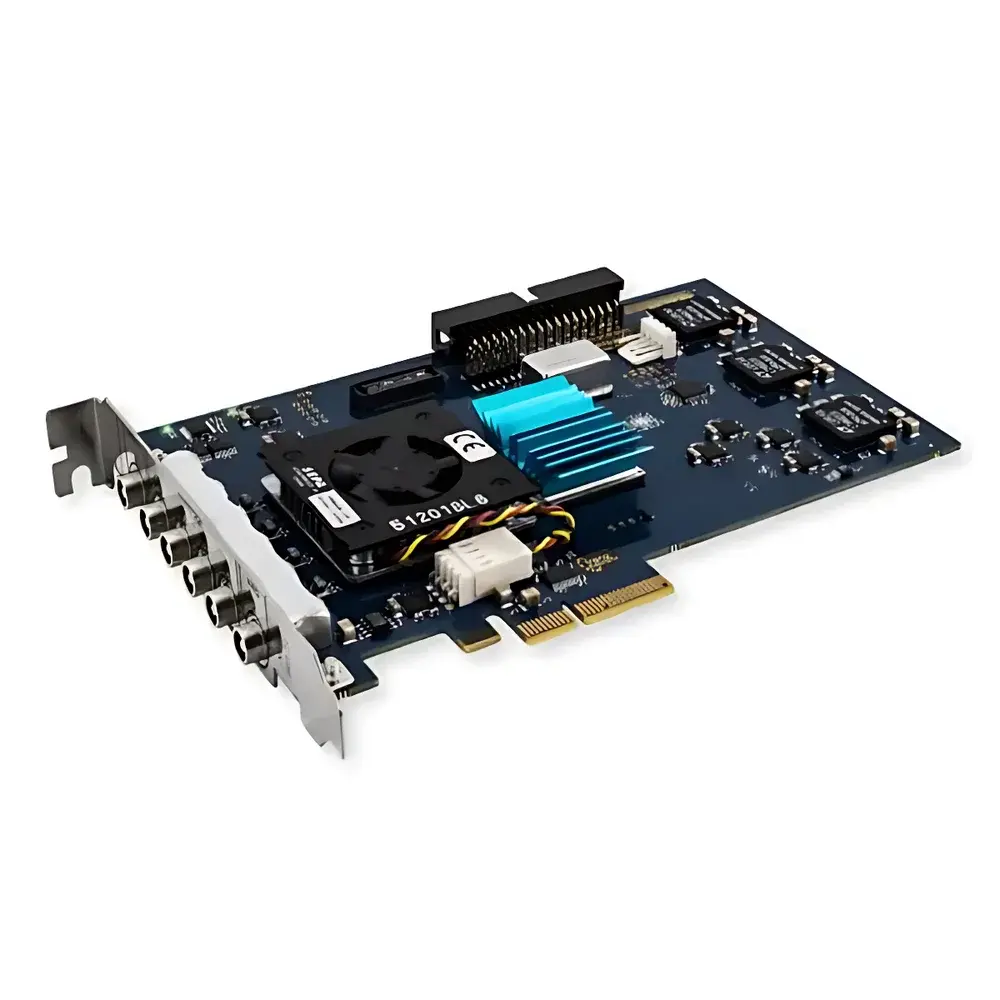
Auniontech Ndigo6G-12 High-Speed Pulse Acquisition Card for Time-of-Flight (ToF) Measurements
| Brand | Auniontech |
|---|---|
| Origin | Shanghai, China |
| Manufacturer Type | Authorized Distributor |
| Product Origin | Domestic (PRC) |
| Model | Ndigo6G-12 Time Measurement & Frequency Analysis Card |
| Pricing | Available Upon Request |
| ADC Channels | 4 |
| TDC Channels | 4 |
| Gating Channels | 4 |
| Sampling Rate (Single Channel) | 6.4 GS/s |
| Multi-Channel Sampling Rate | 1.6 GS/s per channel |
| Resolution | 12 bits |
| TDC Bin Width | 12 ps |
| TDC Dual-Pulse Resolution | Typically 4 ns |
| TDC Readout Rate | 30 MHits/s |
| ADC Data Throughput | 6000 MB/s |
| Onboard Clock Stability | ±50 ppb (10 MHz internal or external reference) |
| Interface | PCIe 3.0 x8 |
| Onboard Memory | Calibrated buffer with real-time streaming capability |
| Trigger Flexibility | Adjustable trigger window, overlapping event support, programmable gate/veto logic, cross-channel and external digital trigger matrix |
Overview
The Auniontech Ndigo6G-12 is a hybrid high-speed pulse acquisition card engineered for ultra-precise time-resolved measurements in demanding Time-of-Flight (ToF) applications. It integrates four synchronized 12-bit analog-to-digital converter (ADC) channels with four independent time-to-digital converter (TDC) channels—each delivering sub-13 ps timing resolution—within a single PCIe 3.0 x8 form factor. Unlike conventional digitizers, the Ndigo6G-12 implements a dual-domain architecture: it captures both the full waveform morphology (amplitude, shape, area) at up to 6.4 GS/s per channel *and* records absolute pulse arrival timestamps with picosecond-level fidelity. This co-acquisition enables correlated analysis of temporal position and analog characteristics—critical for applications where pulse jitter, baseline drift, or amplitude-dependent timing offsets must be quantified and corrected. The card operates on the principle of interleaved sampling combined with high-stability TDC interpolation, leveraging an onboard ultra-low-jitter 10 MHz clock (±50 ppb stability) or external synchronization for system-level phase coherence. Its design adheres to the functional requirements of scientific-grade ToF instrumentation, supporting deterministic latency, hardware-triggered acquisition, and deterministic data flow suitable for real-time signal processing pipelines.
Key Features
- Hybrid ADC/TDC Architecture: Simultaneous acquisition of analog waveforms (12-bit, 6.4 GS/s single-channel, 1.6 GS/s per channel in quad mode) and precise timestamping (12 ps bin width, 4 ns dual-pulse resolution).
- Zero-Suppression Logic: Configurable threshold-based event detection that discards baseline-only segments, reducing data volume by >90% without compromising timing integrity.
- Dynamic Range Optimization: Programmable DC offset adjustment shifts the ADC input baseline to maximize utilization of the full 12-bit range—effectively doubling dynamic range for unipolar pulse capture.
- Integrated TiGer Timing Generator: Onboard digital pattern generator supports user-defined pulse trains, gating sequences, and synchronized control signals—eliminating reliance on external function generators.
- Flexible Trigger & Gating Engine: Hardware-implemented gate/veto logic with cross-channel correlation, external digital inputs, and a configurable trigger matrix enabling complex coincidence/anti-coincidence logic.
- Real-Time Data Streaming: Sustained 6 GB/s PCIe throughput with calibrated on-board memory buffering; supports continuous acquisition at full rate with zero dropped samples under deterministic host DMA scheduling.
Sample Compatibility & Compliance
The Ndigo6G-12 is compatible with a broad spectrum of pulsed optical, electronic, and ionizing radiation sources—including picosecond laser diodes, SPAD/MCP-PMT outputs, TOF mass spectrometer detectors, and RF pulse generators. Its input impedance (50 Ω), bandwidth (DC-coupled, >3 GHz typical), and low-noise front-end ensure faithful reproduction of fast-rising edges (<100 ps rise time). From a compliance perspective, the card meets CE EMC Class B requirements and conforms to PCI-SIG Gen3 specifications. While not certified as medical or industrial safety equipment, its firmware architecture supports audit-ready operation: all configuration parameters are logged with timestamps, and firmware updates preserve calibration metadata. For regulated environments (e.g., GLP/GMP-compliant labs), the card’s deterministic trigger response, traceable clock source, and binary reproducible data output enable integration into validated measurement workflows aligned with ISO/IEC 17025 documentation practices.
Software & Data Management
The Ndigo6G-12 ships with a comprehensive, open-source-compatible SDK supporting Windows (C/C++, Python, MATLAB) and Linux (C, Python). The API provides low-latency access to raw ADC buffers and TDC event lists, with optional on-the-fly histogramming, timestamp alignment, and pulse parameter extraction (e.g., leading-edge time, peak amplitude, integrated charge). All firmware is field-upgradable via PCIe without hardware reset. Data is stored in vendor-neutral binary formats (IEEE 754 float64 for timestamps, uint16 for ADC samples) with embedded metadata (sampling rate, clock source, trigger settings, calibration coefficients). Integration with HDF5 or ASDF standards is supported through reference implementations. For long-duration experiments, the card supports ring-buffer streaming directly to NVMe storage arrays—enabling multi-hour FLIM or LIDAR acquisitions with full temporal fidelity.
Applications
- Fluorescence Lifetime Imaging Microscopy (FLIM): Resolves nanosecond-scale decay kinetics with <5 ps timing precision, enabling phasor-based lifetime unmixing and FRET efficiency quantification.
- LIDAR & 3D ToF Imaging: Captures single-photon return timing from multiple spatial channels, supporting direct ToF depth mapping at >100 kpoints/s with sub-centimeter ranging accuracy.
- Time-of-Flight Mass Spectrometry (TOF-MS): Measures ion arrival times with sub-nanosecond jitter, supporting high-mass-resolution spectra (>20,000 FWHM) in reflectron configurations.
- Optical Time-Domain Reflectometry (OTDR): Detects Rayleigh backscatter events with picosecond temporal localization, enabling fault detection within <1 mm spatial resolution in single-mode fiber.
- Time-Correlated Single Photon Counting (TCSPC): Delivers dead-time-free acquisition at >30 MHz hit rates while preserving inter-event timing correlations for fluorescence correlation spectroscopy (FCS) and photon antibunching analysis.
FAQ
What is the effective timing resolution when combining ADC and TDC data?
The system achieves <5 ps effective timing resolution for threshold-crossing events when using leading-edge interpolation derived from the 6.4 GS/s waveform reconstruction, validated against NIST-traceable pulsed lasers.
Can the Ndigo6G-12 operate in standalone mode without host CPU intervention?
No—it requires continuous PCIe host interaction for data streaming and real-time control; however, its onboard TiGer generator and trigger logic enable fully autonomous experiment sequencing once configured.
Is firmware calibration traceable to national standards?
Yes—factory calibration includes temperature-compensated TDC nonlinearity correction and ADC gain/offset maps, with certificate of conformance referencing NIST SP 250-95 methodology.
Does the card support synchronized multi-board operation?
Yes—up to eight Ndigo6G-12 cards can be phase-locked via common 10 MHz reference and PPS signals, achieving sub-20 ps inter-card skew across all channels.
Are driver and SDK updates provided for long-term support?
Auniontech guarantees minimum 7-year SDK maintenance and backward-compatible firmware updates for all production units, documented in the official product lifecycle statement.