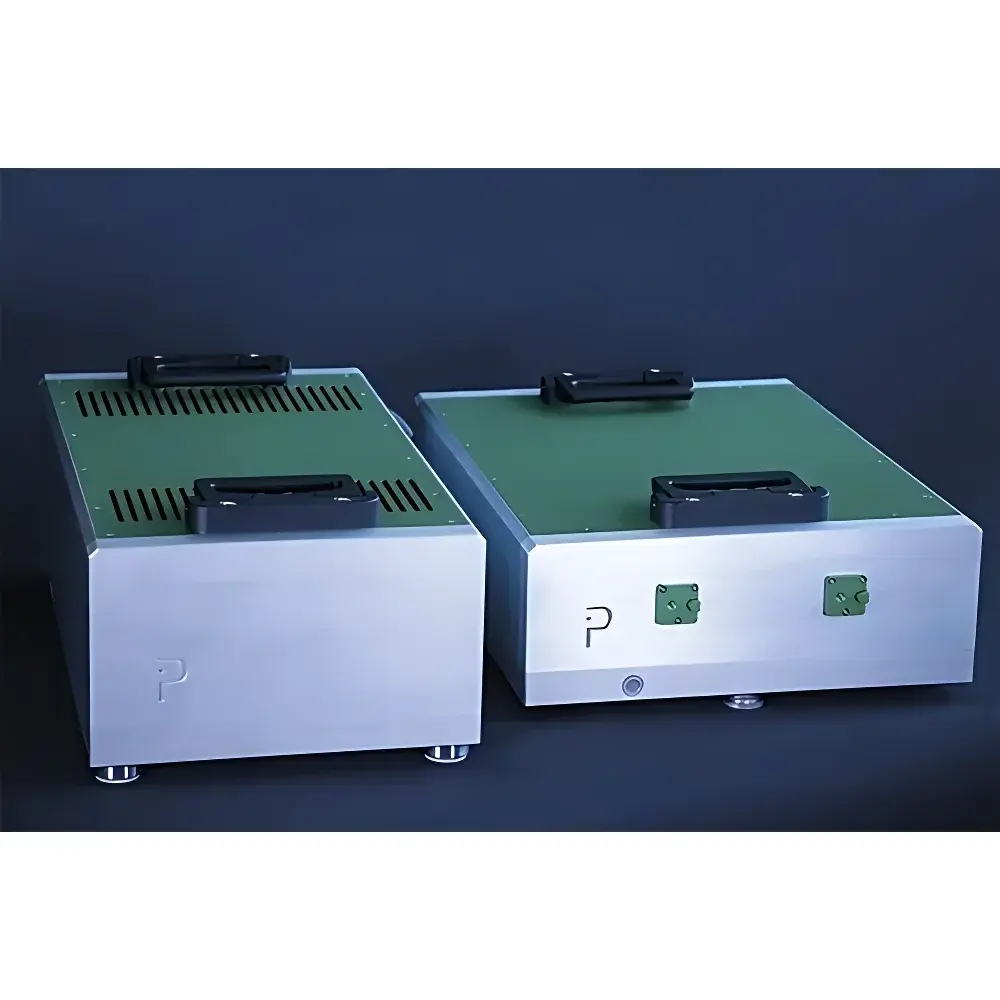
Auniontech FSX Series Dual-Output Femtosecond Laser (1040 nm + Tunable 750–1300 nm)
| Brand | Auniontech |
|---|---|
| Model | FSX Series |
| Laser Type | Solid-State Femtosecond Oscillator & Amplifier System |
| Output Wavelengths | Fixed 1040 nm + Second Output Either Fixed (750–1300 nm, factory-set) or Continuously Tunable (750–1300 nm) |
| Pulse Width | <130 fs |
| Avg. Power | >1 W @ 1040 nm |
| Repetition Rate | 80 MHz |
| Pulse Energy | >12.5 nJ @ 1040 nm |
| Beam Quality | M² < 1.1 (TEM₀₀) |
| Polarization Extinction Ratio | >23 dB |
| Pointing Stability | <30 μrad rms (12 h, constant temp) |
| Cooling | Air-cooled |
| Output | Collimated Free-Space Beam |
| Compliance | CE, RoHS, IEC 60825-1 Class 4 Laser Product |
Overview
The Auniontech FSX Series Dual-Output Femtosecond Laser is a turnkey, air-cooled solid-state laser platform engineered for demanding nonlinear optical applications in life sciences and quantum photonics. Based on mode-locked Yb-doped oscillator-amplifier architecture, the system delivers two synchronized femtosecond outputs: a fixed-wavelength beam at 1040 nm and a second output either pre-configured within the 750–1300 nm range (FSX-Dual) or continuously tunable across that full spectral window (FSX-Tune). This dual-channel design enables simultaneous excitation of multiple fluorophores or nonlinear processes—such as two-photon absorption (2PA), second-harmonic generation (SHG), and third-harmonic generation (THG)—without mechanical realignment or optical switching delays. The laser operates at a stable 80 MHz repetition rate with pulse durations 100 kW per pulse at 1040 nm) while maintaining excellent temporal coherence and low timing jitter. Its robust thermal management eliminates sensitivity to ambient fluctuations between 18°C and 28°C, supporting uninterrupted 24/7 operation in shared core facilities or mobile imaging labs.
Key Features
- Engineered for multi-modal bioimaging: Optimized spectral pairing (1040 nm + 750–1300 nm) matches common fluorophore absorption bands and harmonic generation phase-matching conditions in biological tissue.
- Air-cooled architecture: Eliminates dependence on external chillers or water lines—reduces footprint, simplifies installation, and enables rapid warm-up (<5 min to full specification).
- Compact, modular form factor: Laser head and controller are physically decoupled; the controller unit fits under standard optical tables or inside equipment racks, minimizing lab-space impact.
- High beam fidelity: TEM₀₀ spatial profile with M² 23 dB ensures consistent coupling into single-mode fibers and high-numerical-aperture microscope objectives.
- Industrial-grade stability: Pointing drift <30 μrad rms over 12 hours at constant temperature, and <5 μrad/°C across the operational ambient range—critical for long-duration time-lapse or FLIM experiments.
- One-button operational readiness: Fully integrated control firmware enables plug-and-play deployment with minimal user calibration; all alignment-critical optics are factory-sealed and kinematically stabilized.
Sample Compatibility & Compliance
The FSX Series is compatible with standard optical components rated for near-infrared femtosecond pulses, including dielectric mirrors (HR/HT coatings from 700–1350 nm), achromatic waveplates, and dispersion-compensated objective lenses. It meets IEC 60825-1:2014 Class 4 laser safety requirements and carries CE and RoHS certifications. For regulated environments—including GLP-compliant imaging cores or ISO 13485-certified medical device development labs—the system supports optional audit-trail-enabled software logging (compatible with 21 CFR Part 11–compliant data acquisition platforms). All optical paths are sealed against dust ingress (IP20-rated enclosure), and thermal drift compensation algorithms ensure repeatable pulse energy delivery across multi-day acquisition protocols.
Software & Data Management
The FSX Series integrates with industry-standard control ecosystems via USB 2.0 and Ethernet interfaces. Native drivers are provided for MATLAB, Python (PyVISA), and LabVIEW. Optional SDKs support synchronization with scanning galvos, Pockels cells, or time-correlated single-photon counting (TCSPC) modules. Real-time monitoring includes pulse energy feedback (via internal photodiode), repetition rate lock status, and cavity alignment diagnostics. Data logs—timestamped, with metadata tagging for wavelength, power, and environmental sensor readings—are exportable in HDF5 or CSV format for traceability in publications or regulatory submissions.
Applications
- Multi-photon microscopy: Simultaneous 2P/SHG/THG imaging of collagen, elastin, NAD(P)H, and fluorescent proteins in thick-tissue sections or live animals.
- Fluorescence lifetime imaging (FLIM): Time-resolved detection using 1040 nm excitation and tunable secondary wavelength for spectral unmixing or FRET acceptor optimization.
- CARS and SRS spectroscopy: Pump-probe configuration with fixed 1040 nm pump and tunable Stokes beam across the fingerprint region (750–1300 nm).
- Ultrafast amplifier seeding: Low-jitter, high-repetition-rate source for Ti:sapphire or OPCPA systems requiring precise temporal synchronization.
- Nonlinear frequency conversion: Generation of supercontinuum white light or THz pulses via filamentation in bulk crystals or gas-filled hollow-core fibers.
- Two-photon polymerization: Sub-diffraction-limit 3D microfabrication with dual-wavelength dose control for gradient refractive index structures.
FAQ
Is the 750–1300 nm output truly continuously tunable across the entire range?
Yes—the FSX-Tune variant employs an intracavity birefringent filter and motorized grating stage enabling smooth, software-controlled tuning without mode hops or power discontinuities.
Can the two outputs be temporally delayed relative to each other?
No—both beams originate from the same mode-locked oscillator and share identical timing; external delay lines must be added for pump-probe experiments.
What is the maximum permissible back-reflection into the laser head?
<0.5% reflected power is recommended to avoid destabilizing the oscillator cavity; optional optical isolators are available as accessories.
Does the system support external triggering or synchronization?
Yes—TTL-compatible sync outputs (at 80 MHz and divided frequencies) and an external trigger input for burst-mode operation are standard.
Is service and calibration available outside China?
Auniontech maintains authorized service partners in Germany, the USA, and Japan; on-site calibration (including pulse width verification via autocorrelation) is offered under extended warranty contracts.